

Wayground
Jesus Walks on Water: Mt. 14: 23-35 - Printable Religious Studies Worksheets kindergarten - Wayground

Jesus Walks on Water: Mt. 14: 23-35

16 questions

5th - 5th Grade

Religious Studies

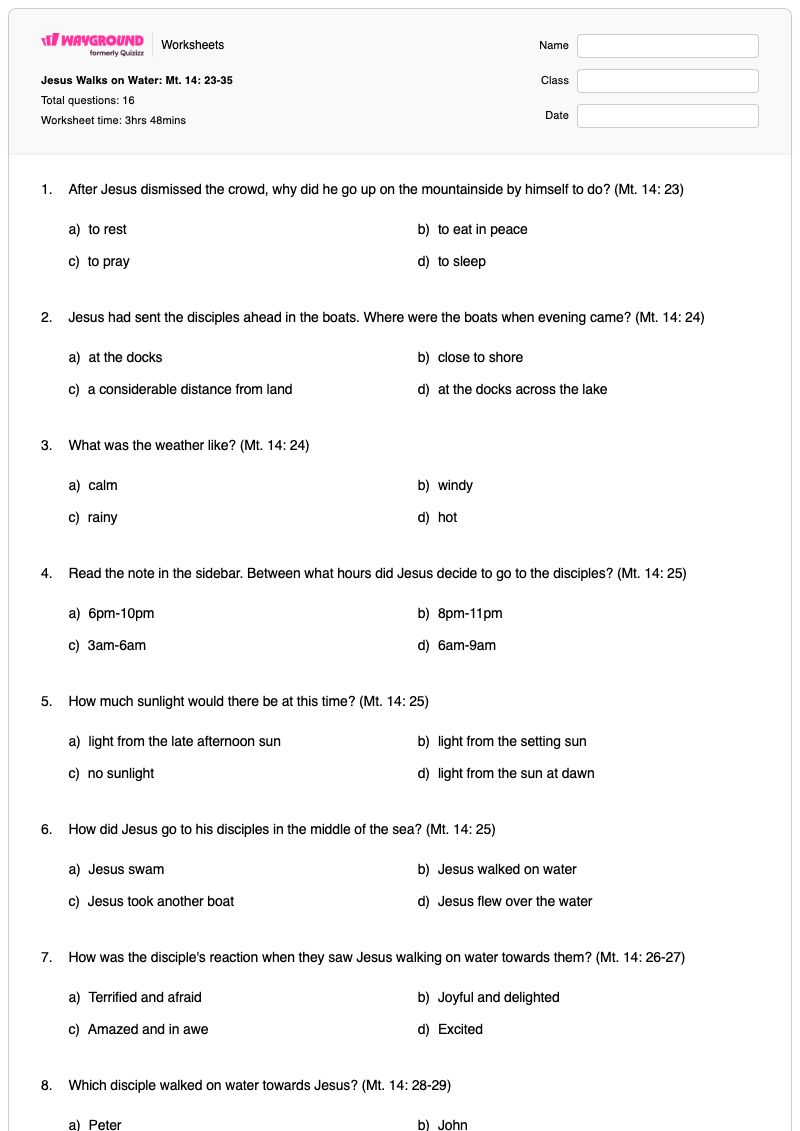
Jesus Walks on Water: Mt. 14:23–35 is a Grade 5 Religious Studies worksheet that helps students examine key details and faith themes in Matthew 14:23–35. The question set asks students to identify why Jesus prayed, locate the disciples’ boats, interpret the storm and time of day, describe Jesus and Peter walking on water, and explain why Peter began to sink. Students also identify the disciples’ declaration about Jesus and consider how faith applies to challenges in daily life. This free printable worksheet uses 12 multiple-choice questions, one fill-in-the-blank response, and three multiple-select questions. It reinforces close reading of a Gospel passage while asking students to distinguish accurate details from distractors and connect Peter’s experience with faith, prayer, and dependence on Jesus. The worksheet includes a complete answer key, making it useful for Religious Studies lessons, independent practice, review, or formative assessment.

Worksheet settings

Font size

S
M
L
XL
Worksheets

Jesus Walks on Water: Mt. 14: 23-35

Total questions: 16

Name
Class
Date
1.

After Jesus dismissed the crowd, why did he go up on the mountainside by himself to do? (Mt. 14: 23)

a)

to rest

b)

to eat in peace

c)

to pray

d)

to sleep

2.

Jesus had sent the disciples ahead in the boats. Where were the boats when evening came? (Mt. 14: 24)

a)

at the docks

b)

close to shore

c)

a considerable distance from land

d)

at the docks across the lake

3.

What was the weather like? (Mt. 14: 24)

a)

calm

b)

windy

c)

rainy

d)

hot

4.

Read the note in the sidebar. Between what hours did Jesus decide to go to the disciples? (Mt. 14: 25)

a)

6pm-10pm

b)

8pm-11pm

c)

3am-6am

d)

6am-9am

5.

How much sunlight would there be at this time? (Mt. 14: 25)

a)

light from the late afternoon sun

b)

light from the setting sun

c)

no sunlight

d)

light from the sun at dawn

6.

How did Jesus go to his disciples in the middle of the sea? (Mt. 14: 25)

a)

Jesus swam

b)

Jesus walked on water

c)

Jesus took another boat

d)

Jesus flew over the water

7.

How was the disciple's reaction when they saw Jesus walking on water towards them? (Mt. 14: 26-27)

a)

Terrified and afraid

b)

Joyful and delighted

c)

Amazed and in awe

d)

Excited

8.

Which disciple walked on water towards Jesus? (Mt. 14: 28-29)

a)

Peter

b)

John

c)

Matthew

d)

Simon

9.

What did Peter do after Jesus asked him to come? (Mt. 14: 29)

a)

Peter remained on the boat, too afraid to move.

b)

Peter started to pray.

c)

Peter got down out of the boat, walked on the water and came toward Jesus.

d)

Peter asked Jesus if he could hold on to him.

10.

How was Peter able to walk on water?

a)

Through his own efforts

b)

Through his faith and dependence on Jesus

c)

Peter was always able to walk on water on his own

d)

Actually, Peter did not walk on water

11.

Why did Peter began to sink into the sea? (Mt. 14: 30-31)

a)

The waves and water pushed Peter down

b)

He saw the wind and the storm and was filled with fear and began to doubt

c)

Jesus decided to stop helping him to walk on water

d)

A big fish pulled Peter into the water

12.

Why did Jesus not remove the wind and the storm?

a)

Jesus cannot remove the wind and the storm

b)

Jesus loves the wind and the storm

c)

Jesus wants Peter to know that the wind and storm will not affect Peter if Peter maintains his focus and faith on Jesus

d)

Jesus wanted to punish Peter

13.

What did those in the boat say when they saw all of this? (Mt. 14: 33)

(a)  

14.

What are the storms happening around us?

(Select all the correct answers)

a)

unemployment

b)

family troubles

c)

friendship troubles

d)

all of the above

15.

How can we grow our faith in God

(Select all the correct answers)

a)

Read God's word (bible)

b)

Spend time with God through prayer

c)

Pay attention to Pastor during sermon

d)

Pray for deeper Faith in God

16.

What happens if we do not have faith in God ?

(Select all the correct answers)

a)

We cannot please God

b)

We will not have a close relationship with God

c)

We will have peace

d)

We will still be able to overcome every storm on our own

Answer Key

Jesus Walks on Water: Mt. 14: 23-35

Total questions: 16

1.
c)

to pray

2.
c)

a considerable distance from land

3.
b)

windy

4.
c)

3am-6am

5.
c)

no sunlight

6.
b)

Jesus walked on water

7.
a)

Terrified and afraid

8.
a)

Peter

9.
c)

Peter got down out of the boat, walked on the water and came toward Jesus.

10.
b)

Through his faith and dependence on Jesus

11.
b)

He saw the wind and the storm and was filled with fear and began to doubt

12.
c)

Jesus wants Peter to know that the wind and storm will not affect Peter if Peter maintains his focus and faith on Jesus

13.
Truly you are the Son of God.
14.
d)

all of the above

15.
a)

Read God's word (bible)

, b)

Spend time with God through prayer

, c)

Pay attention to Pastor during sermon

, d)

Pray for deeper Faith in God

16.
b)

We will not have a close relationship with God

, a)

We cannot please God

FAQs

What does the Jesus Walks on Water worksheet cover?

This Grade 5 Religious Studies worksheet examines Matthew 14:23–35 through multiple-choice, fill-in-the-blank, and multiple-select questions. Students identify details such as Jesus praying, the disciples facing a windy sea at night, Peter walking toward Jesus, and Peter sinking when fear and doubt take over. The final items connect the passage’s faith theme with prayer, Scripture, preaching, and everyday storms.

How can I use this worksheet to teach the Jesus walks on water passage?

Read or review Matthew 14:23–35 before students begin, then use the questions to guide attention to the setting, time of day, storm, and characters’ reactions. Pause after the Peter questions to discuss how the worksheet contrasts dependence on Jesus with fear and doubt. Finish with the multiple-select questions as a class conversation about sources of faith and challenges students may recognize in daily life.

What mistakes should I watch for when students complete this worksheet?

Students may confuse Jesus’ reason for going up the mountainside with resting or sleeping, or overlook that the boats were a considerable distance from land in windy conditions. They may also choose the wrong time period, confuse Peter with another disciple, or attribute Peter’s walking to his own ability rather than faith and dependence on Jesus. For the multiple-select items, remind students to evaluate every option because more than one answer can be correct.

How do I assign and grade this Jesus Walks on Water worksheet?

On Wayground, you can assign this worksheet as a printable PDF or as a digital quiz, and it includes a complete answer key for checking the multiple-choice, fill-in-the-blank, and multiple-select responses. Printable submissions can be graded by scanning student work with the Wayground for Teachers app. The PDF option can also support schools that are reducing screen time.

What faith applications do students explore in this worksheet?

The final multiple-select questions ask students to identify everyday storms, including unemployment, family troubles, and friendship troubles. Students then select practices that can help grow faith, including reading the Bible, praying, listening during a sermon, and praying for deeper faith. These items extend the worksheet beyond recalling Matthew 14:23–35 and invite students to connect its faith focus with life situations.

Where can I find more worksheets like this on Wayground?

Wayground offers a comprehensive collection of free printable worksheets and practice problems across all subjects, with downloadable PDFs and answer keys to help students master essential skills and concepts. Browse more resources at https://wayground.com/en-us/worksheets.