

Wayground
Rocks and Minerals - Printable Science Worksheets - Wayground

Rocks and Minerals

11 questions

3rd - 3rd Grade

Science

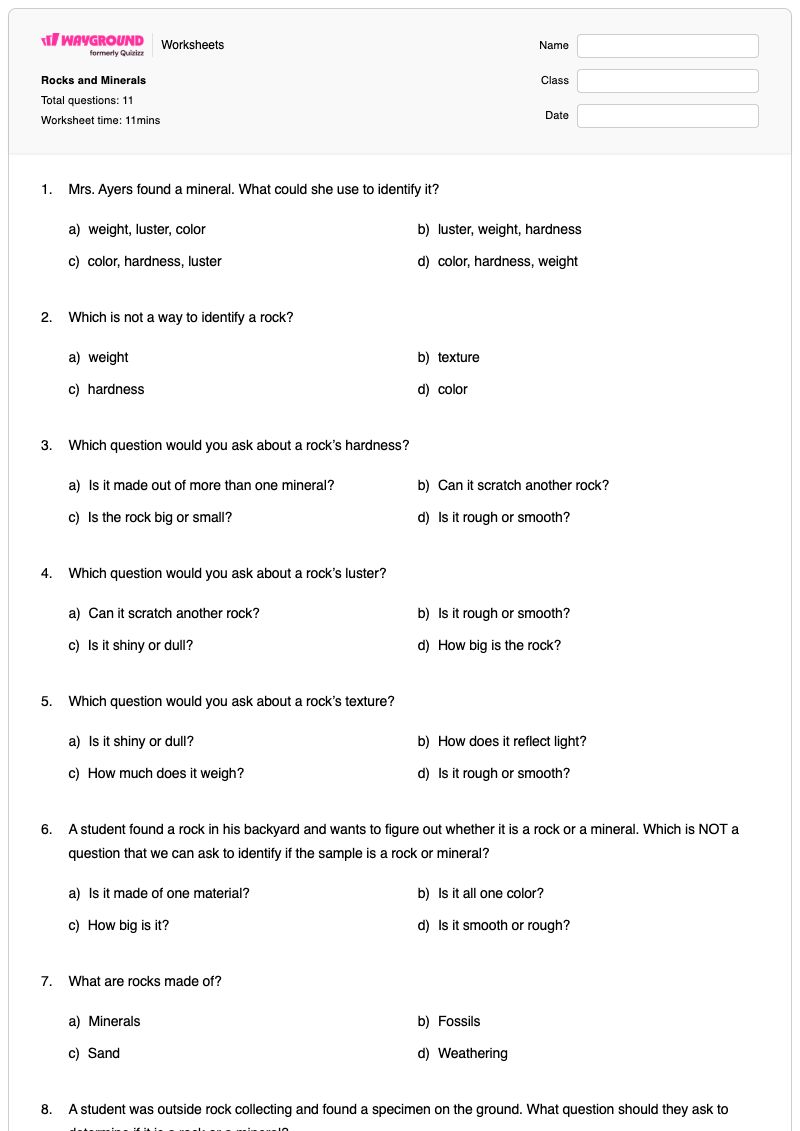
Rocks and Minerals is a Grade 3 science worksheet with 11 multiple-choice questions that helps students identify and classify rocks and minerals using observable properties. Students distinguish hardness, luster, texture, color, and composition; connect hardness to a mineral’s ability to scratch another material; and recognize that rocks are made of minerals. Several questions ask students to select the best investigative question for identifying a sample or grouping minerals by luster. This worksheet gives students practice applying vocabulary and evidence-based reasoning to familiar rock and mineral observations rather than simply recalling definitions. It is useful for introducing the properties of rocks and minerals, reinforcing a classroom investigation, or checking understanding after a hands-on observation activity. The free printable worksheet includes a complete answer key for efficient review and grading.

Worksheet settings

Font size

S
M
L
XL
Worksheets

Rocks and Minerals

Total questions: 11

Name
Class
Date
1.

Mrs. Ayers found a mineral. What could she use to identify it?

a)

weight, luster, color

b)

luster, weight, hardness

c)

color, hardness, luster

d)

color, hardness, weight

2.

Which is not a way to identify a rock?

a)

weight

b)

texture

c)

hardness

d)

color

3.

Which question would you ask about a rock’s hardness?

a)

Is it made out of more than one mineral?

b)

Can it scratch another rock?

c)

Is the rock big or small?

d)

Is it rough or smooth?

4.

Which question would you ask about a rock’s luster?

a)

Can it scratch another rock?

b)

Is it rough or smooth?

c)

Is it shiny or dull?

d)

How big is the rock?

5.

Which question would you ask about a rock’s texture?

a)

Is it shiny or dull?

b)

How does it reflect light?

c)

How much does it weigh?

d)

Is it rough or smooth?

6.

A student found a rock in his backyard and wants to figure out whether it is a rock or a mineral. Which is NOT a question that we can ask to identify if the sample is a rock or mineral?

a)

Is it made of one material?

b)

Is it all one color?

c)

How big is it?

d)

Is it smooth or rough?

7.

What are rocks made of?

a)

Minerals

b)

Fossils

c)

Sand

d)

Weathering

8.

A student was outside rock collecting and found a specimen on the ground. What question should they ask to determine if it is a rock or a mineral?

a)

How heavy is the specimen?

b)

Is the specimen made of the same material throughout?

c)

How big is the specimen?

d)

Is the specimen hard or soft?

9.

John rubs together a soft mineral and a hard mineral. What will most likely happen when the minerals are rubbed against each other?

a)

The harder mineral will scratch the softer mineral.

b)

The minerals will both leave scratches on the other

c)

The minerals will not leave any scratches on each other.

d)

The softer mineral will scratch the harder mineral

10.

There are several examples of rocks and minerals on a lab table. Josh chooses a sample that is gray, with black layers. When he uses a hand lens, he observes small crystals throughout the sample. The sample weighs about 12 grams and it breaks very easily. What questions could Josh ask that would help him determine if the sample is a rock or a mineral?

a)

How many materials make up the sample? How many grams does the sample weigh?

b)

Is the sample easy to break open? What is the color of the sample?

c)

Does the sample have crystals? How much does the sample weigh?

d)

Is the sample made out of only one material?

11.

The students in Mrs. Hagerty's third grade class are observing and classifying minerals. One group has decided they want to group their minerals by luster. Which question will best help the students classify the minerals?

a)

What does the mineral feel like?

b)

Is the mineral metallic?

c)

What color is each mineral?

d)

Can the mineral be scratched?

Answer Key

Rocks and Minerals

Total questions: 11

1.
c)

color, hardness, luster

2.
a)

weight

3.
b)

Can it scratch another rock?

4.
c)

Is it shiny or dull?

5.
d)

Is it rough or smooth?

6.
c)

How big is it?

7.
a)

Minerals

8.
b)

Is the specimen made of the same material throughout?

9.
a)

The harder mineral will scratch the softer mineral.

10.
d)

Is the sample made out of only one material?

11.
b)

Is the mineral metallic?

FAQs

What does the Rocks and Minerals worksheet cover?

This Grade 3 science worksheet uses 11 multiple-choice questions to assess how students identify and classify rocks and minerals by color, hardness, luster, texture, and composition. Students apply these properties to choose useful investigation questions, determine whether a sample is made of one material, and reason that a harder mineral can scratch a softer one.

How can I use this worksheet to teach students about identifying rocks and minerals?

Introduce the worksheet by modeling a rock or mineral observation with the questions it emphasizes: Is it rough or smooth, shiny or dull, able to scratch another material, or made of one material throughout? Have students explain why weight and size are less useful for identification than properties such as hardness and luster. Then use the multiple-choice items as guided practice before assigning the remaining questions independently.

What mistakes should I watch for when students complete this worksheet?

Students may choose weight or size as an identification property even though the worksheet focuses on color, hardness, luster, texture, and composition. They may also confuse hardness with texture, selecting “rough or smooth” instead of considering whether a sample can scratch another rock, or reverse which mineral scratches the other. Watch for confusion between a rock being made of minerals and a specimen being made of one material throughout.

How do I assign and grade this Rocks and Minerals worksheet?

The worksheet is available as a printable PDF and as a digital quiz on Wayground, with a complete answer key for all 11 multiple-choice questions. For printable submissions, you can scan student work with the Wayground for Teachers app to support grading and review. The printable format also gives schools an option for practicing these science concepts with less screen use.

How can I differentiate this Rocks and Minerals worksheet for my students?

Use the worksheet’s Advanced Settings to create a version with wider font spacing or a larger font size, making the 11 multiple-choice questions easier to navigate. You can also enable a dyslexia-friendly font or translate the rock and mineral questions into another language when appropriate for your learners.

Where can I find more worksheets like this on Wayground?

Wayground offers a comprehensive collection of free printable worksheets and practice problems across all subjects, with downloadable PDFs and answer keys to help students master essential skills and concepts. Browse more resources at https://wayground.com/en-us/worksheets.