

Wayground
Momentum: Elastic and Inelastic Collisions - Printable Science Worksheets 9th Grade - Wayground

Momentum: Elastic and Inelastic Collisions

Eric Soria-Patrick

Created by Eric Soria-Patrick

16 questions

9th Grade

Science

Updated Sept 2026

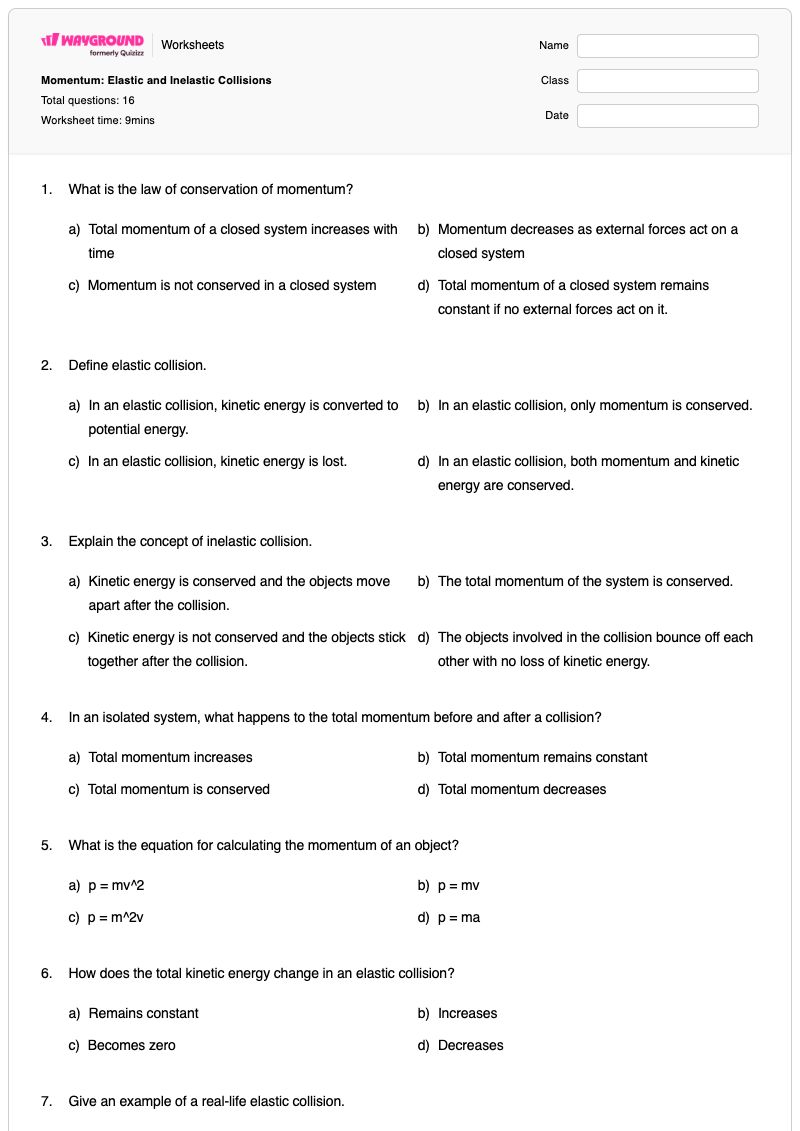
Momentum: Elastic and Inelastic Collisions is a free printable Grade 9 physics worksheet with 16 multiple-choice questions on conservation of momentum and the differences between elastic and inelastic collisions. Students identify the momentum equation p = mv, determine whether momentum and kinetic energy are conserved, recognize collision types from descriptions and real-life examples, and identify what happens in perfectly inelastic collisions. The worksheet also applies these ideas to collision scenarios, including a swimmer jumping from a raft and cars that dent and release thermal energy. These questions help students distinguish conservation of momentum from conservation of kinetic energy and use a simple momentum relationship to reason about motion after separation. An answer key is included, making the worksheet useful for guided practice, independent review, or a quick Grade 9 physics check.

Worksheet settings

Font size

S
M
L
XL
WaygroundWorksheets

Momentum: Elastic and Inelastic Collisions

Total questions: 16

Name
Class
Date
1.

What is the law of conservation of momentum?

a)

Total momentum of a closed system increases with time

b)

Momentum decreases as external forces act on a closed system

c)

Momentum is not conserved in a closed system

d)

Total momentum of a closed system remains constant if no external forces act on it.

2.

Define elastic collision.

a)

In an elastic collision, kinetic energy is converted to potential energy.

b)

In an elastic collision, only momentum is conserved.

c)

In an elastic collision, kinetic energy is lost.

d)

In an elastic collision, both momentum and kinetic energy are conserved.

3.

Explain the concept of inelastic collision.

a)

Kinetic energy is conserved and the objects move apart after the collision.

b)

The total momentum of the system is conserved.

c)

Kinetic energy is not conserved and the objects stick together after the collision.

d)

The objects involved in the collision bounce off each other with no loss of kinetic energy.

4.

In an isolated system, what happens to the total momentum before and after a collision?

a)

Total momentum increases

b)

Total momentum remains constant

c)

Total momentum is conserved

d)

Total momentum decreases

5.

What is the equation for calculating the momentum of an object?

a)

p = mv^2

b)

p = mv

c)

p = m^2v

d)

p = ma

6.

How does the total kinetic energy change in an elastic collision?

a)

Remains constant

b)

Increases

c)

Becomes zero

d)

Decreases

7.

Give an example of a real-life elastic collision.

a)

Ping pong

b)

Bowling

c)

Billiards

d)

Soccer

8.

Give an example of a real-life inelastic collision.

a)

Two billiard balls colliding and bouncing off each other

b)

A car crash is an example of a real-life inelastic collision.

c)

A bouncing ball

d)

A rocket launching into space

9.

What are the key differences between elastic and inelastic collisions?

a)

Momentum conservation

b)

Potential energy conservation

c)

Kinetic energy conservation

d)

No difference between the two

10.

A baseball hits a bat and both move in opposite directions after the collision. What type of collision is it?

a)

Elastic

b)

Inelastic

11.

A swimmer with a mass of 75kg dives off a raft with a mass of 500kg. If the swimmer's speed is 4m/s immediately after leaving the raft, what is the speed of the raft? (Hint: The swimmer and the raft are connected ans not moving and then they seperate).

a)

0.06 m/s

b)

6 m/s

c)

0.6m/s

d)

2m/s

12.

How is momentum conserved in a collision?

a)

Momentum is created in a collision

b)

Momentum is lost in a collision

c)

Momentum is only conserved in explosions

d)

Conservation of momentum principle

13.

Two cars collide in a car crash. During the crash the cars bumpers became dented and some thermal energy was given off in the crash. Was momentum conserved in the crash?

a)

No

b)

Yes

14.

Two cars collide in a car crash. During the crash the cars bumpers became dented and some thermal energy was given off in the crash. Was Total Kinetic Energy conserved in the crash?

a)

No

b)

Yes

15.

If there is a perfectly inelastic collision, which of the following must be true?

a)

The total momentum of the system is 0

b)

The total kinetic energy of the system is conserved

c)

The objects stick together after colliding

d)

The total momentum of the system is not conserved

16.

A piece of silly putty is dropped onto a skateboard as it rolls by. The putty sticks to the skateboard and moves the direction the board is moving. What type of collision is this?

a)

Inelastic collision

b)

Elastic Collision

c)

Perfectly Inelastic collision

d)

No collision

WaygroundAnswer Key

Momentum: Elastic and Inelastic Collisions

Total questions: 16

1.
d)

Total momentum of a closed system remains constant if no external forces act on it.

2.
d)

In an elastic collision, both momentum and kinetic energy are conserved.

3.
c)

Kinetic energy is not conserved and the objects stick together after the collision.

4.
c)

Total momentum is conserved

5.
b)

p = mv

6.
a)

Remains constant

7.
c)

Billiards

8.
b)

A car crash is an example of a real-life inelastic collision.

9.
c)

Kinetic energy conservation

10.
a)

Elastic

11.
c)

0.6m/s

12.
d)

Conservation of momentum principle

13.
b)

Yes

14.
a)

No

15.
c)

The objects stick together after colliding

16.
c)

Perfectly Inelastic collision

FAQs

What does this worksheet cover about elastic and inelastic collisions?

This Grade 9 physics worksheet uses 16 multiple-choice questions to assess conservation of momentum, the equation p = mv, and the defining differences between elastic and inelastic collisions. Students classify collision examples, determine whether momentum or kinetic energy is conserved, identify perfectly inelastic collisions, and apply momentum reasoning to a swimmer-and-raft scenario.

How can I use this worksheet to teach elastic and inelastic collisions?

Introduce the worksheet by reviewing that total momentum remains constant in a closed or isolated system, then contrast that principle with kinetic energy in elastic and inelastic collisions. Have students explain why billiards and car crashes are treated differently in the questions, and use the swimmer-and-raft item to model how momentum can be shared when objects separate.

What mistakes should I watch for on this collisions worksheet?

Students may incorrectly assume that kinetic energy is conserved whenever momentum is conserved, especially in the car-crash questions where bumpers dent and thermal energy is released. Watch for confusion between elastic and perfectly inelastic collisions, selecting the wrong momentum equation instead of p = mv, and overlooking the mass relationship when calculating the raft's speed.

How do I assign and grade this momentum worksheet?

The worksheet is available as a printable PDF and as a digital quiz on Wayground, and it includes a complete answer key for all 16 multiple-choice questions. Printable submissions can be graded by scanning student work with the Wayground for Teachers app, while the digital quiz supports online response collection and grading.

How can I differentiate this elastic and inelastic collisions worksheet?

In the worksheet's Advanced Settings, adjust font spacing or font size to make the multiple-choice questions and calculation item easier to read. You can also apply a dyslexia-friendly font or translate the worksheet when students need a different reading format or language support.

Where can I find more worksheets like this on Wayground?

Wayground offers a comprehensive collection of free printable worksheets and practice problems across all subjects, with downloadable PDFs and answer keys to support essential skills and concepts. Browse more resources at https://wayground.com/en-us/worksheets.