

Wayground
Genetics Practice (Mendelian & Non-mendelian) - Printable Science Worksheets class 10 - Wayground

Genetics Practice (Mendelian & Non-mendelian)

Ashley Murphy

Created by Ashley Murphy

14 questions

10th Grade

Science

Updated May 2026

Genetics Practice (Mendelian & Non-mendelian) is a Grade 10 science worksheet with 14 multiple-choice questions covering foundational inheritance concepts. Students identify genotype and phenotype, determine whether allele pairs are homozygous or heterozygous, and use dominant and recessive relationships to predict offspring fractions and genotype ratios from simple crosses. The worksheet also asks students to distinguish codominance from incomplete dominance using examples involving calico cats, roses, and horse coat colors. It extends these skills to ABO blood-type inheritance, including identifying codominant and recessive alleles and determining likely parental genotypes. This free printable worksheet includes a complete answer key and can support review, independent practice, or a quick check of Grade 10 students’ understanding of Mendelian and non-Mendelian inheritance.

Worksheet settings

Font size

S
M
L
XL
WaygroundWorksheets

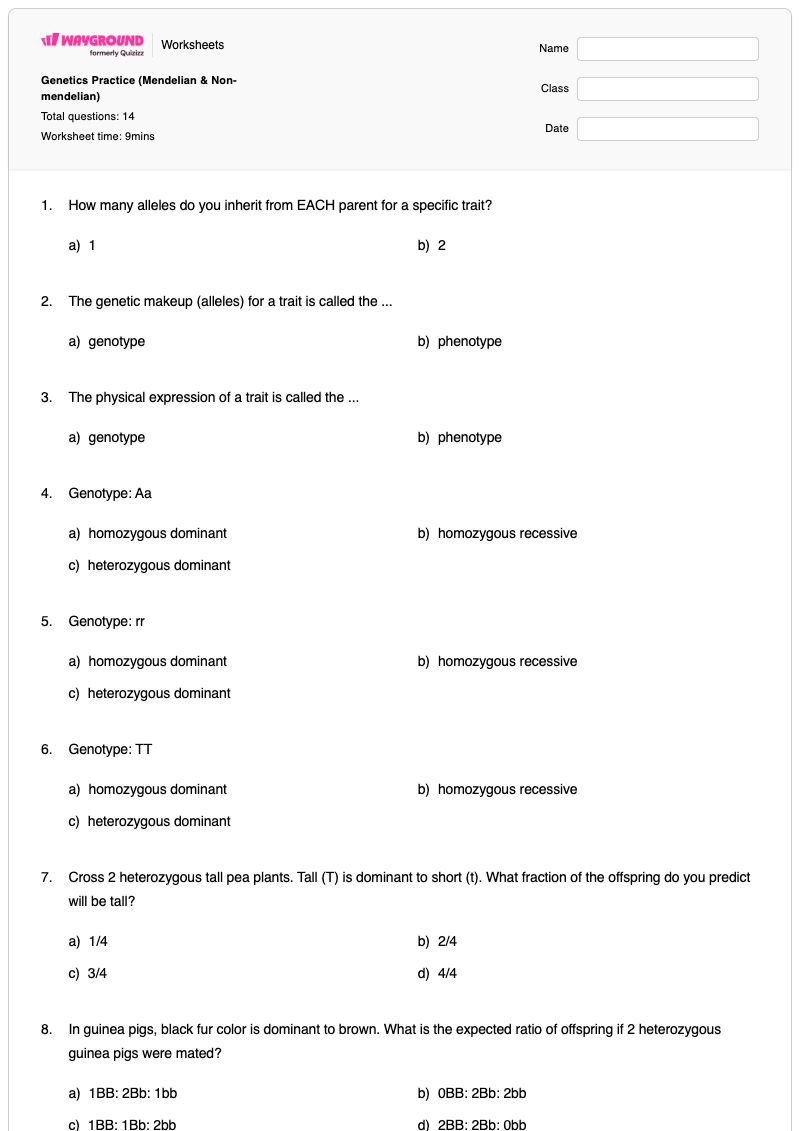
Genetics Practice (Mendelian & Non-mendelian)

Total questions: 14

Name
Class
Date
1.

How many alleles do you inherit from EACH parent for a specific trait?

a)

1

b)

2

2.

The genetic makeup (alleles) for a trait is called the ...

a)

genotype

b)

phenotype

3.

The physical expression of a trait is called the ...

a)

genotype

b)

phenotype

4.

Genotype: Aa

a)

homozygous dominant

b)

homozygous recessive

c)

heterozygous dominant

5.

Genotype: rr

a)

homozygous dominant

b)

homozygous recessive

c)

heterozygous dominant

6.

Genotype: TT

a)

homozygous dominant

b)

homozygous recessive

c)

heterozygous dominant

7.

Cross 2 heterozygous tall pea plants. Tall (T) is dominant to short (t). What fraction of the offspring do you predict will be tall?

a)

1/4

b)

2/4

c)

3/4

d)

4/4

8.

In guinea pigs, black fur color is dominant to brown. What is the expected ratio of offspring if 2 heterozygous guinea pigs were mated?

a)

1BB: 2Bb: 1bb

b)

0BB: 2Bb: 2bb

c)

1BB: 1Bb: 2bb

d)

2BB: 2Bb: 0bb

9.
A calico cat shows both the traits for orange fur and black fur. What kind of allele expression is this?
a)
Incomplete Dominance
b)
Co dominance
c)
Independent assortment
d)
Recessive inheritance
10.
What do you call the non-Mendelian inheritance pattern that states that neither trait is dominant and the traits appear to…
What do you call the non-Mendelian inheritance pattern that states that neither trait is dominant and the traits appear to blend together?
a)
Codominance
b)
Incomplete dominance
c)
Polygenic traits
11.

In roses, petal color can be white, red, or pink. What would be the expected genotypes and phenotypes if a red rose was crossed with a pink rose? What type of inheritance pattern is this?

a)

incomplete dominance; 2RR: 2PP: 0WW

b)

codominance; 2RR: 2PP: 0WW

c)

incomplete dominance; 2RR: 2RW: 0WW

d)

codominance; 2RR: 2RW: 0WW

12.

In horses, coat color can be brown, white or brown with white spots. What would be the expected genotypes and phenotypes if a white horse mated with a brown with white spots horse? What type of inheritance pattern is this?

a)

incomplete dominance; 0BB: 2BW: 2WW

b)

codominance; 0BB: 2BW: 2WW

c)

incomplete dominance; 1BB: 2BW: 1WW

d)

codominance; 1BB: 2BW: 1WW

13.
Which of the following statements is true regarding blood types?
a)
A and O are codominant, B is recessive.
b)
B and O are codominant, A is recessive.
c)
A and B are codominant, O is recessive.
d)
A , B and O are all codominant with each other.
14.

A man with type A blood and a woman with type B blood have 4 kids. Each child has a different blood type. What are the most likely genotypes of the man and woman?

a)

Man: IAIA

Woman: IBIB

b)

Man: IAi

Woman: ii

c)

Man: ii

Woman: IBi

d)

Man: IAi

Woman: IBi

WaygroundAnswer Key

Genetics Practice (Mendelian & Non-mendelian)

Total questions: 14

1.
a)

1

2.
a)

genotype

3.
b)

phenotype

4.
c)

heterozygous dominant

5.
b)

homozygous recessive

6.
a)

homozygous dominant

7.
c)

3/4

8.
a)

1BB: 2Bb: 1bb

9.
b) Co dominance
10.
b) Incomplete dominance
11.
c)

incomplete dominance; 2RR: 2RW: 0WW

12.
b)

codominance; 0BB: 2BW: 2WW

13.
c) A and B are codominant, O is recessive.
14.
d)

Man: IAi

Woman: IBi

FAQs

What does the Genetics Practice worksheet cover?

This Grade 10 science worksheet uses 14 multiple-choice questions to assess genotype and phenotype vocabulary, homozygous and heterozygous classifications, and predictions from simple genetic crosses. Students also interpret codominance, incomplete dominance, and ABO blood-type inheritance by selecting expected offspring fractions, genotype ratios, inheritance patterns, and parental genotypes.

How can I use this worksheet to teach Mendelian and non-Mendelian inheritance?

Introduce the worksheet by reviewing that each parent contributes one allele, then model how allele pairs determine genotype and how traits appear as phenotypes. Have students complete the questions in sections—vocabulary and genotype classification, dominant-recessive crosses, then codominance, incomplete dominance, and blood types—and ask them to justify the ratios they select using a Punnett square.

What mistakes should I watch for when students complete this genetics worksheet?

Watch for students confusing genotype with phenotype, treating a heterozygous pair such as Aa as homozygous, or choosing the wrong tall-offspring fraction in a Tt × Tt cross. Students may also confuse codominance, in which both traits appear, with incomplete dominance, in which traits blend, or misidentify O as codominant in the ABO blood-type questions.

How do I assign and grade this genetics worksheet?

The worksheet is available as a printable PDF and as a digital quiz on Wayground, and it includes a complete answer key for all 14 multiple-choice questions. For printable submissions, you can grade student work by scanning it with the Wayground for Teachers app.

How can I differentiate this genetics worksheet for my students?

Use the worksheet’s Advanced Settings to adjust font spacing or font size so the allele notation, inheritance-pattern choices, and blood-type answer options are easier to read. You can also apply a dyslexia-friendly font or translate the worksheet into another language when those file-level changes support access to the genetics questions.

Where can I find more worksheets like this on Wayground?

Wayground offers a comprehensive collection of free printable worksheets and practice problems across all subjects, with downloadable PDFs and answer keys to help students master essential skills and concepts. Browse more resources at https://wayground.com/en-us/worksheets.