

Wayground
Simile, Metaphor, Personification, Alliteration, & Onomatopoeia - Printable ELA Worksheets class 7 - Wayground

Simile, Metaphor, Personification, Alliteration, & Onomatopoeia

Thomas Kiernan

Created by Thomas Kiernan

12 questions

7th Grade

ELA

Updated Sept 2026

Simile, Metaphor, Personification, Alliteration, & Onomatopoeia is a Grade 7 English worksheet that helps students identify five figurative language techniques in definitions and example sentences. Across 12 questions, including 9 multiple-choice and 3 multiple-select items, students distinguish similes, metaphors, personification, alliteration, and onomatopoeia by recognizing comparison words, human-like actions, repeated beginning sounds, and sound words. The worksheet also asks students to interpret the meaning of figurative sentences, such as understanding that calling a car a “dinosaur” means it is very old and that someone who eats “like a horse” eats a lot. Use this free printable worksheet for guided practice, independent review, or a quick formative check, and use the included answer key to evaluate student understanding.

Worksheet settings

Font size

S
M
L
XL
WaygroundWorksheets

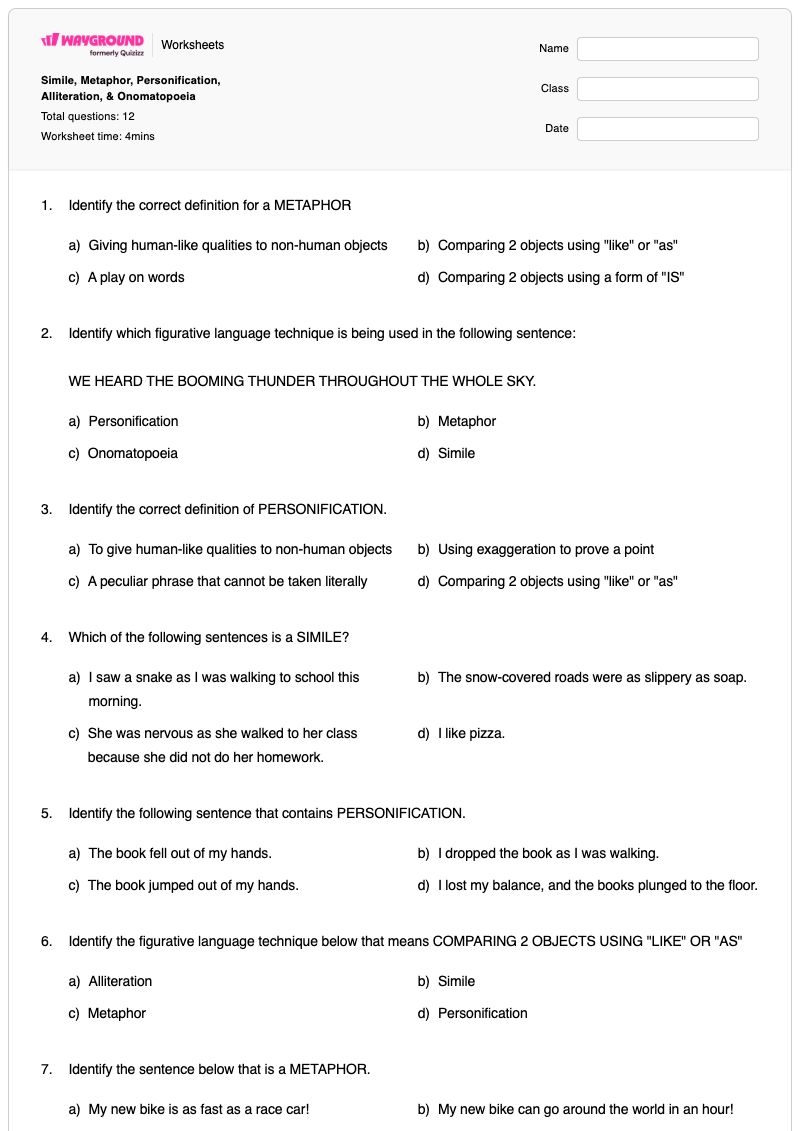
Simile, Metaphor, Personification, Alliteration, & Onomatopoeia

Total questions: 12

Name
Class
Date
1.

Identify the correct definition for a METAPHOR

a)

Giving human-like qualities to non-human objects

b)

Comparing 2 objects using "like" or "as"

c)

A play on words

d)

Comparing 2 objects using a form of "IS"

2.

Identify which figurative language technique is being used in the following sentence:


WE HEARD THE BOOMING THUNDER THROUGHOUT THE WHOLE SKY.

a)

Personification

b)

Metaphor

c)

Onomatopoeia

d)

Simile

3.

Identify the correct definition of PERSONIFICATION.

a)

To give human-like qualities to non-human objects

b)

Using exaggeration to prove a point

c)

A peculiar phrase that cannot be taken literally

d)

Comparing 2 objects using "like" or "as"

4.

Which of the following sentences is a SIMILE?

a)

I saw a snake as I was walking to school this morning.

b)

The snow-covered roads were as slippery as soap.

c)

She was nervous as she walked to her class because she did not do her homework.

d)

I like pizza.

5.

Identify the following sentence that contains PERSONIFICATION.

a)

The book fell out of my hands.

b)

I dropped the book as I was walking.

c)

The book jumped out of my hands.

d)

I lost my balance, and the books plunged to the floor.

6.

Identify the figurative language technique below that means COMPARING 2 OBJECTS USING "LIKE" OR "AS"

a)

Alliteration

b)

Simile

c)

Metaphor

d)

Personification

7.

Identify the sentence below that is a METAPHOR.

a)

My new bike is as fast as a race car!

b)

My new bike can go around the world in an hour!

c)

My new bike is a jet plane because it goes so fast!

d)

My new bike is the fastest bike ever in the history of time!

8.

Identify the figurative language technique found in the following sentence.


THE TIMID TURTLE TOOTLED TO THE TRAIN TRACKS.

a)

Metaphor

b)

Pun

c)

Alliteration

d)

Onomatopoeia

9.

Identify the figurative language technique that is used when TWO OR MORE WORDS BEGIN WITH THE SAME SOUND IN A SENTENCE OR A LINE OF POETRY.

a)

Alliteration

b)

Play on words

c)

Onomatopoeia

d)

Hyperbole

10.

Identify the sentence that uses an ONOMATOPOEIA.

a)

My cereal was really loud today.

b)

My cereal crackled when I poured the milk in the bowl.

c)

My cereal made a lot of noises this morning.

d)

My cereal was talking to me as I poured the milk in the bowl.

11.

Identify the figurative language used AND identify the meaning of the sentence.


OUR CAR IS A DINOSAUR, SO WE NEED TO BUY A NEW ONE.

a)

Simile; our car is old.

b)

Hyperbole; our car is a breathing animal

c)

Pun; a play on words

d)

Metaphor; our car is very old.

12.

Identify the type of figurative language AND explain the meaning of the sentence below.


MY BROTHER EATS LIKE A HORSE.

a)

Metaphor; my brother eats a lot

b)

Simile; my brother eats a lot.

c)

Personification; giving a non-human object human-like characteristics.

d)

Onomatopoeia--describes what it sounds like

WaygroundAnswer Key

Simile, Metaphor, Personification, Alliteration, & Onomatopoeia

Total questions: 12

1.
d)

Comparing 2 objects using a form of "IS"

2.
c)

Onomatopoeia

3.
a)

To give human-like qualities to non-human objects

4.
b)

The snow-covered roads were as slippery as soap.

5.
c)

The book jumped out of my hands.

6.
b)

Simile

7.
c)

My new bike is a jet plane because it goes so fast!

8.
c)

Alliteration

9.
a)

Alliteration

10.
b)

My cereal crackled when I poured the milk in the bowl.

11.
d)

Metaphor; our car is very old.

12.
b)

Simile; my brother eats a lot.

FAQs

What does this worksheet cover, and how does it help students learn figurative language?

This Grade 7 worksheet practices identifying similes, metaphors, personification, alliteration, and onomatopoeia through definitions and example sentences. Students apply clues such as “like” or “as,” a comparison using a form of “is,” human-like qualities, repeated beginning sounds, and words that imitate sounds. The final items also ask students to connect a figurative expression to its intended meaning.

How can I use this worksheet to teach similes, metaphors, personification, alliteration, and onomatopoeia?

Introduce each technique with its definition, then model how to find the clue in a sentence—for example, “as slippery as soap” signals a simile and “the timid turtle tootled” highlights alliteration. Have students complete the definition and identification items first, then discuss why the selected sentence fits the technique. Use the car and horse examples to prompt students to explain the meaning behind a figurative comparison.

What mistakes should I watch for when students complete this figurative language worksheet?

Students may confuse similes and metaphors, especially by selecting a simile for a comparison that uses “is,” or by overlooking “like” and “as” in the simile items. They may also mistake any unusual sentence for personification instead of checking whether a non-human object receives a human-like action, or confuse alliteration with onomatopoeia by focusing on sound rather than repeated beginning sounds. For the multiple-select items, check that students identify both the technique and the meaning when the prompt requires both.

How do I assign and grade this figurative language worksheet?

This worksheet is available as a printable PDF and as a digital quiz on Wayground, so you can use the same 12-item practice set in either format. It includes a complete answer key, and printable submissions can be graded by scanning student work with the Wayground for Teachers app.

How does this worksheet help students interpret the meaning of figurative expressions?

The final questions move beyond naming a technique by asking students to interpret expressions such as “Our car is a dinosaur” and “My brother eats like a horse.” Students must match the correct label—metaphor or simile—with the intended meaning, such as an old car or someone who eats a lot. This helps them avoid treating figurative statements as literal facts.

Where can I find more worksheets like this on Wayground?

Wayground offers a comprehensive collection of free printable worksheets and practice problems across all subjects, with downloadable PDFs and answer keys to support essential skills and concepts. Browse more resources at https://wayground.com/en-us/worksheets.