Quadratics Forms and Parabolas Key Features is a Grade 9–11 mathematics worksheet with 18 multiple-choice questions on recognizing quadratic forms and interpreting key features of parabolas. Students identify vertices, axes of symmetry, y-intercepts, x-intercepts, and maximum or minimum values, recognize that quadratic graphs form parabolas, and distinguish vertex, standard, and factored forms from equations.
The questions connect algebraic representations with graphical features, helping students match equations to forms and read important information from parabola graphs. This free printable worksheet with an answer key works well for guided practice, independent review, or a quick check of understanding after introducing quadratic functions. It supports standards-aligned practice related to graphing quadratic functions and interpreting their key features across graphs and equations.
Worksheet settings
Font size
S
M
L
XL
Worksheets
Quadratics Forms and Parabolas Key Features
Total questions: 18
Name
Class
Date
1.
What is the vertex of the given parabola?
a)
(1, 2)
b)
x = 2
c)
(2, 1)
d)
(0, -4)
2.
What is the vertex of the given parabola?
a)
(1, - 4)
b)
(-1, 0), (3, 0)
c)
x = 1
d)
(-4, 1)
3.
What is the Axis of symmetry?
a)
Y=3
b)
y=-3
c)
x= 3
d)
x=-3
4.
Quadratic equations take the shape of a _______ when graphed.
a)
parabola
b)
straight line
c)
snaked line
d)
elliptical
5.
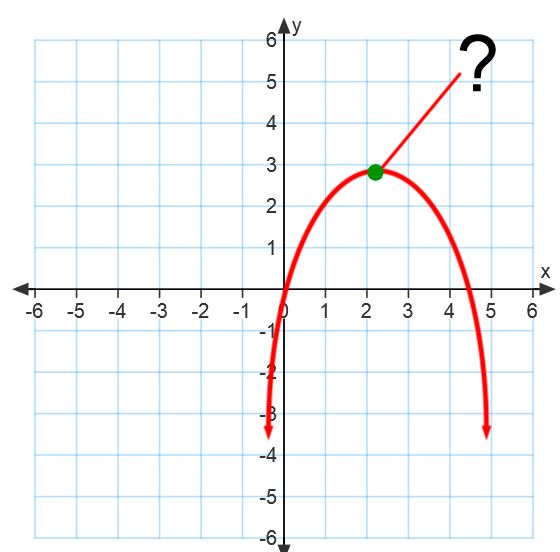
What is the green dot on this parabola called (besides the vertex)?
a)
maximum
b)
minumum
c)
roots
d)
zeros
6.
What is the name of this form:
y = a(x - h)2 + k
45.F.IF.7 graph quadratic functions expressed algebraically by hand and by using technology
a)
vertex form
b)
standard form
c)
factored form
d)
zero form
7.
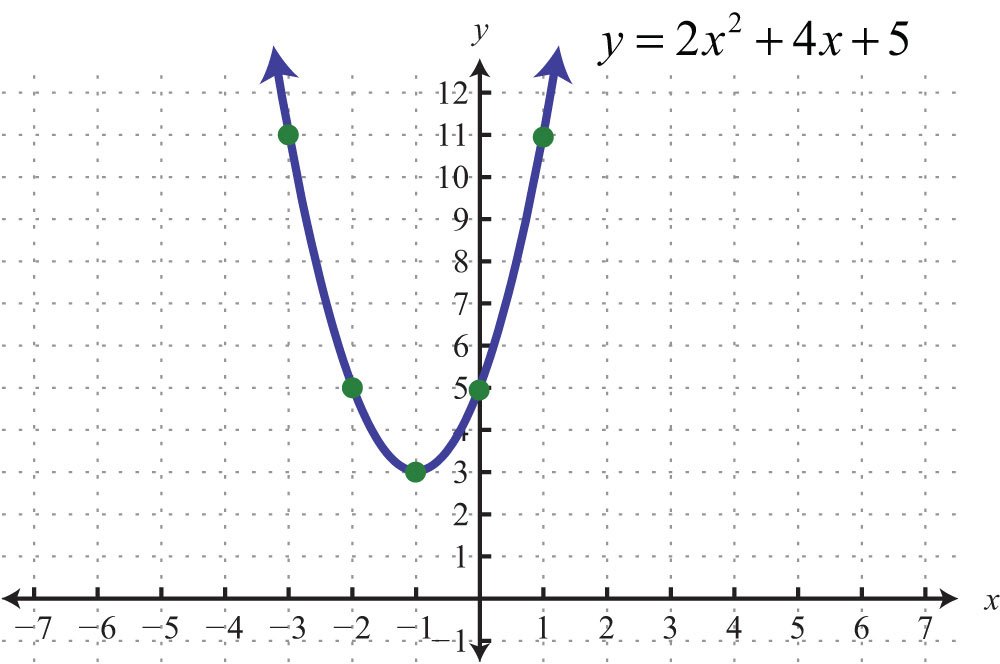
What is the y-intercept of this parabola?
46.F.IF.4 interpret key features of quadratic functions represented in graphs, tables, equations, and verbal descriptions
a)
(−1, 3)
b)
(−3, 11)
c)
(−2, 5)
d)
(0, 5)
8.
Which of the following is Standard Form?
a)
y=ax2+bx+c
b)
y=a(x−p)(x−q)
c)
y=a(x−h)2+k
9.
Identify the y-intercept
a)
(0, -3)
b)
(3, 0)
c)
(0, 3)
d)
(2, 1)
10.
Identify the form for the following Quadratic:
y = 3(x + 4)2 - 1
a)
Vertex Form
b)
Standard Form
c)
Factored Form
11.
Identify the form for the following Quadratic:
y = x2 - x + 1
a)
Vertex Form
b)
Standard Form
c)
Factored Form
12.
Identify the form for the following Quadratic:
y = -3(x - 2)(x - 6)
a)
Vertex Form
b)
Standard Form
c)
Factored Form
13.
What are the x- intercepts?
a)
x= 0 and x= -4
b)
x= 0 and x= 4
c)
y= 0
d)
x= 2
14.
Does this graph have a maximum or minimum value?
a)
maximum
b)
minimum
c)
neither
d)
both
15.
Name the Axis of Symmetry
a)
x = 1
b)
x = 0
16.
What is the vertex?
a)
(-3, 0)
b)
(3, 0)
c)
(0, 18)
d)
(18, 0)
17.
Which function has an axis of symmetry of x = 0?
a)
b)
c)
d)
None of the above
18.
If the vertex of a parabola is (2, −3), what is the axis of symmetry?
a)
x=−3
b)
y=−3
c)
x=2
d)
y=2
Answer Key
Quadratics Forms and Parabolas Key Features
Total questions: 18
1.
c)
(2, 1)
2.
a)
(1, - 4)
3.
c) x= 3
4.
a)
parabola
5.
a)
maximum
6.
a) vertex form
7.
d) (0, 5)
8.
a)
y=ax2+bx+c
9.
a)
(0, -3)
10.
a)
Vertex Form
11.
b)
Standard Form
12.
c)
Factored Form
13.
b) x= 0 and x= 4
14.
b) minimum
15.
b)
x = 0
16.
c)
(0, 18)
17.
b)
18.
c)
x=2
140 %
Browse by subjects
Browse by grades
Browse by format
FAQs
What does this quadratics worksheet help students practice?
This worksheet uses 18 multiple-choice questions to build skill in identifying vertex form, standard form, and factored form, while reading parabola features such as the vertex, axis of symmetry, x- and y-intercepts, and maximum or minimum value. Students repeatedly connect the equation or graph to the correct feature or form, strengthening interpretation of quadratic functions.
How can I use this worksheet to teach quadratic forms and parabola features?
Introduce one feature at a time by displaying a parabola and asking students to locate its vertex, axis of symmetry, and intercepts before assigning the corresponding multiple-choice items. Then have students sort the displayed equations into vertex, standard, and factored form and explain which part of each equation helped them choose. Use the answer choices as discussion prompts when students select a distractor.
What mistakes should I watch for on this quadratic forms and parabolas worksheet?
Watch for students reversing the coordinates of a vertex or y-intercept, confusing an x-intercept with a y-intercept, or choosing a horizontal line such as y = 3 instead of the vertical axis of symmetry x = 3. Students may also confuse maximum and minimum with roots or zeros, or mistake factored form for vertex form because both equations use parentheses.
How do I assign and grade this quadratics worksheet?
You can assign this worksheet as a printable PDF or as a digital quiz on Wayground, and the complete answer key supports quick checking of all 18 multiple-choice questions. For printable submissions, scan student work with the Wayground for Teachers app to help grade responses efficiently.
How can I differentiate this worksheet on quadratic forms and parabola features?
Use the worksheet’s Advanced Settings to adjust font spacing or font size so the graph-based questions, equations, and answer choices are easier to read. You can also apply a dyslexia-friendly font or translate the worksheet into another language while keeping the vertex, intercept, axis-of-symmetry, and quadratic-form practice intact.
Where can I find more worksheets like this on Wayground?
Wayground offers a broad collection of free printable worksheets and practice problems across subjects, with downloadable PDFs and answer keys to support mastery of essential skills and concepts. Browse more resources at https://wayground.com/en-us/worksheets.


 Worksheets