

Wayground
L13 Participial, Gerund, and Infinitive Phrases - Printable English Worksheets class 9 - Wayground

L13 Participial, Gerund, and Infinitive Phrases

24 questions

9th - 9th Grade

English

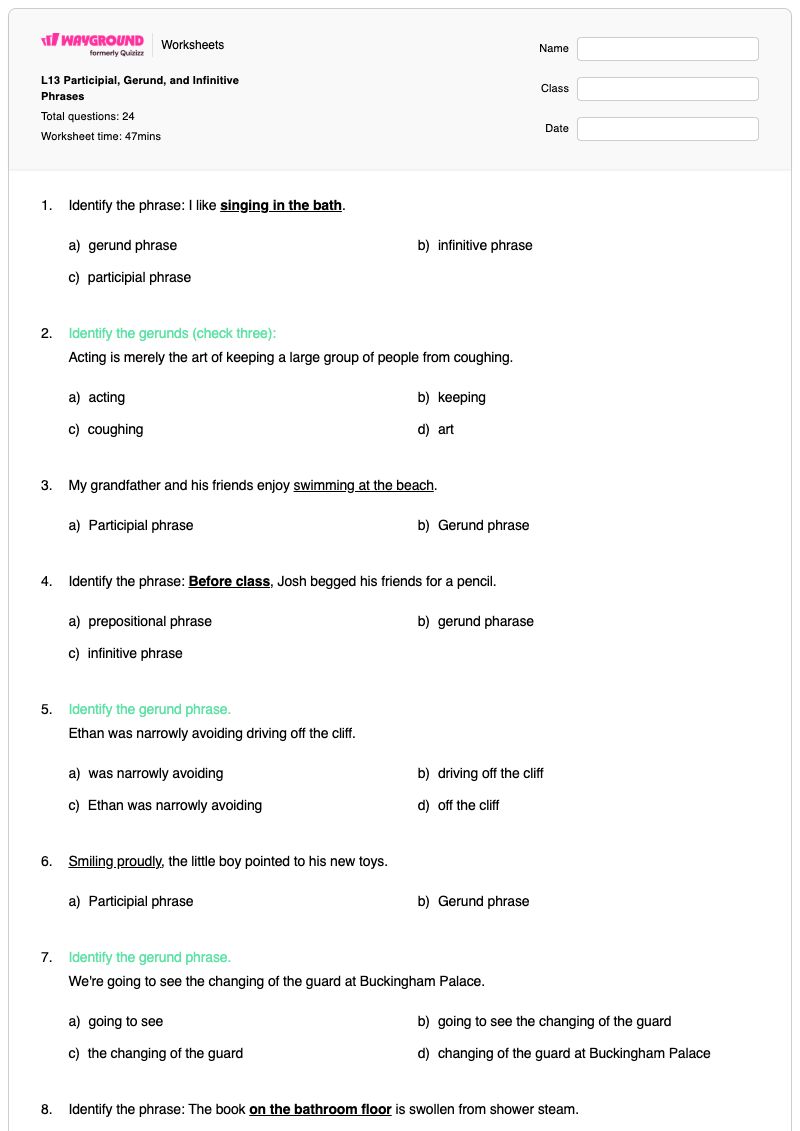
This Grade 9 English grammar worksheet gives students focused practice identifying gerund, participial, and infinitive phrases in complete sentences. Across 24 questions—23 multiple choice and one multiple-select item—students identify phrases such as “driving off the cliff,” “smiling proudly,” and “to understand the interplay of muscle and bone,” distinguish gerunds from participles, and recognize when an infinitive phrase functions as a noun. Several items also include prepositional and noun phrases as comparison choices, helping students analyze phrase structure rather than rely only on word endings. Designed for English grammar instruction, review, or assessment, this worksheet helps students connect phrase form with its role in a sentence. The multiple-select question requires students to find all gerunds in a sentence, while other items ask them to locate a phrase or classify its type. It is a free printable worksheet with a complete answer key, making it useful for independent practice, classroom work, or checking understanding after instruction.

Worksheet settings

Font size

S
M
L
XL
Worksheets

L13 Participial, Gerund, and Infinitive Phrases

Total questions: 24

Name
Class
Date
1.

Identify the phrase: I like singing in the bath.

a)

gerund phrase

b)

infinitive phrase

c)

participial phrase

2.

Identify the gerunds (check three):

Acting is merely the art of keeping a large group of people from coughing.

a)

acting

b)

keeping

c)

coughing

d)

art

3.

My grandfather and his friends enjoy swimming at the beach.

a)

Participial phrase

b)

Gerund phrase

4.

Identify the phrase: Before class, Josh begged his friends for a pencil.

a)

prepositional phrase

b)

gerund pharase

c)

infinitive phrase

5.

Identify the gerund phrase.

Ethan was narrowly avoiding driving off the cliff.

a)

was narrowly avoiding

b)

driving off the cliff

c)

Ethan was narrowly avoiding

d)

off the cliff

6.

Smiling proudly, the little boy pointed to his new toys.

a)

Participial phrase

b)

Gerund phrase

7.

Identify the gerund phrase.

We're going to see the changing of the guard at Buckingham Palace.

a)

going to see

b)

going to see the changing of the guard

c)

the changing of the guard

d)

changing of the guard at Buckingham Palace

8.

Identify the phrase: The book on the bathroom floor is swollen from shower steam.

a)

noun phrase

b)

prepositional phrase

c)

gerund phrase

9.

Identify the infinitive phrase. If there is no infinitive, choose none.


“Come eat lunch,” Mom yelled as I opened the door to my room.

a)

come eat lunch

b)

yelled as I opened

c)

to my room

d)

none

10.

Identify the gerund phrase.

Piling too much laundry into a washing machine was causing it to malfunction.

a)

washing machine

b)

piling too much laundry into a washing machine

c)

piling too much

d)

was causing it to malfunction

11.

Identify the phrase: Kelvin, an aspiring comic book artist, is taking Anatomy and Physiology this semester to understand the interplay of muscle and bone in the human body.

a)

gerund phrase

b)

infinitive phrase

c)

participial phrase

12.
What type of phrase is in red?
Trembling with rage, she stalked out. 
a)
infinitive
b)
participial
c)
gerund
d)
appositive
13.

To train for the marathon will take at least 6 months.

a)

noun

b)

adjective

c)

adverb

14.
What is the participial phrase in the following sentence?
Sweeping across the night sky, the bats hunted their prey.
a)
Sweeping across the night sky,
b)
the bats hunted 
c)
hunted their prey.
d)
across the night sky
15.

Going to the beach this summer will be a lot of fun.

a)

Participial phrase

b)

Gerund phrase

16.

The little boy stomped into his room, slamming the door behind him.

a)

Participial phrase

b)

Gerund phrase

17.

Searching for an answer, I looked in a current dictionary.

a)

Participial phrase

b)

Gerund phrase

18.

Campfires built with your own hands give you a sense of accomplishment.

a)

Participial phrase

b)

Gerund phrase

19.

Identify the phrase: The horse trotting up to the fence hopes that you have an apple or carrot.

a)

gerund phrase

b)

participial phrase

c)

infinitive phrase

20.

Which sentence has an infinitive phrase?

a)

My mother loves writing in her journal.

b)

To write is the best solution for your problems.

c)

I write in class every day.

d)

Writing is good for you.

21.

The Football Hall of Fame is fun to visit on a cold day.

a)

noun

b)

adjective

c)

adverb

22.
What noun is the participial phrase modifying?
Quickly checking over his answers, Patrick handed in his test just before time ran out.
a)
Patrick
b)
answers
c)
test
d)
ran
23.

Identify the phrase: Eating ice cream on a windy day can be a messy experience if you have long, untamed hair.

a)

infinitive phrase

b)

gerund phrase

c)

participial phrase

24.

The captain of the ship is the authority to obey at all times.

a)

noun

b)

adjective

c)

adverb

Answer Key

L13 Participial, Gerund, and Infinitive Phrases

Total questions: 24

1.
a)

gerund phrase

2.
a)

acting

, b)

keeping

, c)

coughing

3.
b)

Gerund phrase

4.
a)

prepositional phrase

5.
b)

driving off the cliff

6.
a)

Participial phrase

7.
d)

changing of the guard at Buckingham Palace

8.
b)

prepositional phrase

9.
d)

none

10.
b)

piling too much laundry into a washing machine

11.
b)

infinitive phrase

12.
b) participial
13.
a)

noun

14.
a) Sweeping across the night sky,
15.
b)

Gerund phrase

16.
a)

Participial phrase

17.
a)

Participial phrase

18.
a)

Participial phrase

19.
b)

participial phrase

20.
b)

To write is the best solution for your problems.

21.
c)

adverb

22.
a) Patrick
23.
b)

gerund phrase

24.
b)

adjective

FAQs

What does the L13 Participial, Gerund, and Infinitive Phrases worksheet cover?

This Grade 9 worksheet contains 24 questions that ask students to identify and classify gerund, participial, and infinitive phrases in context. Students locate complete phrases such as “piling too much laundry into a washing machine,” distinguish a gerund phrase from a participial phrase, and determine that an infinitive phrase can function as a noun. The set includes 23 multiple-choice questions and one multiple-select question in which students identify all the gerunds in a sentence.

How can I use this worksheet to teach gerund, participial, and infinitive phrases?

Introduce the worksheet by modeling how the phrase functions in a sentence, using an example such as “Swimming at the beach” as a gerund phrase and “Smiling proudly” as a participial phrase. Have students underline the full phrase before selecting an answer, then ask them to explain whether it acts as a noun or describes a noun. Use the infinitive item with “to train for the marathon” to discuss how an infinitive phrase can serve as a noun.

What mistakes should I watch for when students complete this phrase-identification worksheet?

Students may select only the first word of a phrase instead of the complete phrase, as in “driving off the cliff” or “changing of the guard at Buckingham Palace.” They may also confuse a gerund with a participle because both can begin with an -ing word; have them check whether the phrase names an activity or describes a noun. In the multiple-select item, watch for students who choose “art,” a noun, instead of selecting all three gerunds: “acting,” “keeping,” and “coughing.”

How do I assign and grade this worksheet?

You can assign this phrase-identification worksheet as a printable PDF or as a digital quiz on Wayground. It includes a complete answer key for the 24 questions, including the multiple-select item. Printable submissions can be graded by scanning student work with the Wayground for Teachers app.

How can I differentiate this worksheet for my students?

Use the worksheet’s Advanced Settings to adjust font spacing and font size so the phrase-identification questions are easier to scan. You can also apply a dyslexia-friendly font or translate the worksheet into another language. These options can support students as they compare phrases such as “Sweeping across the night sky” and “To train for the marathon.”

Where can I find more worksheets like this on Wayground?

Wayground offers a comprehensive collection of free printable worksheets and practice problems across subjects, with downloadable PDFs and answer keys to help students master essential skills and concepts. Browse more resources at https://wayground.com/en-us/worksheets.