

Wayground
Part, Whole, & Percent - Printable Mathematics Worksheets class 6 - Wayground

Part, Whole, & Percent

20 questions

6th - 6th Grade

Mathematics

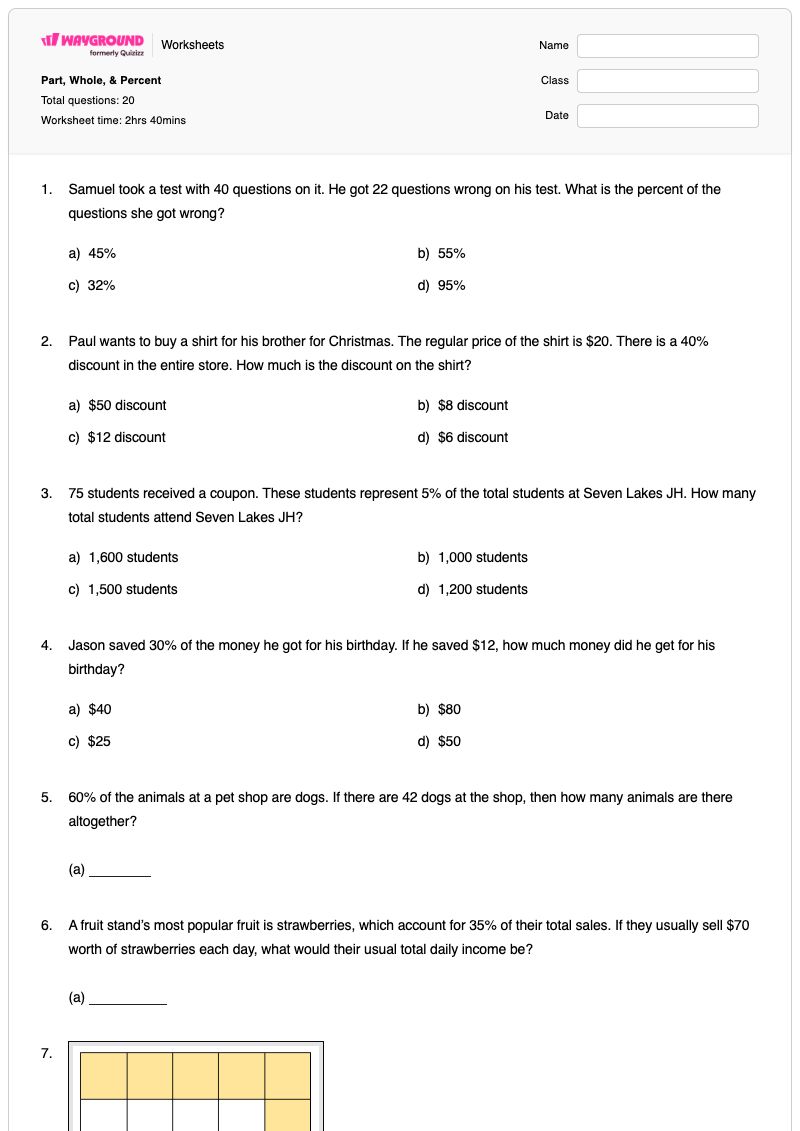
Part, Whole, & Percent is a free Grade 6 mathematics worksheet that develops students’ ability to connect parts, wholes, and percentages in practical problems. Across 20 items—17 multiple-choice questions and 3 fill-in-the-blank questions—students find a percent from a part and whole, calculate a part from a given percent, and determine the whole when a part and percent are known. The worksheet also includes shaded-model questions that ask students to represent visual portions as percentages. The problems place these skills in familiar contexts, including test results, discounts, class demographics, election votes, sales, survey responses, and total distances. Students must decide which quantity represents the whole, translate between fractions and percentages when using visual models, and select or write an appropriate solution. This free printable worksheet includes a complete answer key, making it useful for independent practice, classwork, homework, or a quick Grade 6 assessment of percent reasoning.

Worksheet settings

Font size

S
M
L
XL
Worksheets

Part, Whole, & Percent

Total questions: 20

Name
Class
Date
1.

Samuel took a test with 40 questions on it. He got 22 questions wrong on his test. What is the percent of the questions she got wrong?

a)

45%

b)

55%

c)

32%

d)

95%

2.

Paul wants to buy a shirt for his brother for Christmas. The regular price of the shirt is $20. There is a 40% discount in the entire store. How much is the discount on the shirt?

a)

$50 discount

b)

$8 discount

c)

$12 discount

d)

$6 discount

3.

75 students received a coupon. These students represent 5% of the total students at Seven Lakes JH. How many total students attend Seven Lakes JH?

a)

1,600 students

b)

1,000 students

c)

1,500 students

d)

1,200 students

4.

Jason saved 30% of the money he got for his birthday. If he saved $12, how much money did he get for his birthday?

a)

$40

b)

$80

c)

$25

d)

$50

5.

60% of the animals at a pet shop are dogs. If there are 42 dogs at the shop, then how many animals are there altogether?

(a)  

6.

A fruit stand’s most popular fruit is strawberries, which account for 35% of their total sales. If they usually sell $70 worth of strawberries each day, what would their usual total daily income be?

(a)  

7.

What is the percent of the shaded region in the figure? (Hint: It might help to write as a fraction first)

a)

60%

b)

12%

c)

40%

d)

8%

8.
In the school election James ran against Ben for secretary.  James received 75% of the votes.  If 240 students voted, how many votes did James receive?
a)
175
b)
160
c)
153
d)
180
9.

Caroline took a math test and answered 19 questions correctly and 6 questions incorrectly. What percent of the questions did she answer correctly?

a)

76%

b)

66%

c)

24%

d)

54%

10.

What Percent of the image is shaded?

a)

3%

b)

30%

c)

33%

d)

300%

11.

There are 10 girls and 15 boys in French class. What percent are girls?

a)

40%

b)

60%

c)

75%

d)

66 ⅔%

12.
Eric earned 60 points on his last test. If there were 75 possible points, what was his percent grade?
a)
20%
b)
40%
c)
60%
d)
80%
13.

Write a percent to represent the shaded portion of the model. (Hint: you might write it as a fraction first)

a)

16%

b)

42%

c)

64%

d)

80%

14.

A painter has finished painting 45% of a really long fence. If she has painted 90 feet so far, how long is the entire fence?

a)

80 ft

b)

200 ft

c)

80 ft

d)

300 ft

15.

In a food survey of 350 people, 70 people said they like to eat Ajillos tacos. What percent of people do NOT like to eat Ajillos Tacos

a)

25%

b)

20%

c)

80%

d)

85%

16.

What percent of the image is shaded?

a)

3%

b)

37.5%

c)

30%

d)

62.5%

17.

There were 160 people in a school cafeteria. Fifty percent of them had pizza and the rest had chicken. How many students had chicken?

a)

180

b)

160

c)

130

d)

80

18.

800 balloons were made to use for a water balloon fight. They used 160 of the balloons on the opponents. What percent of the balloons were used on the opponents?

a)

20%

b)

40%

c)

10%

d)

15%

19.
Angela made 90% of the 50 free throws she attempted.  How many free throws did Angela make?
a)
10
b)
27
c)
41
d)
45
20.

A store’s parking lot is 10% full. If there are 12 cars in the parking lot, how many cars can the entire parking lot hold?

(a)  

Answer Key

Part, Whole, & Percent

Total questions: 20

1.
b)

55%

2.
b)

$8 discount

3.
c)

1,500 students

4.
a)

$40

5.
70
6.
$200, 200
7.
a)

60%

8.
d) 180
9.
a)

76%

10.
b)

30%

11.
a)

40%

12.
d) 80%
13.
c)

64%

14.
b)

200 ft

15.
c)

80%

16.
b)

37.5%

17.
d)

80

18.
a)

20%

19.
d) 45
20.
120

FAQs

What does the Part, Whole, & Percent worksheet cover?

This Grade 6 worksheet practices finding a percentage from a part and whole, finding the part from a percentage, and finding the whole when the part and percentage are given. Its 20 items combine 17 multiple-choice questions, 3 fill-in-the-blank problems, and shaded-model questions, so students apply percent reasoning to visual models and contexts such as discounts, test scores, sales, and surveys.

How can I use this worksheet to teach part, whole, and percent relationships?

Introduce the relationship by having students identify which number is the part, which is the whole, and which is the percent in a few context problems before they calculate. Then use the shaded-model items to connect a fraction of a region to a percentage, followed by problems that ask students to find a missing part or whole. Ask students to explain why, for example, a discount is a part of the regular price while the regular price is the whole.

What mistakes should I watch for when students complete this percent worksheet?

Students may reverse the part and whole, especially in problems asking for the total number of students, animals, sales, or the length of a fence. They may also calculate the percent who like something instead of the percent who do not, or choose a percent that does not match the shaded fraction. In the fill-in-the-blank items, check that students solve for the total whole rather than reporting the given part.

How do I assign and grade this Part, Whole, & Percent worksheet?

Wayground provides this worksheet as a printable PDF and as a digital quiz, and it includes a complete answer key for checking the 17 multiple-choice and 3 fill-in-the-blank responses. Printable submissions can be graded by scanning student work with the Wayground for Teachers app. The PDF option can also support schools that are reducing screen time.

How can I differentiate this worksheet for my students?

Use the worksheet’s Advanced Settings to adjust font spacing and font size so the percent word problems and shaded-model prompts are easier to read. You can also apply a dyslexia-friendly font or translate the worksheet into another language when appropriate for your learners.

Where can I find more worksheets like this on Wayground?

Wayground offers a comprehensive collection of free printable worksheets and practice problems across subjects, with downloadable PDFs and answer keys to help students master essential skills and concepts. Browse more resources at https://wayground.com/en-us/worksheets.