This free printable Grade 9 physics worksheet helps students understand how overlapping waves interact through constructive and destructive interference. Across eight multiple-choice questions, students identify what happens when crests overlap with troughs, recognize that in-phase waves produce constructive interference, determine how interference changes amplitude, and distinguish amplitude from related wave terms such as wavelength and frequency.
The worksheet also includes a diagram-based question on locating the positions of greatest constructive interference, an item about complete cancellation, and a question identifying wave types that can exhibit interference. It is suitable for reviewing key vocabulary, checking conceptual understanding, or assessing students after instruction on wave behavior. A complete answer key is included so teachers can quickly review the eight responses and address misunderstandings about phase, amplitude, and resultant waves.
Worksheet settings
Font size
S
M
L
XL
Worksheets
Interference
Total questions: 8
Name
Class
Date
1.
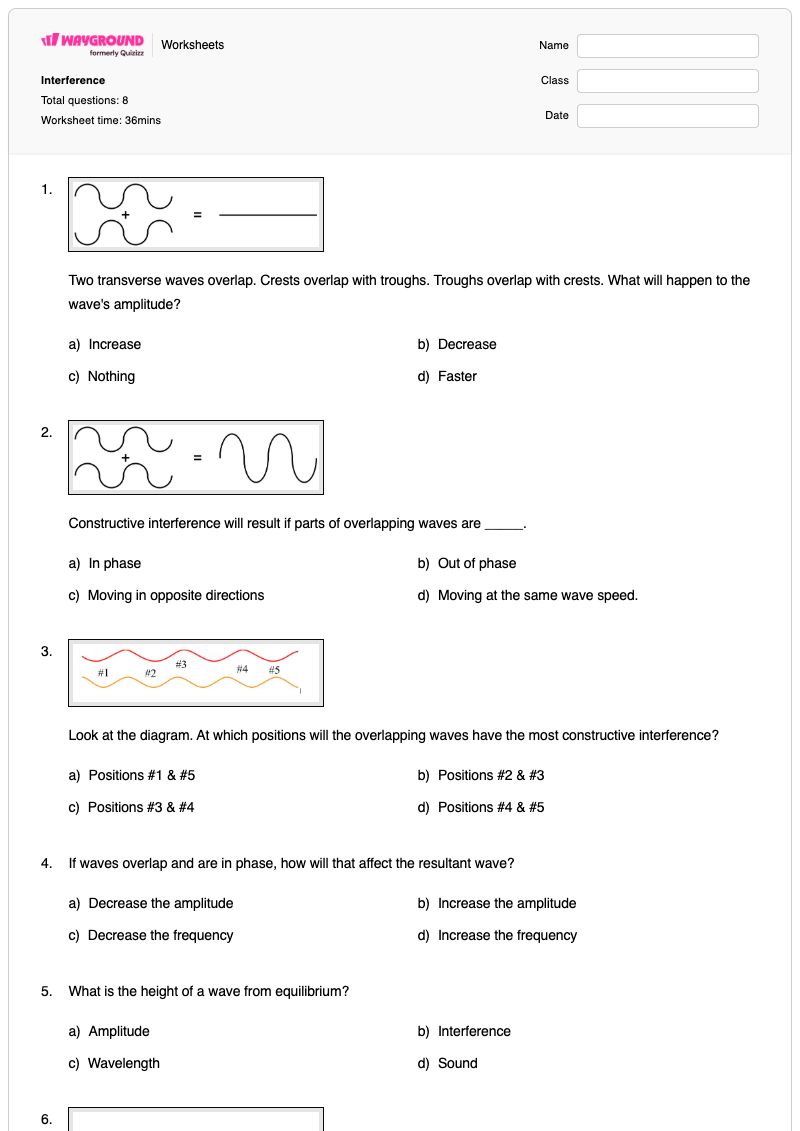
Two transverse waves overlap. Crests overlap with troughs. Troughs overlap with crests. What will happen to the wave's amplitude?
a)
Increase
b)
Decrease
c)
Nothing
d)
Faster
2.
Constructive interference will result if parts of overlapping waves are _____.
a)
In phase
b)
Out of phase
c)
Moving in opposite directions
d)
Moving at the same wave speed.
3.
Look at the diagram. At which positions will the overlapping waves have the most constructive interference?
a)
Positions #1 & #5
b)
Positions #2 & #3
c)
Positions #3 & #4
d)
Positions #4 & #5
4.
If waves overlap and are in phase, how will that affect the resultant wave?
a)
Decrease the amplitude
b)
Increase the amplitude
c)
Decrease the frequency
d)
Increase the frequency
5.
What is the height of a wave from equilibrium?
a)
Amplitude
b)
Interference
c)
Wavelength
d)
Sound
6.
What will be the result after these two waves overlap?
a)
A taller wave
b)
A shorter wave
c)
A wave with no amplitude
d)
3 waves
7.
What types of waves exhibit interference?
a)
Radio Waves
b)
Water Waves
c)
Slinky Waves
d)
All of the above
8.
Which of the following does not describe two waves "in phase"
a)
Waves that overlap with crest on trough and trough on crest
b)
Waves that overlap with trough on trough and crest on crest
c)
Waves that completely overlap
d)
Waves that constructively interfere with eachother
Answer Key
Interference
Total questions: 8
1.
b)
Decrease
2.
a) In phase
3.
b)
Positions #2 & #3
4.
b)
Increase the amplitude
5.
a)
Amplitude
6.
c)
A wave with no amplitude
7.
d)
All of the above
8.
a)
Waves that overlap with crest on trough and trough on crest
140 %
Browse by subjects
Browse by grades
Browse by format
FAQs
What does this worksheet cover about wave interference?
This Grade 9 physics worksheet uses eight multiple-choice questions to assess how overlapping waves interact. Students identify constructive and destructive interference, determine how in-phase and out-of-phase waves affect amplitude, interpret a diagram showing interference positions, and distinguish amplitude from frequency and wavelength.
How can I use this worksheet to teach constructive and destructive interference?
Introduce the worksheet by reviewing what happens when crests meet crests and when crests meet troughs. As students answer the multiple-choice items, ask them to explain why in-phase waves produce a taller resultant wave and why complete cancellation can produce a wave with no amplitude. Use the diagram question to connect these ideas to specific positions along overlapping waves.
What mistakes should I watch for when students complete this interference worksheet?
Students may confuse amplitude with frequency or wavelength when identifying the height of a wave from equilibrium. They may also reverse the effects of in-phase and out-of-phase waves, treating crest-on-trough overlap as constructive interference instead of cancellation. In the diagram item, check that students compare the overlapping wave positions rather than choosing based on the height of only one wave.
How do I assign and grade this wave interference worksheet?
You can assign the interference worksheet as a printable PDF or as a digital quiz on Wayground. It includes a complete answer key for all eight multiple-choice questions, and printable submissions can be graded by scanning student work with the Wayground for Teachers app. The printable format also gives schools an option for reducing screen time.
How can I differentiate this wave interference worksheet for my students?
Use the worksheet’s Advanced Settings to adjust font spacing or increase the font size so the multiple-choice options and interference diagram are easier to read. You can also apply a dyslexia-friendly font or translate the worksheet into another language when that supports access to the wave-interference vocabulary.
Where can I find more worksheets like this on Wayground?
Wayground offers a comprehensive collection of free printable worksheets and practice problems across subjects, with downloadable PDFs and answer keys to support essential skills and concepts. Browse more resources at https://wayground.com/en-us/worksheets.


 Worksheets


