
WorksheetsWaves
Total questions: 20
Answer Key
Created by Anquinette Jones
20 questions
8th - 10th Grade
Science
Updated Sept 2026
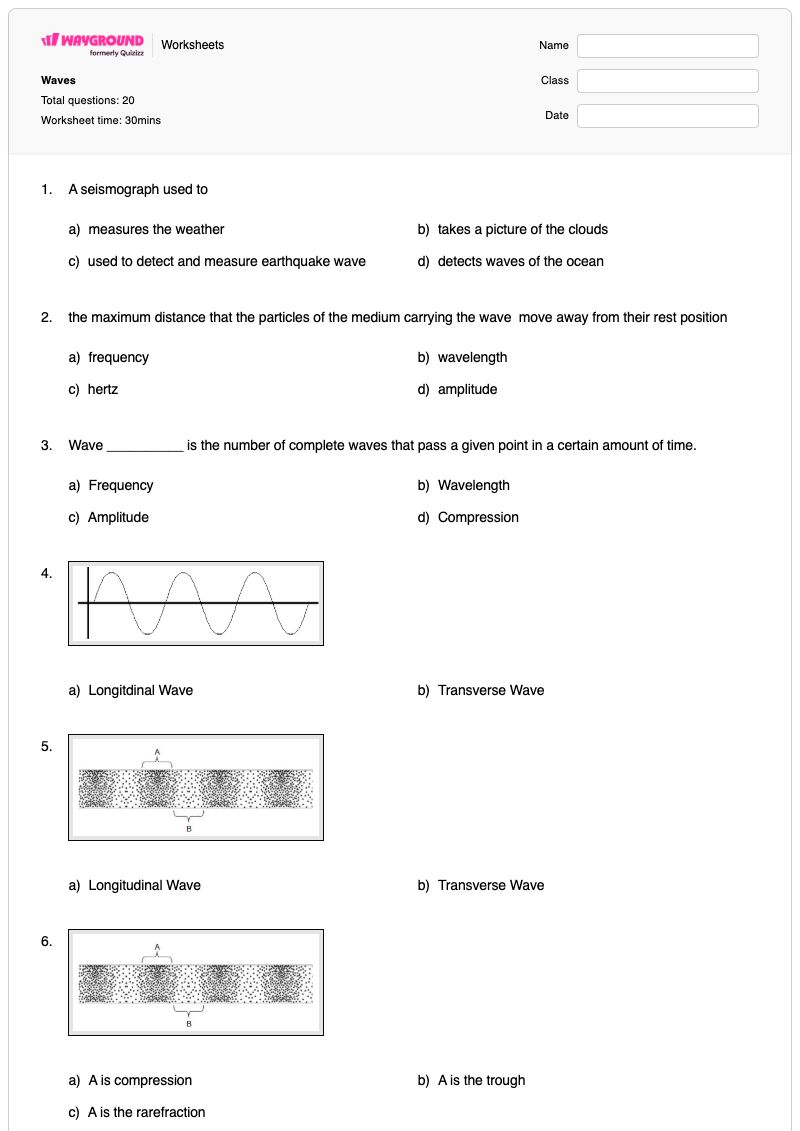
Waves is a free printable physics worksheet for Grades 8–10 that builds foundational understanding of wave motion through 20 multiple-choice questions. Students identify waves as disturbances that transfer energy, distinguish transverse and longitudinal waves, and recognize the role of a medium. They also interpret amplitude, frequency, and wavelength, including calculating frequency with the relationship speed = wavelength × frequency. The worksheet extends practice to real-world and applied concepts, including how seismographs detect earthquake waves, the law of reflection, total internal reflection, diffraction, and the law of conservation of energy. Its selected-response format helps teachers quickly check whether students can connect definitions, wave behavior, measurements, and basic calculations. Use it for physics review, independent practice, or a formative assessment after instruction. A complete answer key is included with the free printable worksheet.
Worksheet settings
Font size
Worksheets
Answer KeyThis Grade 8–10 physics worksheet uses 20 multiple-choice questions to assess wave motion, including the meaning of a wave and medium, transverse versus longitudinal waves, amplitude, frequency, and wavelength. Students also apply speed = wavelength × frequency to find frequency and identify applications and principles such as seismographs, reflection, total internal reflection, diffraction, and conservation of energy.
Introduce the worksheet by reviewing a labeled wave diagram and having students connect crest-to-crest distance with wavelength, maximum displacement with amplitude, and cycles per second with frequency. Before students complete the multiple-choice items, model the wave-speed calculation using the provided units, then discuss why a seismograph, reflection, diffraction, and different wave types represent applications of wave behavior. Use students’ selected answers as prompts for brief explanations rather than asking them to guess from definitions alone.
Students may confuse amplitude with wavelength, especially because both describe measurable features of a wave; remind them that amplitude is displacement from rest, while wavelength is the distance between matching points such as crest to crest. They may also reverse transverse and longitudinal motion, confuse frequency with wavelength, or select an incorrect unit when using speed = wavelength × frequency. Check that students distinguish the law of reflection from conservation of energy and understand that a seismograph detects and measures earthquake waves.
You can assign Waves as a printable PDF or as a digital quiz on Wayground. The worksheet includes a complete answer key for checking the 20 multiple-choice responses, and printable submissions can be graded by scanning student work with the Wayground for Teachers app. The PDF option also supports classrooms that want to reduce screen time.
Use the worksheet’s Advanced Settings to adjust font spacing or choose a larger font size so the wave definitions, formulas, and multiple-choice options are easier to follow. You can also apply a dyslexia-friendly font or translate the worksheet into another language when students need support reading the terminology and calculation prompt. These adjustments preserve the worksheet’s focus on wave properties, classifications, and applications.
Wayground offers a broad collection of free printable worksheets and practice problems across subjects, with downloadable PDFs and answer keys to help students master essential skills and concepts. Browse more resources at https://wayground.com/en-us/worksheets.