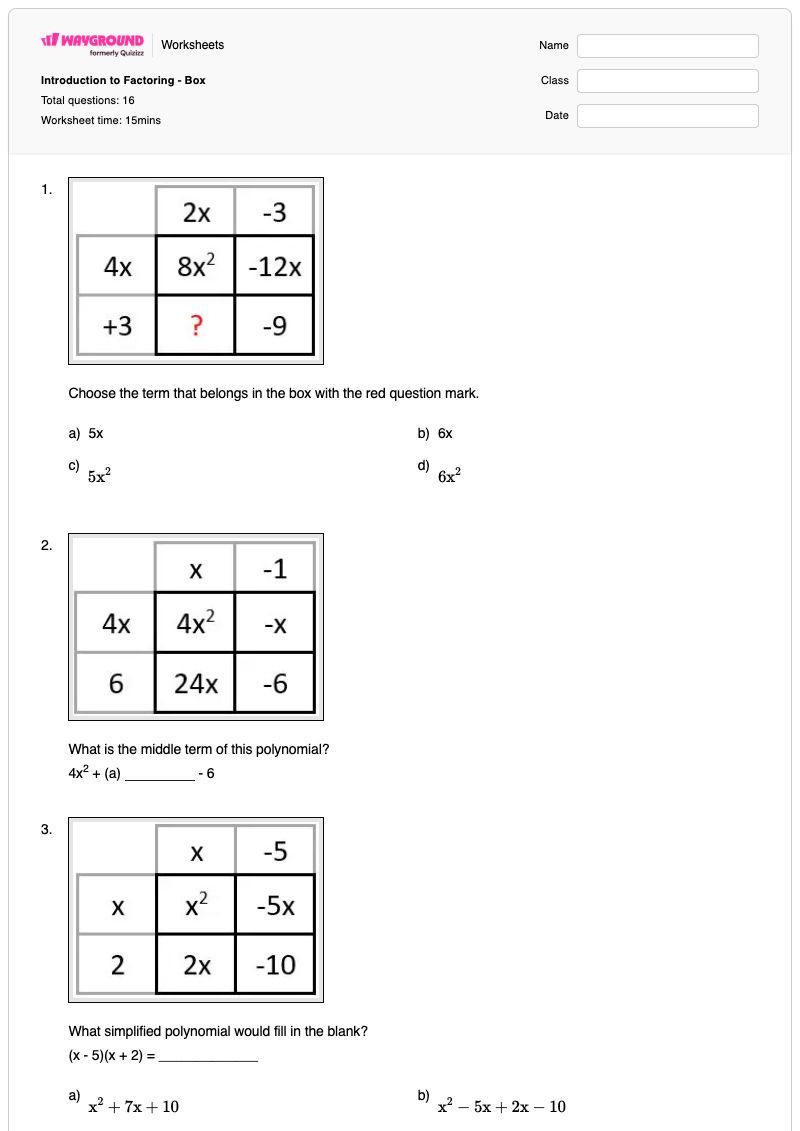
Introduction to Factoring - Box is a Grade 9–12 mathematics worksheet that builds foundational factoring skills through box-method and polynomial practice. Students identify missing terms in factoring boxes, determine middle terms, expand a binomial product into simplified polynomial form, and select factored forms that multiply to given expressions. The worksheet also reinforces integer sign rules and asks students to find number pairs with specified products and sums.
Its mixed format includes multiple-choice, fill-in-the-blank, and multiple-select questions, giving students practice both recognizing correct factor pairs and producing missing terms independently. The exercises move from completing individual box entries to factoring polynomials with linear and non-unit coefficients, while requiring careful attention to positive and negative values. This free printable worksheet is designed for secondary mathematics instruction, independent practice, review, or a quick skills check, and includes a complete answer key for efficient feedback.
Worksheet settings
Font size
S
M
L
XL
Worksheets
Introduction to Factoring - Box
Total questions: 16
Name
Class
Date
1.
Choose the term that belongs in the box with the red question mark.
a)
5x
b)
6x
c)
5x2
d)
6x2
2.
What is the middle term of this polynomial?
4x2 + (a) - 6
3.
What simplified polynomial would fill in the blank?
(x - 5)(x + 2) = _____________
a)
x2+7x+10
b)
x2−5x+2x−10
c)
x2−3x−10
d)
x2+3x−10
4.
Type the term that goes in the box with the red question mark.
(a)
5.
What term goes in the box with the red question mark?
(a)
6.
What term goes in the box with the red question mark to factor without decimal values.
(a)
7.
What polynomials multiply to get this box?
(What is the factored form)?
a)
(x + 5)(x - 6)
b)
(x - 5)(x + 6)
c)
(x - 2)(x - 3)
d)
(x + 5)(x + 6)
8.
What polynomials multiply to get this box?
(What is the factored form)?
a)
(x + 2)(x + 2)
b)
(x + 2)(x + 3)
c)
(3x + 2)(x + 2)
d)
(3x - 1)(x + 2)
9.
What polynomials multiply to get this box?
(What is the factored form)?
a)
(3x + 2)(2x + 3)
b)
(6x + 3)(x - 2)
c)
(3x + 2)(2x - 3)
d)
(3x - 2)(2x + 3)
10.
-30 + 10 will equal what kind of number
a)
Positve
b)
Negative
11.
12 + -11 will equal what kind of number
a)
Positve
b)
Negative
12.
What will NOT result in a positive solution. Mulitple correct answers.
a)
negative * negative
b)
positive * negative
c)
positive * postive
d)
negative * positive
13.
Two numbers that multiply to -18 and add to -7 are: (a)
Separate your numbers with a comma and don't use a space!
14.
Two numbers that multiply to 8 and add to -9 are: (a)
Separate your numbers with a comma and don't use a space!
15.
Two numbers that multiply to 42 and add to 17 are: (a)
Separate your numbers with a comma and don't use a space!
16.
Two numbers that multiply to -54 and add to 3 are: (a)
Separate your numbers with a comma and don't use a space!
Answer Key
Introduction to Factoring - Box
Total questions: 16
1.
b)
6x
2.
23x
3.
c)
x2−3x−10
4.
-1
5.
2x
6.
4x
7.
a)
(x + 5)(x - 6)
8.
c)
(3x + 2)(x + 2)
9.
d)
(3x - 2)(2x + 3)
10.
b)
Negative
11.
a)
Positve
12.
b)
positive * negative
, d)
negative * positive
13.
-9,2, 2,-9
14.
-1,-8, -8,-1
15.
14,3, 3,14
16.
9,-6, -6,9
140 %
Browse by subjects
Browse by grades
Browse by format
FAQs
What does this factoring worksheet help students practice?
This worksheet teaches students to factor polynomials with the box method by finding missing box terms, identifying middle terms, and selecting binomial factors that reproduce a given polynomial. It also connects factoring to integer sign rules and to finding two numbers with a required product and sum, including examples with non-unit leading coefficients.
How can I use this worksheet to teach factoring with the box method?
Introduce the box as a way to organize the terms produced when two binomials are multiplied, then model how the known product and sum guide the missing entries. Have students explain why each candidate factor pair works by multiplying it back out, and use the sign questions before the final number-pair items to reinforce how positive and negative factors affect the result.
What mistakes should I watch for when students complete this factoring worksheet?
Watch for students choosing factor pairs based only on the product while ignoring the required sum, especially in the items asking for two numbers. Students may also reverse a sign, confuse a positive product with a positive sum, or select factors without checking their multiplication against the original polynomial. In the box items, check that they place the correct missing term and combine like terms accurately when identifying the middle term.
How do I assign and grade this factoring worksheet?
Wayground provides this factoring worksheet as both a printable PDF and a digital quiz, with a complete answer key for checking the multiple-choice, fill-in-the-blank, and multiple-select responses. For printable submissions, you can scan student work with the Wayground for Teachers app to help grade responses efficiently. The printable format can also support schools that are reducing screen time.
How can I differentiate this factoring worksheet for my students?
In the worksheet’s Advanced Settings, adjust font spacing or choose a larger font size to make the factoring boxes, polynomial expressions, and answer choices easier to read. You can also enable a dyslexia-friendly font or translate the worksheet into another language when those options support access to the mixed-format factoring practice.
Where can I find more worksheets like this on Wayground?
Wayground offers a comprehensive collection of free printable worksheets and practice problems across subjects, with downloadable PDFs and answer keys to help students master essential skills and concepts. Browse more resources at https://wayground.com/en-us/worksheets.


 Worksheets


