
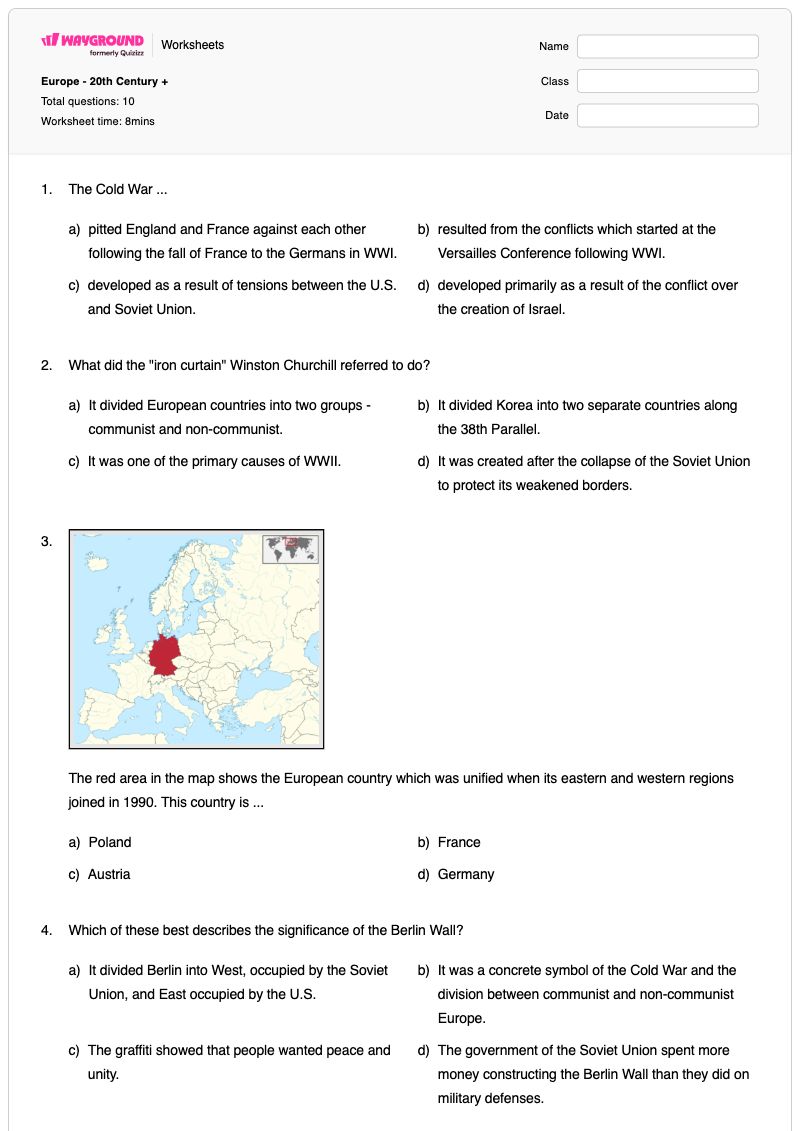

Europe - 20th Century + is a Grade 6 social studies worksheet that reviews major political developments in modern European history. Students answer nine multiple-choice questions and one multiple-select question about the origins of the Cold War, the Iron Curtain, the Berlin Wall, Germany’s reunification, the Treaty of Versailles, Nazi anti-Semitism, postwar Soviet influence in Eastern Europe, and the creation of the European Union. Map-based questions ask students to identify Germany and recognize the Iron Curtain.
The questions build students’ ability to connect historical events with their political causes, geographic divisions, and lasting significance. The multiple-select item also checks whether students can distinguish the United States and Soviet Union as the principal Cold War rivals. Designed for Grade 6 social studies review, independent practice, homework, or a formative assessment, this free printable worksheet includes a complete answer key for efficient checking.
Worksheet settings
Font size
S
M
L
XL
Worksheets
Europe - 20th Century +
Total questions: 10
Name
Class
Date
1.
The Cold War ...
a)
pitted England and France against each other following the fall of France to the Germans in WWI.
b)
resulted from the conflicts which started at the Versailles Conference following WWI.
c)
developed as a result of tensions between the U.S. and Soviet Union.
d)
developed primarily as a result of the conflict over the creation of Israel.
2.
What did the "iron curtain" Winston Churchill referred to do?
a)
It divided European countries into two groups - communist and non-communist.
b)
It divided Korea into two separate countries along the 38th Parallel.
c)
It was one of the primary causes of WWII.
d)
It was created after the collapse of the Soviet Union to protect its weakened borders.
3.
The red area in the map shows the European country which was unified when its eastern and western regions joined in 1990. This country is ...
a)
Poland
b)
France
c)
Austria
d)
Germany
4.
Which of these best describes the significance of the Berlin Wall?
a)
It divided Berlin into West, occupied by the Soviet Union, and East occupied by the U.S.
b)
It was a concrete symbol of the Cold War and the division between communist and non-communist Europe.
c)
The graffiti showed that people wanted peace and unity.
d)
The government of the Soviet Union spent more money constructing the Berlin Wall than they did on military defenses.
5.
Which of the following would be the best title for this map?
a)
World War I
b)
World War II
c)
NATO Countries
d)
The Iron Curtain
6.
Which of the following were the main countries facing conflict during the Cold War? (Select all that apply).
a)
Germany
b)
The United States
c)
Korea
d)
The Soviet Union
7.
What beliefs did the Nazis base propaganda which led to the Holocaust?
a)
anti-capitalist
b)
anti-semitism
c)
anti-communist
8.
What was a result of the harsh conditions imposed by the Treaty of Versailles after World War I?
a)
economic and political instability in Germany
b)
uprisings during the French Revolution
c)
the development of democracy in Italy
d)
the Bolshevik Revolution in Russia
9.
Following WWII many European countries associated with the Soviet Union. Why?
a)
Eastern European countries were forced to adopt communism
b)
Soviet Union invited Eastern European countries to join.
c)
They spoke the same language
d)
They were rejected by the European Union
10.
Recently many European nations have been working to cooperate by...
a)
Ignoring the United States
b)
Creating the European Union
c)
Decrease stockpiles of weapons
d)
Controlling immigration to the region
Answer Key
Europe - 20th Century +
Total questions: 10
1.
c)
developed as a result of tensions between the U.S. and Soviet Union.
2.
a)
It divided European countries into two groups - communist and non-communist.
3.
d)
Germany
4.
b)
It was a concrete symbol of the Cold War and the division between communist and non-communist Europe.
5.
d)
The Iron Curtain
6.
b)
The United States
, d)
The Soviet Union
7.
b)
anti-semitism
8.
a) economic and political instability in Germany
9.
a) Eastern European countries were forced to adopt communism
10.
b) Creating the European Union
140 %
Browse by subjects
Browse by grades
Browse by format
FAQs
What does the Europe - 20th Century + worksheet cover?
This Grade 6 worksheet uses nine multiple-choice questions and one multiple-select question to assess students’ understanding of major 20th-century European developments. Students identify the U.S.–Soviet tensions behind the Cold War, interpret the Iron Curtain and Berlin Wall, connect the Treaty of Versailles with instability in Germany, and recognize postwar European cooperation through the European Union.
How can I use this worksheet to teach 20th-century European history?
Introduce the worksheet by building a simple cause-and-effect sequence from World War I and the Treaty of Versailles through World War II, the Cold War, German reunification, and the European Union. Have students justify answers to the Iron Curtain, Berlin Wall, and map questions by explaining how each reflects the division or later cooperation of Europe. Use the multiple-select question as a discussion prompt about why the United States and Soviet Union were the main Cold War rivals.
What mistakes should I watch for when students complete this worksheet?
Students may confuse the Cold War with a direct military conflict between European countries, or mistake the Iron Curtain for a physical barrier such as the Berlin Wall rather than a division between communist and non-communist Europe. They may also select Germany, Korea, or both as the main Cold War powers instead of identifying the United States and Soviet Union, and confuse Germany’s 1990 reunification with another European country.
How do I assign and grade this Europe - 20th Century + worksheet?
Wayground provides this worksheet as a printable PDF and as a digital quiz, with a complete answer key for all nine multiple-choice items and the multiple-select item. After students complete the printable version, you can grade their work by scanning it with the Wayground for Teachers app.
How can I differentiate this worksheet for my students?
Because this worksheet includes text-heavy multiple-choice questions, map-based items, and a multiple-select question, you can adjust font spacing and font size to improve readability. Under Advanced Settings, you can also apply a dyslexia-friendly font or translate the worksheet into another language when appropriate.
Where can I find more worksheets like this on Wayground?
Wayground offers a broad collection of free printable worksheets and practice problems across subjects, with downloadable PDFs and answer keys to support essential skills and concepts. Browse more resources at https://wayground.com/en-us/worksheets.