

Wayground
Punnett Squares - Printable Science Worksheets class 6 - Wayground

Punnett Squares

15 questions

6th - 6th Grade

Science

This Grade 6 science worksheet gives students 15 multiple-choice questions on using Punnett squares to predict inheritance outcomes. Students identify missing allele combinations, distinguish homozygous from heterozygous and purebred genotypes, connect dominant and recessive alleles to phenotypes, and calculate probabilities such as 25%, 50%, and 75% for offspring traits. The questions use examples involving plant height, fur color, flower color, hair color, and eye color so students apply the same reasoning across different traits. Completing the worksheet helps learners read allele notation, complete Punnett square entries, and interpret genotype and phenotype results rather than simply memorizing definitions. It is a free printable worksheet for Grade 6 science and includes a complete answer key for efficient review, independent practice, or formative assessment.

Worksheet settings

Font size

S
M
L
XL
Worksheets

Punnett Squares

Total questions: 15

Name
Class
Date
1.
T - tall and t = short
In the punnett square below, what belongs in the missing square
a)
tt
b)
Tt
c)
Bb
d)
TT
2.
B = brown fur  b = white fur
In the punnett square, what is the probability for white fur? 
a)
0%
b)
25%
c)
50%
d)
75%
3.
In plants, tall (T) is dominant to short (t). Perform the following cross: Tt x Tt. What is the probability of producing a short plant?
a)
0%
b)
25%
c)
50%
d)
75%
4.
What is the probability of heterozygous offspring?
a)
25%
b)
50%
c)
0%
d)
100%
5.
What allele combination should go in the missing box?
a)
AA
b)
Aa
c)
aa
d)
none of these
6.
In a flowering plant species, red flower color (R) is dominant over white flower color (r). What is the genotype of any red-flowering plant resulting from this species?
a)
rr
b)
R
c)
RR
d)
RR or Rr
7.
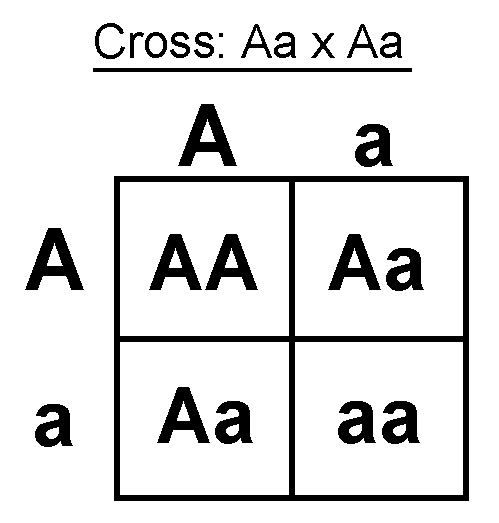
What is the phenotype of the offspring? (A-Brown hair; a-blond hair) 
a)
50 % Brown Hair and 50% Blond Hair 
b)
25 % Brown Hair and 75% Blond Hair 
c)
75 % Brown Hair and 25% Blond Hair 
d)
0% Brown Hair and 100% Blond Hair 
8.

If a heterozygous parent and a homozygous recessive parent mate, what percentage of their offspring will be dominant?

a)

25%

b)

50%

c)

75%

d)

100%

9.
Two brown eyed parents (Bb) have a baby. What is the chance the baby is blue eyed?
a)
0 %
b)
25%
c)
50%
d)
75%
10.

In a heterozygous genotype, the ___________ allele takes over in the phenotype.

a)

recessive

b)

dominant

c)

both

11.

T - tall and t = short

In the Punnett square, what belongs in the missing square?

a)

tt

b)

Tt

c)

TT

12.

G = green, g = yellow

The genotype for a yellow plant is...

a)

GG

b)

Gg

c)

gg

d)

all of the choices result in yellow

13.

Which of the following alleles is purebred recessive?

a)

Tt

b)

tt

c)

TT

14.

Each one of the boxes on the Punnett square represents what probability of an offspring's genotype?

a)

25%

b)

1%

c)

10%

d)

0%

15.

Which of the following genotypes is homozygous dominant?

a)

aa

b)

Aa

c)

AA

Answer Key

Punnett Squares

Total questions: 15

1.
a) tt
2.
c) 50%
3.
b) 25%
4.
b) 50%
5.
b) Aa
6.
d) RR or Rr
7.
c) 75 % Brown Hair and 25% Blond Hair 
8.
b)

50%

9.
b) 25%
10.
b)

dominant

11.
a)

tt

12.
c)

gg

13.
b)

tt

14.
a)

25%

15.
c)

AA

FAQs

What does this Punnett Squares worksheet help Grade 6 students learn?

This worksheet builds skill in completing missing Punnett square entries and using allele notation to determine genotype and phenotype probabilities. Its 15 multiple-choice questions ask students to identify homozygous and heterozygous combinations, recognize dominant and recessive alleles, and calculate outcomes such as 25%, 50%, and 75%.

How can I use this worksheet to teach Punnett squares?

Introduce the symbols and trait definitions first, then model one cross by placing each parent allele along the Punnett square edges and filling the boxes. Use the worksheet’s missing-square items to check whether students can form genotypes before moving to probability questions, and ask them to explain how a genotype such as Tt relates to a dominant phenotype.

What mistakes should I watch for when students complete this Punnett Squares worksheet?

Students may confuse genotype symbols with phenotype descriptions, such as selecting a trait color instead of the allele combination that produces it. Watch for errors in labeling homozygous versus heterozygous pairs, treating a dominant trait as always homozygous, or choosing 50% instead of 25% when one of four Punnett square boxes shows the outcome.

How do I assign and grade this Punnett Squares worksheet?

You can assign this worksheet as a printable PDF or as a digital quiz on Wayground. The complete answer key supports quick grading of all 15 multiple-choice questions, and printable student work can be graded by scanning it with the Wayground for Teachers app.

How can I differentiate this Punnett Squares worksheet for my students?

In the worksheet’s Advanced Settings, adjust font spacing or choose a larger font size to make the allele combinations, probability choices, and Punnett square questions easier to read. You can also apply a dyslexia-friendly font or translate the worksheet into another language while keeping its multiple-choice format.

Where can I find more worksheets like this on Wayground?

Wayground offers a comprehensive collection of free printable worksheets and practice problems across all subjects, with downloadable PDFs and answer keys to support essential skill development. Browse more resources at https://wayground.com/en-us/worksheets.