

Wayground
Reading Comprehension Strategies - Printable ELA Worksheets class 4 - Wayground

Reading Comprehension Strategies

Jo Ann Jones

Created by Jo Ann Jones

18 questions

4th Grade

ELA

Updated Sept 2026

This Grade 4 English worksheet builds students’ understanding of core reading comprehension strategies and literary terms through 18 multiple-choice questions. Students identify the meanings and purposes of compare and contrast, inferencing, summarizing, paraphrasing, making connections, main idea, predicting, theme, context clues, point of view, visualizing, supporting details, retelling, sequence, and fact versus opinion. The question set helps students distinguish closely related concepts, such as main idea and theme, summarizing and paraphrasing, or predicting and inferencing. It works well for introducing this vocabulary, reviewing reading strategies, or checking whether students can recognize each term’s defining feature. This free printable worksheet is designed for Grade 4 learners and includes a complete answer key for efficient review and assessment.

Worksheet settings

Font size

S
M
L
XL
WaygroundWorksheets

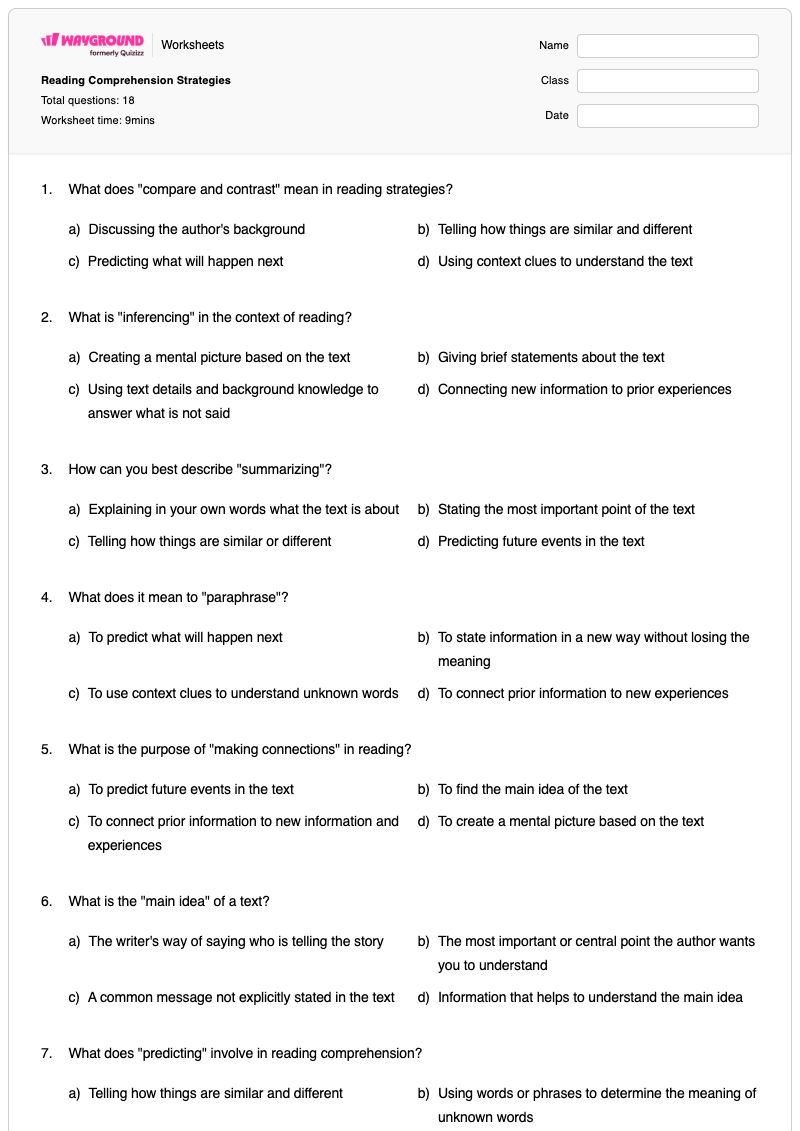
Reading Comprehension Strategies

Total questions: 18

Name
Class
Date
1.

What does "compare and contrast" mean in reading strategies?

a)

Discussing the author's background

b)

Telling how things are similar and different

c)

Predicting what will happen next

d)

Using context clues to understand the text

2.

What is "inferencing" in the context of reading?

a)

Creating a mental picture based on the text

b)

Giving brief statements about the text

c)

Using text details and background knowledge to answer what is not said

d)

Connecting new information to prior experiences

3.

How can you best describe "summarizing"?

a)

Explaining in your own words what the text is about

b)

Stating the most important point of the text

c)

Telling how things are similar or different

d)

Predicting future events in the text

4.

What does it mean to "paraphrase"?

a)

To predict what will happen next

b)

To state information in a new way without losing the meaning

c)

To use context clues to understand unknown words

d)

To connect prior information to new experiences

5.

What is the purpose of "making connections" in reading?

a)

To predict future events in the text

b)

To find the main idea of the text

c)

To connect prior information to new information and experiences

d)

To create a mental picture based on the text

6.

What is the "main idea" of a text?

a)

The writer's way of saying who is telling the story

b)

The most important or central point the author wants you to understand

c)

A common message not explicitly stated in the text

d)

Information that helps to understand the main idea

7.

What does "predicting" involve in reading comprehension?

a)

Telling how things are similar and different

b)

Using words or phrases to determine the meaning of unknown words

c)

Telling what is going to happen next or in the future

d)

Creating a mental picture or image in your mind

8.

What is a "theme" in literature?

a)

The most important or central point of the text

b)

A common message, not explicitly stated in the text

c)

The writer's way of saying who is telling the story

d)

Information that helps to understand the main idea

9.

How are "context clues" used in reading?

a)

To predict what will happen next

b)

To summarize the text in your own words

c)

To determine the meaning of unknown words

d)

To connect new information to prior experiences

10.

What does "point of view" refer to in a story?

a)

The central message of the story

b)

The writer's way of saying who is telling the story to whom

c)

The background knowledge used to understand the story

d)

The mental picture created by the story

11.

What is "visualize" in the context of reading?

a)

To use context clues to understand the text

b)

To create a mental picture or image in your mind based on the words we read or hear

c)

To connect prior information to new information

d)

To state information in a new way

12.

What are "supporting/key details" in a text?

a)

The writer's way of saying who is telling the story

b)

The most important or central point of the text

c)

Information that helps to understand the main idea

d)

A common message not explicitly stated in the text

13.

What does "retelling" involve in storytelling?

a)

Presenting facts and figures

b)

Listing steps or events in order

c)

Describing a problem and its solution

d)

Telling or writing what happened in a story using a beginning, middle, and ending

14.

What is a "sequence"?

a)

A cause and its effects

b)

Steps or events in order

c)

A fact that can be proven to be true

d)

The reason an author writes a story

15.

What distinguishes a "fact" from an "opinion"?

a)

A fact is what you think, feel, or believe

b)

An opinion is a statement that can be proven to be true

c)

A fact is a statement that can be proven to be true

d)

An opinion is why something happens

16.

What is "cause and effect"?

a)

When the author describes a problem and explains how it is solved

b)

The reason an author writes a story

c)

A cause is why something happens, and an effect is what happens

d)

Listing steps or events in order

17.

What is "problem and solution" in literature?

a)

Telling or writing what happened in a story

b)

Listing steps or events in order

c)

When the author describes a problem and explains how the problem is solved

d)

A fact that can be proven to be true

18.

What is the "author's purpose"?

a)

A statement that can be proven to be true

b)

Why something happens and what happens as a result

c)

The reason an author writes a story: to describe, explain/inform, entertain, or to persuade

d)

Listing steps or events in order

WaygroundAnswer Key

Reading Comprehension Strategies

Total questions: 18

1.
b)

Telling how things are similar and different

2.
c)

Using text details and background knowledge to answer what is not said

3.
a)

Explaining in your own words what the text is about

4.
b)

To state information in a new way without losing the meaning

5.
c)

To connect prior information to new information and experiences

6.
b)

The most important or central point the author wants you to understand

7.
c)

Telling what is going to happen next or in the future

8.
b)

A common message, not explicitly stated in the text

9.
c)

To determine the meaning of unknown words

10.
b)

The writer's way of saying who is telling the story to whom

11.
b)

To create a mental picture or image in your mind based on the words we read or hear

12.
c)

Information that helps to understand the main idea

13.
d)

Telling or writing what happened in a story using a beginning, middle, and ending

14.
b)

Steps or events in order

15.
c)

A fact is a statement that can be proven to be true

16.
c)

A cause is why something happens, and an effect is what happens

17.
c)

When the author describes a problem and explains how the problem is solved

18.
c)

The reason an author writes a story: to describe, explain/inform, entertain, or to persuade

FAQs

What does the Reading Comprehension Strategies worksheet cover?

This Grade 4 worksheet uses 18 multiple-choice questions to check students’ understanding of specific reading strategies and literary terms, including inferencing, summarizing, paraphrasing, main idea, theme, context clues, point of view, sequence, and fact versus opinion. Choosing among closely related definitions helps students distinguish what each strategy means and when it supports understanding of a text.

How can I use this worksheet to teach reading comprehension strategies?

Introduce the terms in small groups, such as meaning-making strategies, text-structure skills, and literary concepts, then model one distinction at a time—for example, how an inference combines text details with background knowledge while visualization creates a mental picture. Have students explain why an answer fits each multiple-choice definition, and use incorrect choices to discuss differences between related terms such as main idea and theme.

What mistakes should I watch for when students complete this worksheet?

Students may confuse inferencing with predicting, summarizing with paraphrasing, or main idea with theme because the terms are related but not interchangeable. They may also select context clues for any question about understanding text, overlook that supporting details help explain the main idea, or mix up a sequence of events with a retelling that includes a beginning, middle, and ending.

How do I assign and grade this worksheet?

The Reading Comprehension Strategies worksheet is available as a printable PDF and as a digital quiz on Wayground, and it includes a complete answer key. You can grade digital responses automatically, or scan students’ completed printable work with the Wayground for Teachers app.

How can I differentiate the Reading Comprehension Strategies worksheet for my students?

Use the worksheet’s Advanced Settings to adjust font spacing or increase the font size so the 18 multiple-choice items are easier to read. You can also select a dyslexia-friendly font or translate the worksheet into another language while keeping the reading-strategy definitions and answer choices accessible.

Where can I find more worksheets like this on Wayground?

Wayground offers a comprehensive collection of free printable worksheets and practice problems across all subjects, with downloadable PDFs and answer keys to help students master essential skills and concepts. Browse more resources at https://wayground.com/en-us/worksheets.