

Measurement Conversion - Metric is a free printable Grade 4 mathematics worksheet that builds fluency with metric units and conversions. Students select appropriate units for real-world masses, convert kilograms to grams, grams to milligrams, meters to centimeters or millimeters, liters to milliliters, and apply kilo-, centi-, and milli- relationships. The worksheet also includes a dollar-to-cents connection, an invented-unit application, and a table-based error-analysis item.
The 22-question set contains 21 multiple-choice questions and one multiple-select question, giving students repeated practice choosing units, identifying equivalent measurements, and checking conversion factors. Contexts such as a can of soda, a dumpster, a dog’s length, and chocolate bars make the relationships concrete while keeping the focus on multiplying by powers of ten. A complete answer key is included for efficient checking and review.
Worksheet settings
Font size
S
M
L
XL
Worksheets
Measurement Conversion - Metric
Total questions: 22
Name
Class
Date
1.
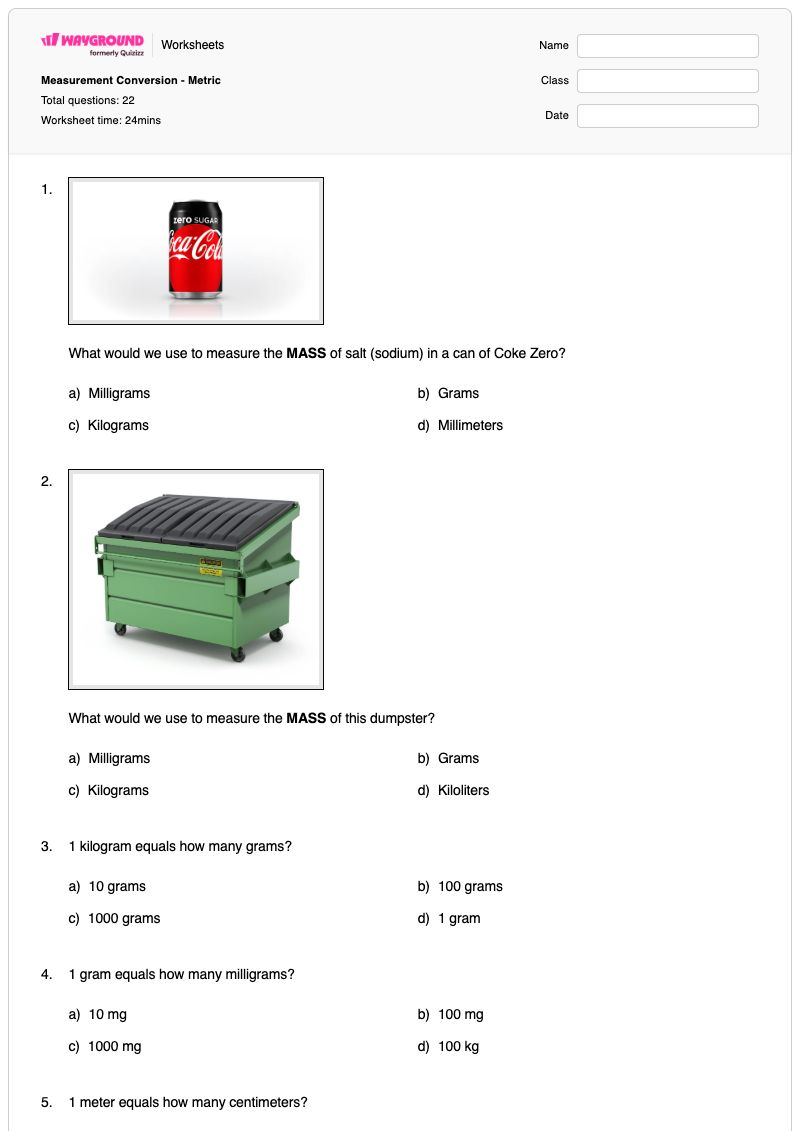
What would we use to measure the MASS of salt (sodium) in a can of Coke Zero?
a)
Milligrams
b)
Grams
c)
Kilograms
d)
Millimeters
2.
What would we use to measure the MASS of this dumpster?
a)
Milligrams
b)
Grams
c)
Kilograms
d)
Kiloliters
3.
1 kilogram equals how many grams?
a)
10 grams
b)
100 grams
c)
1000 grams
d)
1 gram
4.
1 gram equals how many milligrams?
a)
10 mg
b)
100 mg
c)
1000 mg
d)
100 kg
5.
1 meter equals how many centimeters?
a)
10 cm
b)
100 cm
c)
1000 cm
d)
100 mm
6.
1 meter equals how many millimeters?
a)
10 mm
b)
100 cm
c)
1000 mm
d)
100 mm
7.
1 dollar equals how many CENTS?
a)
10 cents
b)
100 cents
c)
1000 cents
d)
No sense.
8.
Mr. Polkowski uses the metric system to make a new scale to measure how happy each class rotation is. The base unit is called haps. What will equal 1000 haps?
a)
1 kilohap
b)
1 millihap
c)
300 millihaps
d)
1000 kilohaps
9.
Mr. Polkowski's favorite chocolate brand is Cadbury. He decides to use the metric system to devise a new way of measure Cadbury chocolate bars. Each large bar is called a cad. 1000 cads equals 1 kilocad. What if Mr. Polkowski breaks up a cad into 100 pieces?
a)
He will get 100 millicads
b)
He will get 100 centicads
c)
He will get 100 cads
10.
Ms. Griffo's dog Sadie is 55 cm long, so she is how many millimeters long?
a)
550 mm
b)
5500 mm
c)
5.5 mm
d)
110 mm
11.
2 liters equals:
a)
2000 mL
b)
200 mL
c)
1 kiloliter
d)
500 mL
12.
55 kilograms equals
a)
550,000 grams
b)
5,500 grams
c)
55,000 grams
d)
5,500 milligrams
13.
What is another word for this chart?
a)
Table
b)
Calends
c)
Centicads
d)
Listadoo
14.
What mistake did Mr. Polkowski make when filling out this table?
a)
He forgot to multiply each Liter x 200
b)
He should have multiplied each Liter x 1000 instead of x 100
c)
He should have multiplied each Liter x 10 instead of x 100
d)
No mistake. He doesn't make mistakes. He's perfect.
15.
4 meters equals
a)
4000 cm
b)
400 cm
c)
1000 mm
d)
4 km
16.
Why didn't Brayan feel this gram on his back?
a)
Because Brayan wasn't paying attention
b)
Because 1 gram is very light
c)
Because Brayan is superhuman and immune to pain
d)
Because 1 gram is very heavy
17.
There are 12 inches in 1 foot, so how many inches are in 2 feet?
a)
18 inches
b)
120 inches
c)
24 inches
d)
36 inches
18.
8 dollars equals how many CENTS?
a)
8 cents
b)
80 cents
c)
800 cents
d)
8000 cents
19.
There are 3 feet in a yard, so how many feet in five yards?
a)
12 feet
b)
8 feet
c)
15 feet
d)
18 feet
20.
What are the three base units of the metric system?
a)
Milligrams, milliliters, millimeters
b)
Grams, liters, meters
c)
Centigrams, centiliters, centimeters
d)
Kilograms, kiloliters, kilometers
21.
There are 16 ounces in a pound, so 2 pounds is how many ounces?
a)
8 ounces
b)
14 ounces
c)
18 ounces
d)
32 ounces
22.
What would we use to measure the mass of this baby cutiecorn? Choose ALL correct answers.
a)
Grams
b)
Kilograms
c)
Milligrams
d)
Pounds and ounces
Answer Key
Measurement Conversion - Metric
Total questions: 22
1.
a)
Milligrams
2.
c)
Kilograms
3.
c)
1000 grams
4.
c)
1000 mg
5.
b)
100 cm
6.
c)
1000 mm
7.
b)
100 cents
8.
a)
1 kilohap
9.
b)
He will get 100 centicads
10.
a)
550 mm
11.
a)
2000 mL
12.
c)
55,000 grams
13.
a)
Table
14.
b)
He should have multiplied each Liter x 1000 instead of x 100
15.
b)
400 cm
16.
b)
Because 1 gram is very light
17.
c)
24 inches
18.
c)
800 cents
19.
c)
15 feet
20.
b)
Grams, liters, meters
21.
d)
32 ounces
22.
d)
Pounds and ounces
, b)
Kilograms
140 %
Browse by subjects
Browse by grades
Browse by format
FAQs
What does the Measurement Conversion - Metric worksheet cover?
This Grade 4 worksheet practices selecting appropriate metric units and converting among kilograms, grams, milligrams, meters, centimeters, millimeters, liters, and milliliters. Its 22 items use mostly multiple-choice questions, plus one multiple-select question, to check unit selection, powers-of-ten conversions, invented-unit prefixes, and a table-based conversion error.
How can I use this worksheet to teach metric unit conversions?
Introduce the worksheet by building a reference chart for kilo-, centi-, and milli- units, then model why 1 kilogram equals 1,000 grams and why 1 meter equals 100 centimeters or 1,000 millimeters. Have students explain their choices in the real-world unit questions before completing the numerical conversions, and use the table-error item as a closing discussion about checking the conversion factor.
What mistakes should I watch for when students complete this metric conversion worksheet?
Students may confuse the size of the unit and choose milligrams for a large object such as a dumpster, or reverse the relationships between kilograms, grams, and milligrams. Watch for incorrect factors of 10, 100, or 1,000 when converting meters, centimeters, millimeters, liters, and milliliters, especially in the table item. Students may also overlook that breaking one unit into 100 parts creates centi-units, not milli-units.
How do I assign and grade this Measurement Conversion - Metric worksheet?
Wayground provides this worksheet as a printable PDF and as a digital quiz, with a complete answer key for the unit-selection and conversion questions. You can grade printable submissions by scanning student work with the Wayground for Teachers app.
How can I differentiate this metric conversion worksheet for my students?
In the worksheet’s Advanced Settings, adjust font spacing and font size to make the conversion choices, equations, and table item easier to read. You can also enable a dyslexia-friendly font or translate the worksheet into another language while students work through the metric-unit questions.
Where can I find more worksheets like this on Wayground?
Wayground offers a broad collection of free printable worksheets and practice problems across subjects, with downloadable PDFs and answer keys to support essential skills and concepts. Browse more resources at https://wayground.com/en-us/worksheets.