

Wayground
Citizenship - Printable Social Studies Worksheets - Wayground

Citizenship

21 questions

7th - 7th Grade

Social Studies

This Grade 7 social studies worksheet develops students’ understanding of U.S. citizenship through 21 multiple-choice questions. Students apply the Fourteenth Amendment’s citizenship definition, distinguish the law of soil from the law of blood, identify naturalization as a pathway to citizenship, and recognize steps and requirements such as legal residency and the Oath of Allegiance. Scenario-based questions ask students to classify citizenship situations involving birthplace, parents, and military service. The worksheet also connects citizenship to civic obligations and participation. Students identify Selective Service registration, petitioning the government, paying taxes, and the distinction between an obligation and a responsibility. It is a free printable worksheet with a complete answer key, suitable for Grade 7 instruction, review, or assessment of citizenship vocabulary and concepts.

Worksheet settings

Font size

S
M
L
XL
Worksheets

Citizenship

Total questions: 21

Name
Class
Date
1.

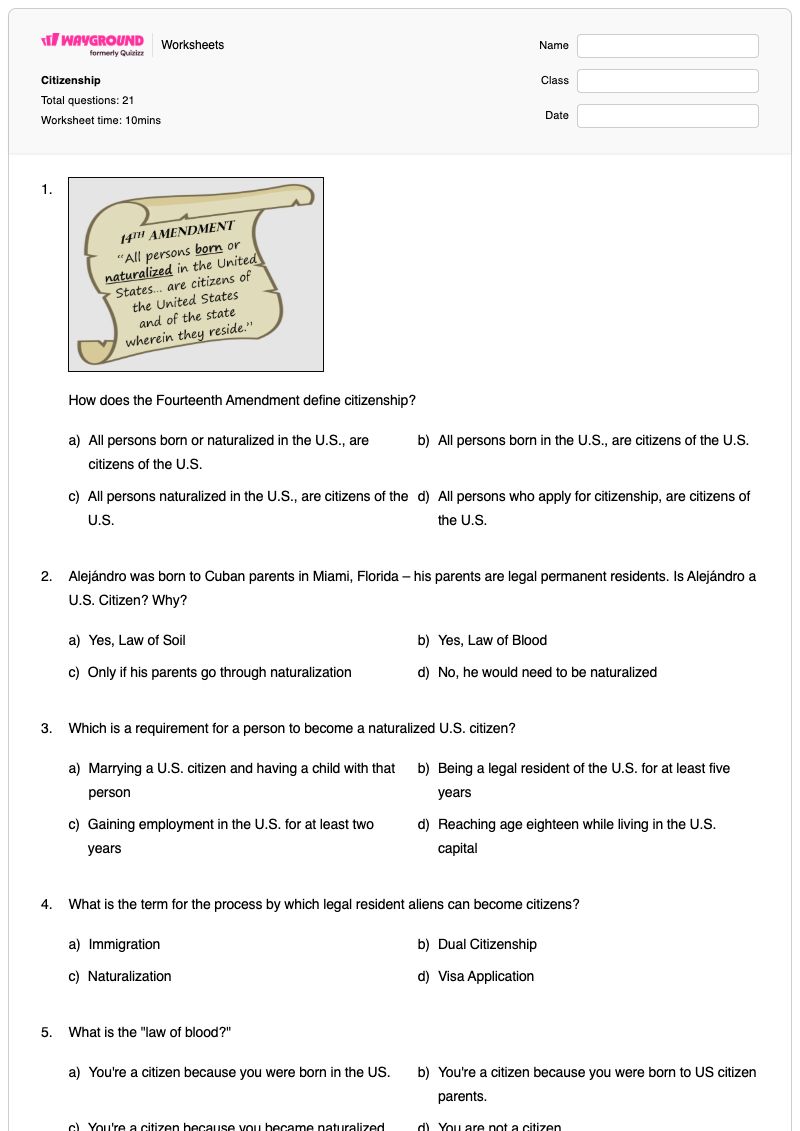
How does the Fourteenth Amendment define citizenship?

a)

All persons born or naturalized in the U.S., are citizens of the U.S.

b)

All persons born in the U.S., are citizens of the U.S.

c)

All persons naturalized in the U.S., are citizens of the U.S.

d)

All persons who apply for citizenship, are citizens of the U.S.

2.

Alejándro was born to Cuban parents in Miami, Florida – his parents are legal permanent residents. Is Alejándro a U.S. Citizen? Why?

a)

Yes, Law of Soil

b)

Yes, Law of Blood

c)

Only if his parents go through naturalization

d)

No, he would need to be naturalized

3.

Which is a requirement for a person to become a naturalized U.S. citizen?

a)

Marrying a U.S. citizen and having a child with that person

b)

Being a legal resident of the U.S. for at least five years

c)

Gaining employment in the U.S. for at least two years

d)

Reaching age eighteen while living in the U.S. capital

4.

What is the term for the process by which legal resident aliens can become citizens?

a)

Immigration

b)

Dual Citizenship

c)

Naturalization

d)

Visa Application

5.

What is the "law of blood?"

a)

You're a citizen because you were born in the US.

b)

You're a citizen because you were born to US citizen parents.

c)

You're a citizen because you became naturalized.

d)

You are not a citizen.

6.

What is the "law of soil?"

a)

You're a citizen because you were born in the US.

b)

You're a citizen because you were born to US citizen parents.

c)

You're a citizen because you became naturalized.

d)

You are not a citizen.

7.

What is the final step in the naturalization process?

a)

Interview

b)

Oath of Allegiance

c)

Live legally in the US for 5+ years

d)

Apply and pay the fee

8.

Male U.S. citizens age 18 - 26 must register with...

a)

the Selective Service

b)

the county voter registry

c)

the FAFSA application

9.

Jordan was born in Germany on a U.S. Air Force base to his parents that were both serving in the U.S. Military. Jordan is 17 years old and now lives in Egypt. What is most likely Jordan’s U.S. citizenship status?

a)

Citizen due to law of blood

b)

Citizen due to law of soil

c)

Not eligible for naturalization yet

d)

Eligible for naturalization

10.

Under American law, which of the following would not be considered a United States citizen?

a)

any baby born in the United States to two foreign parents

b)

any baby born overseas to non-American citizens

c)

any baby born in the United States to American parents

d)

any baby born overseas to American parents

11.

a system by which men ages 18 through 25 register with the U.S. government for possible military service is called...

a)

the common good

b)

petitioning the government

c)

selective service system (SSS)

d)

political participation

e)

welfare

12.

telling the government what you think by writing or signing a document is called...

a)

the common good

b)

petitioning the government

c)

selective service system (SSS)

d)

political participation

e)

welfare

13.

What is a requirement, something a person or government has to do?

a)

obligation

b)

responsibility

14.

Paying taxes is an example of a(n)

a)

obligation

b)

responsibility

15.

Selective service is an example of a(n)

a)

obligation

b)

responsibility

16.

Obeying laws is an example of a(n)

a)

obligation

b)

responsibility

17.

Jury duty is an example of a(n)

a)

obligation

b)

responsibility

18.

Voting is an example of a(n)

a)

obligation

b)

responsibility

19.

How do the obligations and responsibilities of citizenship help the country?

a)

they contribute to the common good

b)

they keep you out of jail

c)

they give you something to do

20.
This document was part of a summons to perform an important civic duty. 
Why is it important for citizens to meet the obligation requested in this document? 
a)
to guarantee our right to confront witnesses.
b)
to preserve constitutional limits on governmental power.
c)
to guarantee our right to be judged by a jury of our peers.
d)
to protect our right to petition for a writ of habeas corpus. 
21.

Clean water, police protection, and paved streets are all privileges enjoyed by American citizens. What civic OBLIGATION must be met in order for these services to continue?

a)

citizens must pay taxes

b)

citizens must vote

c)

citizens must attend school

d)

citizens must volunteer

Answer Key

Citizenship

Total questions: 21

1.
a)

All persons born or naturalized in the U.S., are citizens of the U.S.

2.
a)

Yes, Law of Soil

3.
b)

Being a legal resident of the U.S. for at least five years

4.
c)

Naturalization

5.
b)

You're a citizen because you were born to US citizen parents.

6.
a)

You're a citizen because you were born in the US.

7.
b)

Oath of Allegiance

8.
a)

the Selective Service

9.
b)

Citizen due to law of soil

10.
b)

any baby born overseas to non-American citizens

11.
c)

selective service system (SSS)

12.
b)

petitioning the government

13.
a)

obligation

14.
a)

obligation

15.
a)

obligation

16.
a)

obligation

17.
a)

obligation

18.
b)

responsibility

19.
a)

they contribute to the common good

20.
c) to guarantee our right to be judged by a jury of our peers.
21.
a)

citizens must pay taxes

FAQs

What does this citizenship worksheet help Grade 7 students learn?

This worksheet uses 21 multiple-choice questions to assess how students apply U.S. citizenship concepts rather than simply recall the word citizenship. Students distinguish the law of soil from the law of blood, identify naturalization requirements and its final step, analyze citizenship scenarios, and classify civic terms such as Selective Service, petitioning, obligation, and responsibility.

How can I use this worksheet to teach U.S. citizenship and naturalization?

Introduce the Fourteenth Amendment, the law of soil, and the law of blood before students complete the scenario-based multiple-choice items. Then have students explain why each option is correct or incorrect, using the naturalization questions to sequence the process from application and residency through the Oath of Allegiance. Finish by connecting the Selective Service, petitioning, and tax questions to the broader idea of civic obligations.

What mistakes should I watch for when students complete this citizenship worksheet?

Students may confuse the law of soil, which the worksheet contrasts with citizenship through U.S. citizen parents, or select naturalization when a scenario asks about citizenship based on birth. They may also mistake immigration or visa application for naturalization, confuse the interview with the Oath of Allegiance as the final step, or label an obligation as a responsibility. Watch for confusion between Selective Service registration and voter registration, FAFSA, or general political participation.

How do I assign and grade this citizenship worksheet?

You can assign this citizenship worksheet as a printable PDF or as a digital quiz on Wayground. It includes a complete answer key for the 21 multiple-choice questions, and printable submissions can be graded by scanning student work with the Wayground for Teachers app. The printable option also supports classrooms that are reducing screen time.

How can I differentiate this citizenship worksheet for my students?

In the worksheet’s Advanced Settings, adjust font spacing or font size to make the 21 multiple-choice items easier to read. You can also apply a dyslexia-friendly font or translate the citizenship questions into another language when that supports access to the vocabulary and scenarios.

Where can I find more free worksheets like this on Wayground?

Wayground offers a broad collection of free printable worksheets and practice problems across subjects, with downloadable PDFs and answer keys to help students build essential skills and concepts. Browse more worksheets at https://wayground.com/en-us/worksheets.