

This Grade 6 science worksheet helps students distinguish asexual reproduction from sexual reproduction through 20 multiple-choice questions. Students identify examples and types of asexual reproduction, including binary fission, budding, and regeneration; define genetic variation and gametes; determine how many parents each process requires; and recognize key differences in reproduction speed and offspring similarity or diversity.
The questions use diagrams, definitions, comparisons, advantages and disadvantages, and true-or-false reasoning presented in a multiple-choice format. Students apply vocabulary and biological concepts rather than simply naming the broad topic, making the worksheet useful for introducing or reviewing how reproductive processes differ. This free printable worksheet includes a complete answer key for Grade 6 science instruction, independent practice, review, or assessment.
Worksheet settings
Font size
S
M
L
XL
Worksheets
Asexual/Sexual Reproduction
Total questions: 20
Name
Class
Date
1.
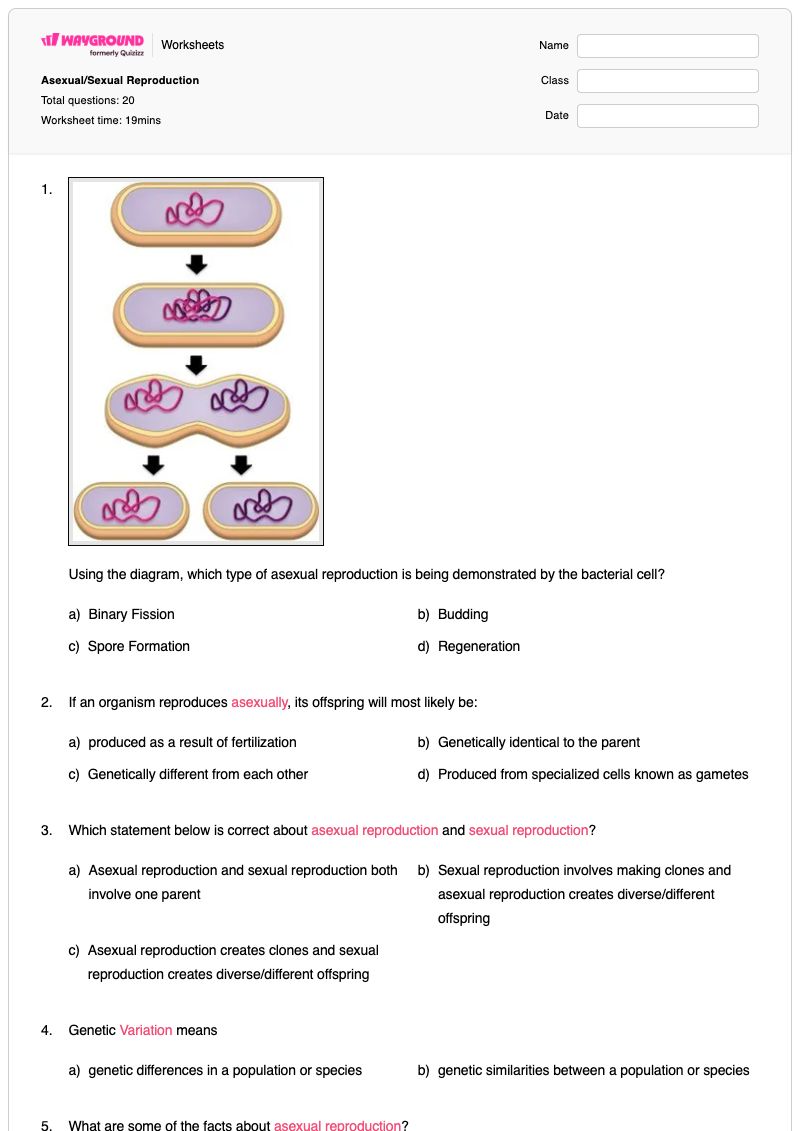
Using the diagram, which type of asexual reproduction is being demonstrated by the bacterial cell?
a)
Binary Fission
b)
Budding
c)
Spore Formation
d)
Regeneration
2.
If an organism reproduces asexually, its offspring will most likely be:
a)
produced as a result of fertilization
b)
Genetically identical to the parent
c)
Genetically different from each other
d)
Produced from specialized cells known as gametes
3.
Which statement below is correct about asexual reproduction and sexual reproduction?
a)
Asexual reproduction and sexual reproduction both involve one parent
b)
Sexual reproduction involves making clones and asexual reproduction creates diverse/different offspring
c)
Asexual reproduction creates clones and sexual reproduction creates diverse/different offspring
4.
Genetic Variation means
a)
genetic differences in a population or species
b)
genetic similarities between a population or species
5.
What are some of the facts about asexual reproduction?
a)
Takes only one mate to reproduce and takes a longer time to reproduce
b)
Takes a shorter amount of time to reproduce and it takes two mates to reproduce
c)
Reproduces diverse offspring and takes a longer time to reproduce
d)
Takes only one mate to reproduce and takes a shorter time to reproduce
6.
What are some of the facts about sexual reproduction?
a)
Takes two mates to reproduce and takes a longer time to reproduce
b)
Takes one mate to reproduce and takes a shorter amount of time to reproduce
c)
Takes two mates to reproduce and takes a shorter amount of time to reproduce
d)
Takes one mate to reproduce and takes a shorter amount of time to reproduce
7.
What is an advantage of sexual reproduction?
a)
Allows genetic variation
b)
Only needs one parent
c)
Offspring are exact copies of parent
8.
What is one disadvantage of sexual reproduction?
a)
Only one parent needed
b)
Offspring are exact copies of parents
c)
Happens very quickly
d)
Needs two parents
9.
When a starfish grows a new body off a broken arm, what kind of reproduction is this?
a)
Sexual
b)
Differentiation
c)
Asexual
d)
Specialization
10.
Which type of asexual reproduction is pictured?
a)
Spore Formation
b)
Regeneration
c)
Budding
d)
Vegetative Propagation
11.
Which type of asexual reproduction is pictured?
a)
Spore Formation
b)
Regeneration
c)
Budding
d)
Vegetative Propagation
12.
What is a gamete?
a)
sex cell
b)
human cells
c)
plant cells
d)
plant and animal cells
13.
Asexual reproduction happens faster than sexual reproduction.
a)
true
b)
false
14.
How many parents are required for asexual reproduction?
a)
none
b)
1
c)
2
d)
4
15.
How many parents are involved with sexual reproduction?
a)
none
b)
1
c)
2
d)
4
16.
The male gamete in sexual reproduction is called the ______. The female gamete is called the _____.
a)
egg, sperm
b)
sperm, egg
c)
stamen, stigma
d)
egg, yolk
17.
Which type of reproduction tends to produce more offspring?
a)
Sexual
b)
Asexual
c)
They occur at the same rate
18.
Which type of reproduction tends to be a longer process?
a)
Sexual
b)
Asexual
c)
They occur at the same rate
d)
Both are slow processes
19.
Budding, vegetative propagation, regeneration, and binary fission are all types of
a)
sexual reproduction
b)
asexual reproduction
20.
In which type of reproduction do the sperm and egg cell join?
a)
asexual
b)
sexual
Answer Key
Asexual/Sexual Reproduction
Total questions: 20
1.
a)
Binary Fission
2.
b) Genetically identical to the parent
3.
c)
Asexual reproduction creates clones and sexual reproduction creates diverse/different offspring
4.
a) genetic differences in a population or species
5.
d) Takes only one mate to reproduce and takes a shorter time to reproduce
6.
a) Takes two mates to reproduce and takes a longer time to reproduce
7.
a) Allows genetic variation
8.
d)
Needs two parents
9.
c) Asexual
10.
c)
Budding
11.
b)
Regeneration
12.
a)
sex cell
13.
a)
true
14.
b)
1
15.
c)
2
16.
b)
sperm, egg
17.
b)
Asexual
18.
a)
Sexual
19.
b)
asexual reproduction
20.
b)
sexual
140 %
Browse by subjects
Browse by grades
Browse by format
FAQs
What does this asexual and sexual reproduction worksheet cover?
This Grade 6 science worksheet uses 20 multiple-choice questions to compare asexual and sexual reproduction. Students identify binary fission, budding, and regeneration from examples or diagrams, and apply concepts such as parent number, gametes, genetic variation, reproduction speed, and whether offspring are genetically identical or diverse.
How can I use this worksheet to teach the difference between asexual and sexual reproduction?
Introduce the lesson by having students compare one-parent and two-parent reproduction, then preview the terms gamete, clone, and genetic variation. As students complete the multiple-choice items, pause to discuss why asexual reproduction can produce genetically identical offspring and why sexual reproduction allows genetic variation; use the diagram-based budding and regeneration questions to connect vocabulary to visual examples.
What mistakes should I watch for when students complete this reproduction worksheet?
Students may confuse budding with regeneration when interpreting the pictured examples, or select asexual reproduction terms such as spore formation without matching the example shown. Watch for confusion between one and two parents, between a gamete and a general plant or animal cell, and between the advantages and disadvantages of sexual reproduction. Some students may also reverse the ideas that asexual reproduction is faster and produces genetically identical offspring, while sexual reproduction takes longer and allows variation.
How do I assign and grade this asexual and sexual reproduction worksheet?
The worksheet is available as a printable PDF and as a digital quiz on Wayground, and it includes a complete answer key for its 20 multiple-choice questions. For printable submissions, you can grade student work by scanning it with the Wayground for Teachers app. The printable format can also support schools that are reducing screen time.
How does this worksheet help students compare asexual and sexual reproduction?
The comparison questions require students to connect reproductive features rather than memorize isolated definitions. They identify that asexual reproduction involves one parent, occurs faster, and produces genetically identical offspring, while sexual reproduction involves two parents, takes longer, and allows genetic variation; the advantage and disadvantage items ask students to apply those differences.
Where can I find more worksheets like this on Wayground?
Wayground offers a comprehensive collection of free printable worksheets and practice problems across all subjects. Teachers can browse more resources, download PDFs, and use included answer keys to help students master essential skills and concepts at https://wayground.com/en-us/worksheets.