

Price Ceiling and Floors is a Grade 11 social studies worksheet that develops students’ understanding of government-set prices and market outcomes. Across 15 questions—3 true/false multiple-select items and 12 multiple-choice items—students identify price ceilings as legal maximums and price floors as legal minimums, distinguish equilibrium price from quantity supplied and quantity demanded, and determine whether a price creates a shortage or surplus. Scenario-based items use prices such as $30, $700, and $1.75 to connect definitions with market results.
The worksheet also reviews related introductory economics vocabulary, including minimum-wage arguments, sole proprietorships, oligopolies, and corporations. It is designed for Grade 11 social studies instruction, guided practice, review, or assessment. This free printable worksheet includes a complete answer key, helping teachers check students’ understanding of price-control effects and foundational business structures efficiently.
Worksheet settings
Font size
S
M
L
XL
Worksheets
Price Ceiling and Floors
Total questions: 15
Name
Class
Date
1.
Price ceiling is located above the equilibrium price.
a)
True
b)
False
2.
Price ceiling is a legal maximum price for a product.
a)
True
b)
False
3.
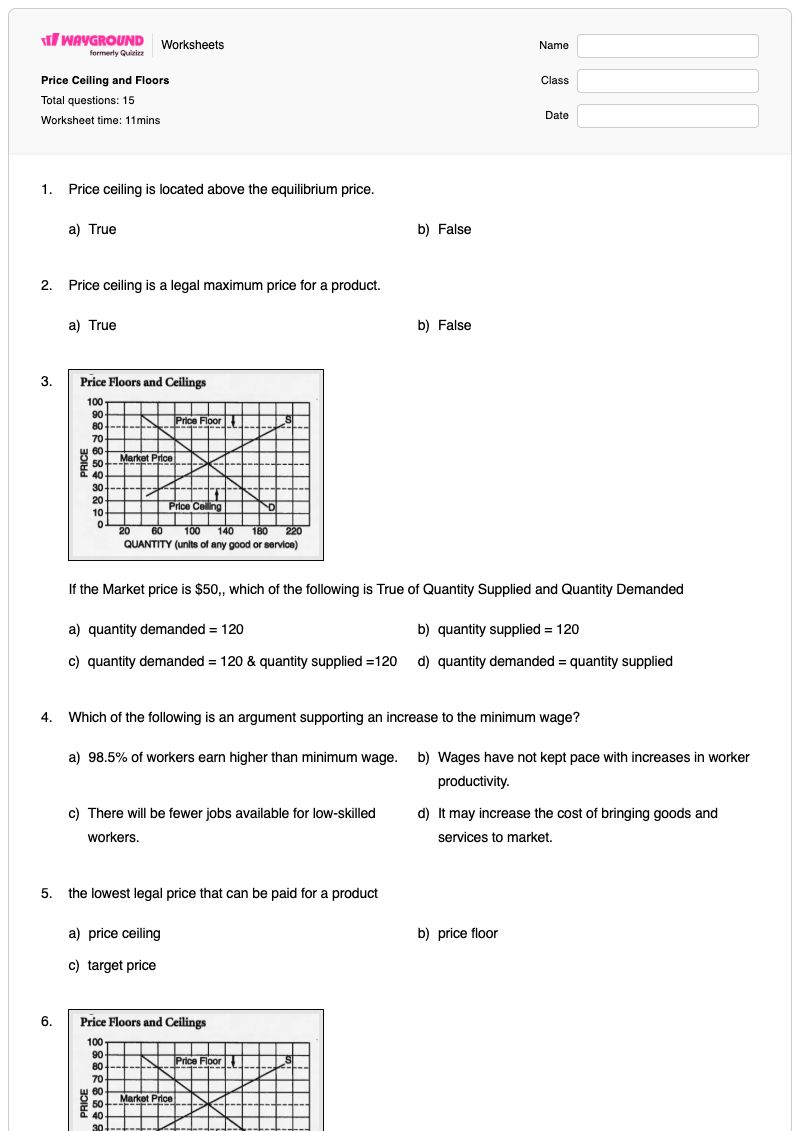
If the Market price is $50,, which of the following is True of Quantity Supplied and Quantity Demanded
a)
quantity demanded = 120
b)
quantity supplied = 120
c)
quantity demanded = 120 & quantity supplied =120
d)
quantity demanded = quantity supplied
4.
Which of the following is an argument supporting an increase to the minimum wage?
a)
98.5% of workers earn higher than minimum wage.
b)
Wages have not kept pace with increases in worker productivity.
c)
There will be fewer jobs available for low-skilled workers.
d)
It may increase the cost of bringing goods and services to market.
5.
the lowest legal price that can be paid for a product
a)
price ceiling
b)
price floor
c)
target price
6.
If the government creates a price ceiling of $30, which one of the following statements is correct?
a)
The quantity demanded = 60
b)
The quantity supplied = 160
c)
There is a surplus of 100
d)
There is a shortage of 100
7.
If the government set the price at $700, would that be a price ceiling or floor?
a)
Price Ceiling
b)
Price Floor
c)
Neither
8.
What would result if the price were set at $1.75
a)
Surplus, Quantity Supplied is greater
b)
Shortage, Quantity Demanded is greater
c)
Quantity Supplied = Quantity Demanded
d)
$1.75
9.
A _______ _______ is an unincorporated business that has just one owner.
a)
sole proprietorship
b)
oligopoly
c)
partnership
d)
monopolistic competition
10.
An ___________ is when a few companies have significant control over a given market.
a)
partnership
b)
oligopoly
c)
monopoly
d)
revenue
11.
minimum price that can be charged for a good/service, set by the government, casues a surplus normally
a)
price ceiling
b)
price floor
c)
shortage
d)
surplus
12.
Shortages, lower quality goods, and increased search costs, are all associated with
a)
Price ceilings
b)
Price floors
13.
The image here is an example of a ________, which causes a _________
a)
Price Ceiling: Shortage
b)
Price Ceiling: Surplus
c)
Price Floor: Shortage
d)
Price Floor: Surplus
14.
A ________ is a business entity that is owned by its shareholders.
a)
monopoly
b)
oligopoly
c)
corporation
d)
sole proprietorship
15.
Price when quantity supplied equals quantity demanded; a price that clears the market
a)
Equilibrium Quantity
b)
Shortage
c)
Surplus
d)
Equilibrium Price
Answer Key
Price Ceiling and Floors
Total questions: 15
1.
b)
False
2.
a)
True
3.
d)
quantity demanded = quantity supplied
, a)
quantity demanded = 120
, b)
quantity supplied = 120
, c)
quantity demanded = 120 & quantity supplied =120
4.
b)
Wages have not kept pace with increases in worker productivity.
5.
b)
price floor
6.
d) There is a shortage of 100
7.
b) Price Floor
8.
a)
Surplus, Quantity Supplied is greater
9.
a)
sole proprietorship
10.
b)
oligopoly
11.
b)
price floor
12.
a)
Price ceilings
13.
d)
Price Floor: Surplus
14.
c)
corporation
15.
d)
Equilibrium Price
140 %
Browse by subjects
Browse by grades
Browse by format
FAQs
What does the Price Ceiling and Floors worksheet cover?
This Grade 11 social studies worksheet uses 3 true/false multiple-select items and 12 multiple-choice questions to assess price ceilings, price floors, equilibrium price, quantity supplied, quantity demanded, shortages, and surpluses. Students apply the definitions to price scenarios, such as identifying the shortage created by a $30 price ceiling and the surplus associated with a $1.75 price, while also reviewing minimum-wage reasoning and basic business structures.
How can I use this worksheet to teach price ceilings and price floors?
Begin by using the opening true/false items to establish that a price ceiling is a legal maximum and a price floor is a legal minimum. Then have students explain each scenario before selecting an answer: ask whether the set price is above or below equilibrium, compare quantity supplied with quantity demanded, and predict a shortage or surplus. Use the business-structure questions at the end as a short vocabulary review or separate economics extension.
What mistakes should I watch for when students complete this worksheet?
Students may reverse the definitions of a ceiling and floor, or assume that either control automatically creates the same market result. Watch for confusion between a shortage, where quantity demanded is greater, and a surplus, where quantity supplied is greater, especially in the $30, $700, and $1.75 scenarios. They may also select equilibrium quantity instead of equilibrium price or confuse sole proprietorship, oligopoly, and corporation.
How do I assign and grade this Price Ceiling and Floors worksheet?
Wayground provides this worksheet as a printable PDF and as a digital quiz, and it includes a complete answer key for all 15 items. You can grade printable submissions by scanning student work with the Wayground for Teachers app, or review responses from the digital quiz on Wayground.
How can I differentiate this worksheet for my students?
Use the worksheet’s Advanced Settings to adjust font spacing and font size so the definition, scenario, and business-structure questions are easier to read. You can also apply a dyslexia-friendly font or translate the worksheet into another language, supporting access to its price-control vocabulary and multiple-choice prompts.
Where can I find more worksheets like this on Wayground?
Wayground offers a comprehensive collection of free printable worksheets and practice problems across all subjects, with downloadable PDFs and answer keys to help students master essential skills and concepts. Browse more resources at https://wayground.com/en-us/worksheets.