
Wayground
Similar Figures and Proportions - Printable Mathematics Worksheets class 6 - Wayground

Similar Figures and Proportions

9 questions

6th - 7th Grade

Mathematics

Similar Figures and Proportions is a free printable Mathematics worksheet for Grades 6–7 that helps students distinguish similar figures from figures that merely share a shape or angle feature. Across 9 multiple-choice questions, students identify corresponding sides, recognize that corresponding angles in similar figures are congruent, and decide whether pairs of figures are similar by checking both angle equality and proportional corresponding side lengths. The worksheet also asks students to solve two proportions, connecting the definition of similarity to numerical reasoning. Its answer choices address common explanations, such as confusing different size with similarity or ignoring side-length proportions, so teachers can quickly identify misconceptions. Use the worksheet for guided practice, independent work, review, or a short formative assessment. It is available as a free printable worksheet with a complete answer key.

Worksheet settings

Font size

S
M
L
XL
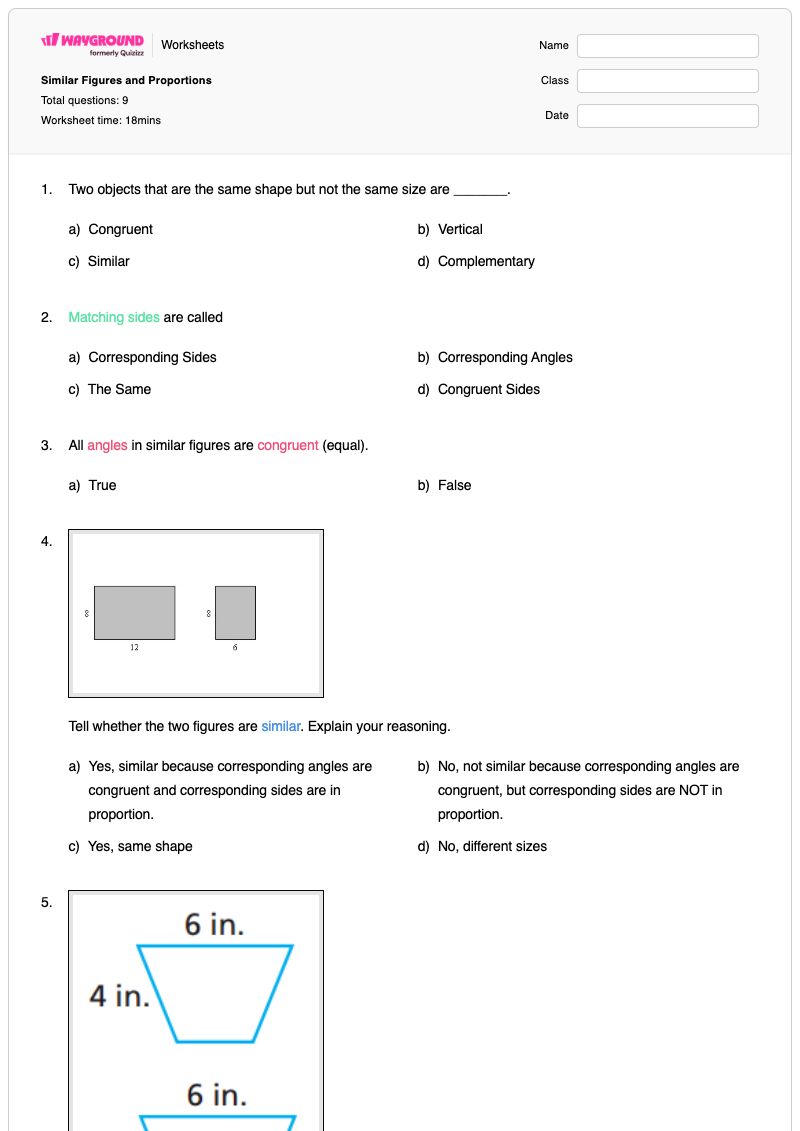
Worksheets

Similar Figures and Proportions

Total questions: 9

Name
Class
Date
1.
Two objects that are the same shape but not the same size are _______.
a)
Congruent
b)
Vertical
c)
Similar
d)
Complementary 
2.
Matching sides are called
a)
Corresponding Sides
b)
Corresponding Angles
c)
The Same
d)
Congruent Sides
3.
All angles in similar figures are congruent (equal).  
a)
True
b)
False
4.
Tell whether the two figures are similar. Explain your reasoning.
a)
Yes, similar because corresponding angles are congruent and corresponding sides are in proportion.
b)
No, not similar because corresponding angles are congruent, but corresponding sides are NOT in proportion.
c)
Yes, same shape
d)
No, different sizes
5.
Are the following similar?
Why or why not?
a)
Yes
b)
No, the corresponding angles are not equal.
c)
No, corresponding sides are NOT in proportion.
d)
i dont know
6.
Tell whether the two figures are similar. Explain your reasoning.
a)
Yes, similar because they are the same shape and side lengths are proportional.
b)
No, not similar because they are the same shape, but side lengths are not proportional.
c)
Yes, same shape
d)
No, different sizes
7.
Tell whether the two figures are similar. Explain your reasoning.
a)
Yes, similar because they are the same shape and side lengths are proportional.
b)
No, not similar because they are the same shape, but side lengths are not proportional.
c)
Yes, same shape
d)
No, different sizes
8.
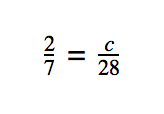
Solve the proportion.
a)
k=5
b)
k=3.3333333
c)
k=60
d)
k=90
9.
Solve the proportion:
a)
4
b)
8
c)
14
d)
10
Answer Key

Similar Figures and Proportions

Total questions: 9

1.
c) Similar
2.
a) Corresponding Sides
3.
a) True
4.
b) No, not similar because corresponding angles are congruent, but corresponding sides are NOT in proportion.
5.
c) No, corresponding sides are NOT in proportion.
6.
a) Yes, similar because they are the same shape and side lengths are proportional.
7.
b) No, not similar because they are the same shape, but side lengths are not proportional.
8.
a) k=5
9.
b) 8

FAQs

What does the Similar Figures and Proportions worksheet cover?

This Grade 6–7 Mathematics worksheet uses 9 multiple-choice questions to teach students how to identify similar figures by checking congruent corresponding angles and proportional corresponding sides. Students also identify corresponding sides and solve two proportions, reinforcing the numerical reasoning behind similarity rather than relying only on figures being the same shape or a different size.

How can I use this worksheet to teach students about similar figures and proportions?

Introduce the worksheet by having students define similar figures, corresponding sides, and corresponding angles before they begin the multiple-choice items. As students evaluate each pair of figures, ask them to explain whether the angles are equal and whether the corresponding side lengths are in proportion. Finish with the two proportion problems to connect their visual decisions about similarity to solving for an unknown value.

What mistakes should I watch for when students complete this worksheet?

Watch for students who choose “similar” because two figures have the same shape or different sizes without checking whether corresponding side lengths are proportional. Students may also confuse corresponding sides with corresponding angles, or recognize equal angles but overlook a failed side-length proportion. In the final two items, check that students set up and solve the proportion correctly rather than selecting a value based on an incorrect cross-multiplication step.

How do I assign and grade the Similar Figures and Proportions worksheet?

The worksheet is available as a printable PDF and as a digital quiz on Wayground, and it includes a complete answer key for all 9 multiple-choice questions. For printable submissions, you can scan student work with the Wayground for Teachers app to help grade responses. The printable format also gives schools an option for reducing screen time.

How can I differentiate this worksheet for my students?

Use the worksheet’s Advanced Settings to adjust font spacing and font size so the similarity definitions, figure-analysis prompts, and proportion problems are easier to read. You can also enable a dyslexia-friendly font or translate the worksheet into another language when that better supports access to the multiple-choice directions and explanations.

Where can I find more worksheets like this on Wayground?

Wayground offers a comprehensive collection of free printable worksheets and practice problems across subjects, with downloadable PDFs and answer keys to support mastery of essential skills and concepts. Browse more resources at https://wayground.com/en-us/worksheets.