This Grade 3 mathematics worksheet helps students represent and interpret subtraction with base-ten blocks, place-value chips, and place-value charts. Across 16 multiple-choice questions, students identify the base-ten-block manipulative, model problems such as 100 − 60 and 88 − 14, determine which subtraction equation matches a pictured model, and read values represented by tens and ones or larger place-value models. The worksheet also includes computation and equation-identification checks connected to place value.
Use it to reinforce the connection between concrete models, place-value representations, and symbolic subtraction. Students must distinguish tens from ones, connect a model to the correct minuend and subtrahend, and select the equation or value that matches what they see. This free printable worksheet is designed for Grade 3 math practice and includes a complete answer key for checking student work.
Worksheet settings
Font size
S
M
L
XL
Worksheets
Base Ten Blocks Subtraction Problems
Total questions: 16
Name
Class
Date
1.
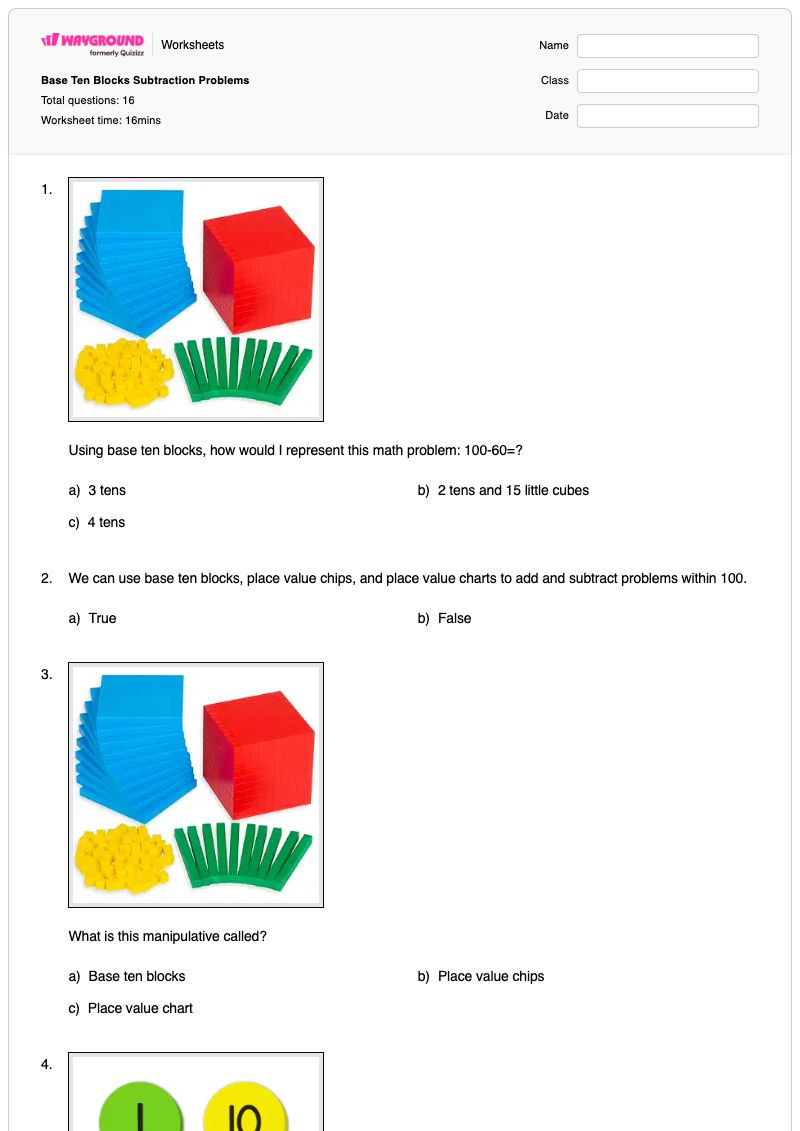
Using base ten blocks, how would I represent this math problem: 100-60=?
a)
3 tens
b)
2 tens and 15 little cubes
c)
4 tens
2.
We can use base ten blocks, place value chips, and place value charts to add and subtract problems within 100.
a)
True
b)
False
3.
What is this manipulative called?
a)
Base ten blocks
b)
Place value chips
c)
Place value chart
4.
Using value chips, how would I represent this math problem: 88-14=?
a)
6 tens and 5 ones
b)
7 tens and 4 ones
c)
7 tens and 2 ones
5.
a)
47
b)
46
c)
110
d)
55
6.
What subtraction problem do these base ten blocks represent?
a)
65 - 23 = 42
b)
65 - 32 = 33
c)
65 - 24 = 41
d)
66 - 23 = 43
7.
What equation is represented by the Base Ten blocks?
a)
326 - 121 = ?
b)
121 + 326 = ?
c)
121 - 326 = ?
d)
226 - 21 = ?
8.
Erin used Base-10 blocks to create a subtraction problem.
The small cube = 1.
a)
879
b)
3,485
c)
1,021
d)
979
9.
Q1. What is the answer to life, the universe, and everything?
a)
1) 32
b)
A) 42
c)
2) 35
d)
3) 36
10.
Q1. What is the answer to the question?
a)
1) 33
b)
A) 70
c)
2) 43
d)
C) 7
11.
Q1. What is the result of 81 + 8?
a)
1) 81
b)
2) 89
c)
3) 99
d)
4) 91
12.
a)
76
b)
67
c)
54
d)
86
13.
Q1. What is the sum of 100 and 12?
a)
A) 100
b)
B) 102
c)
C) 112
d)
D) 92
14.
a)
20068
b)
214
c)
238
d)
268
15.
a)
12
b)
903
c)
93
d)
912
16.
a)
40
b)
30
c)
13
d)
34
Answer Key
Base Ten Blocks Subtraction Problems
Total questions: 16
1.
c)
4 tens
2.
a)
True
3.
a)
Base ten blocks
4.
b)
7 tens and 4 ones
5.
a)
47
6.
a)
65 - 23 = 42
7.
a)
326 - 121 = ?
8.
d)
979
9.
a)
1) 32
10.
c)
2) 43
11.
d)
4) 91
12.
a) 76
13.
c)
C) 112
14.
d)
268
15.
c) 93
16.
d) 34
140 %
Browse by subjects
Browse by grades
Browse by format
FAQs
What does the Base Ten Blocks Subtraction Problems worksheet cover?
This Grade 3 worksheet uses 16 multiple-choice questions to practice representing subtraction with base-ten blocks, place-value chips, and place-value charts. Students identify the manipulative, translate models into subtraction equations, represent problems such as 100 − 60 and 88 − 14, and interpret tens-and-ones values. These tasks connect concrete place-value models to written subtraction equations.
How can I use this worksheet to teach subtraction with base-ten blocks?
Begin by modeling a problem such as 100 − 60 with physical blocks, then ask students to explain how the tens are represented before they answer the matching multiple-choice item. Next, connect the blocks to place-value chips and charts using an example such as 88 − 14. Have students justify why a pictured model matches one equation rather than simply selecting an answer.
What mistakes should I watch for when students complete this worksheet?
Watch for students confusing tens and ones, especially when choosing between representations such as 7 tens and 4 ones or 6 tens and 5 ones. Some students may identify the blocks correctly but reverse the minuend and subtrahend when selecting the matching equation. Others may treat a subtraction model as addition or choose an answer based on a single digit without checking the entire place-value representation.
How do I assign and grade this worksheet?
Wayground provides this base-ten-blocks subtraction worksheet as both a printable PDF and a digital quiz, and it includes a complete answer key. You can print the multiple-choice questions for paper practice or assign the digital version for online completion. Printable submissions can also be graded by scanning student work with the Wayground for Teachers app.
How can I differentiate this base-ten-blocks worksheet for my students?
Use the worksheet’s Advanced Settings to adjust font spacing or choose a larger font size so the place-value models, answer choices, and subtraction equations are easier to read. You can also enable a dyslexia-friendly font or translate the worksheet into another language. These options help students access the visual and multiple-choice format without changing the subtraction tasks.
Where can I find more worksheets like this on Wayground?
Wayground offers a comprehensive collection of free printable worksheets and practice problems across all subjects, with downloadable PDFs and answer keys to support essential skills and concepts. Browse more resources at https://wayground.com/en-us/worksheets.

 Worksheets


