
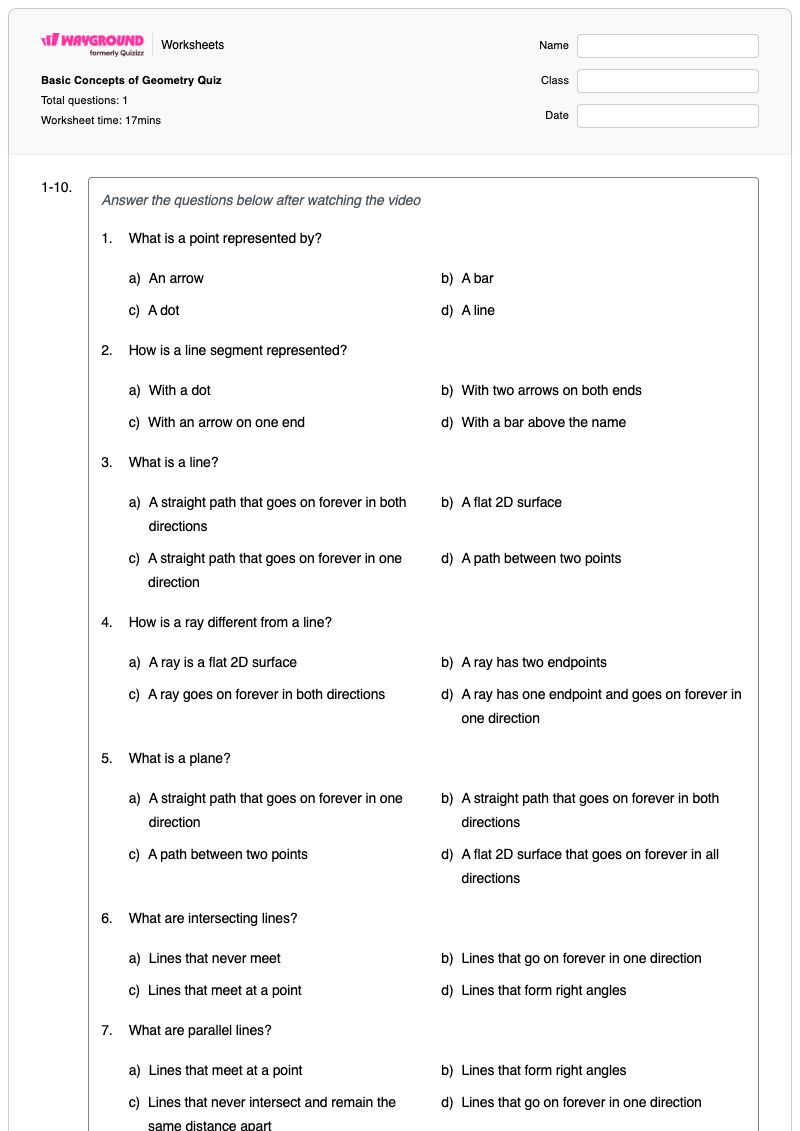

Basic Concepts of Geometry Quiz is a Grade 12 mathematics worksheet that introduces and checks foundational geometric vocabulary and notation. It includes one comprehension-video item and 10 multiple-choice questions covering points, line segments, lines, rays, planes, intersecting lines, parallel lines, and perpendicular lines. Students identify how geometric objects are represented, distinguish figures by their endpoints and direction, and recognize relationships such as intersection, parallelism, and right-angle formation.
This free printable worksheet is useful for introducing basic geometry language, reviewing prerequisite knowledge, or checking understanding before students begin more advanced work with figures and proofs. The multiple-choice format gives teachers a quick way to identify whether students can connect definitions with visual or symbolic representations, while the answer key supports efficient checking and feedback. A complete answer key is included for teacher use.
Worksheet settings
Font size
S
M
L
XL
Worksheets
Basic Concepts of Geometry Quiz
Total questions: 1
Name
Class
Date
1-10.
Answer the questions below after watching the video
1.
What is a point represented by?
a)
An arrow
b)
A bar
c)
A dot
d)
A line
2.
How is a line segment represented?
a)
With a dot
b)
With two arrows on both ends
c)
With an arrow on one end
d)
With a bar above the name
3.
What is a line?
a)
A straight path that goes on forever in both directions
b)
A flat 2D surface
c)
A straight path that goes on forever in one direction
d)
A path between two points
4.
How is a ray different from a line?
a)
A ray is a flat 2D surface
b)
A ray has two endpoints
c)
A ray goes on forever in both directions
d)
A ray has one endpoint and goes on forever in one direction
5.
What is a plane?
a)
A straight path that goes on forever in one direction
b)
A straight path that goes on forever in both directions
c)
A path between two points
d)
A flat 2D surface that goes on forever in all directions
6.
What are intersecting lines?
a)
Lines that never meet
b)
Lines that go on forever in one direction
c)
Lines that meet at a point
d)
Lines that form right angles
7.
What are parallel lines?
a)
Lines that meet at a point
b)
Lines that form right angles
c)
Lines that never intersect and remain the same distance apart
d)
Lines that go on forever in one direction
8.
How are parallel lines represented?
a)
With a bar above the name
b)
With two arrows on both ends
c)
With an arrow on one end
d)
With a specific symbol
9.
What are perpendicular lines?
a)
Lines that never meet
b)
Lines that meet at a point
c)
Lines that form right angles
d)
Lines that go on forever in one direction
10.
How is the right angle formed by perpendicular lines represented?
a)
With a bar above the name
b)
With an arrow on one end
c)
With two arrows on both ends
d)
With a specific symbol
Answer Key
Basic Concepts of Geometry Quiz
Total questions: 1
1-10.
1.
c)
A dot
2.
d)
With a bar above the name
3.
a)
A straight path that goes on forever in both directions
4.
d)
A ray has one endpoint and goes on forever in one direction
5.
d)
A flat 2D surface that goes on forever in all directions
6.
c)
Lines that meet at a point
7.
c)
Lines that never intersect and remain the same distance apart
8.
d)
With a specific symbol
9.
c)
Lines that form right angles
10.
d)
With a specific symbol
140 %
Browse by subjects
Browse by grades
Browse by format
FAQs
What does the Basic Concepts of Geometry Quiz cover?
This Grade 12 mathematics worksheet checks students’ understanding of points, line segments, lines, rays, planes, intersecting lines, parallel lines, and perpendicular lines. One comprehension-video item and 10 multiple-choice questions ask students to identify definitions, distinguish figures by their endpoints and direction, and recognize the representations used for geometric relationships.
How can I use this worksheet to teach basic geometric figures and line relationships?
Introduce the vocabulary by having students compare a point, line segment, line, ray, and plane according to endpoints and how far each extends. Then use the multiple-choice items to discuss why intersecting, parallel, and perpendicular lines are different, including how each relationship is represented. Review the comprehension-video item before students complete the remaining questions independently or in pairs.
What mistakes should I watch for on this geometry quiz?
Students may confuse a line with a ray by overlooking that a line extends in both directions, while a ray has one endpoint and extends in one direction. They may also mix up parallel lines, which remain the same distance apart and never intersect, with perpendicular lines, which form right angles. Watch for errors in notation as well, especially when identifying a point as a dot, a line segment by a bar above its name, or the symbols used for parallel and perpendicular relationships.
How do I assign and grade this geometry worksheet?
The Basic Concepts of Geometry Quiz is available as a printable PDF and as a digital quiz on Wayground, and it includes a complete answer key. For printable submissions, scan student work with the Wayground for Teachers app to support faster grading. The PDF option can also help schools reduce screen time while keeping the same geometry review accessible.
How can I differentiate this geometry quiz for my students?
Use the worksheet’s Advanced Settings to adjust font spacing or choose a larger font size so the multiple-choice options and geometry terminology are easier to read. You can also enable a dyslexia-friendly font or translate the quiz into another language, depending on students’ reading needs. These adjustments apply to the quiz’s definitions, notation questions, and answer choices without changing the concepts assessed.
Where can I find more worksheets like this on Wayground?
Wayground offers a comprehensive collection of free printable worksheets and practice problems across subjects, with downloadable PDFs and answer keys to help students build essential skills and concepts. Browse more resources at https://wayground.com/en-us/worksheets.