

Wayground
Gel Electrophoresis Review - Printable Biology Worksheets - Wayground

Gel Electrophoresis Review

23 questions

9th - 9th Grade

Biology

Gel Electrophoresis Review is a Grade 9 biology worksheet with 23 multiple-choice questions that checks students’ understanding of how gel electrophoresis separates DNA fragments by size. Students review the roles of restriction enzymes, DNA’s negative charge, the electric field, agarose gel, fragment movement, and the position of larger and smaller fragments relative to the wells. The worksheet also applies these ideas to DNA fingerprinting and evidence-based identification, including matching DNA patterns to a blood sample or suspect and comparing relatedness between bat species. One question addresses micropipettor technique, giving students a reminder of accurate laboratory procedure. This free printable worksheet includes a complete answer key and can support review, formative assessment, or an introductory biology laboratory discussion.

Worksheet settings

Font size

S
M
L
XL
Worksheets

Gel Electrophoresis Review

Total questions: 23

Name
Class
Date
1.

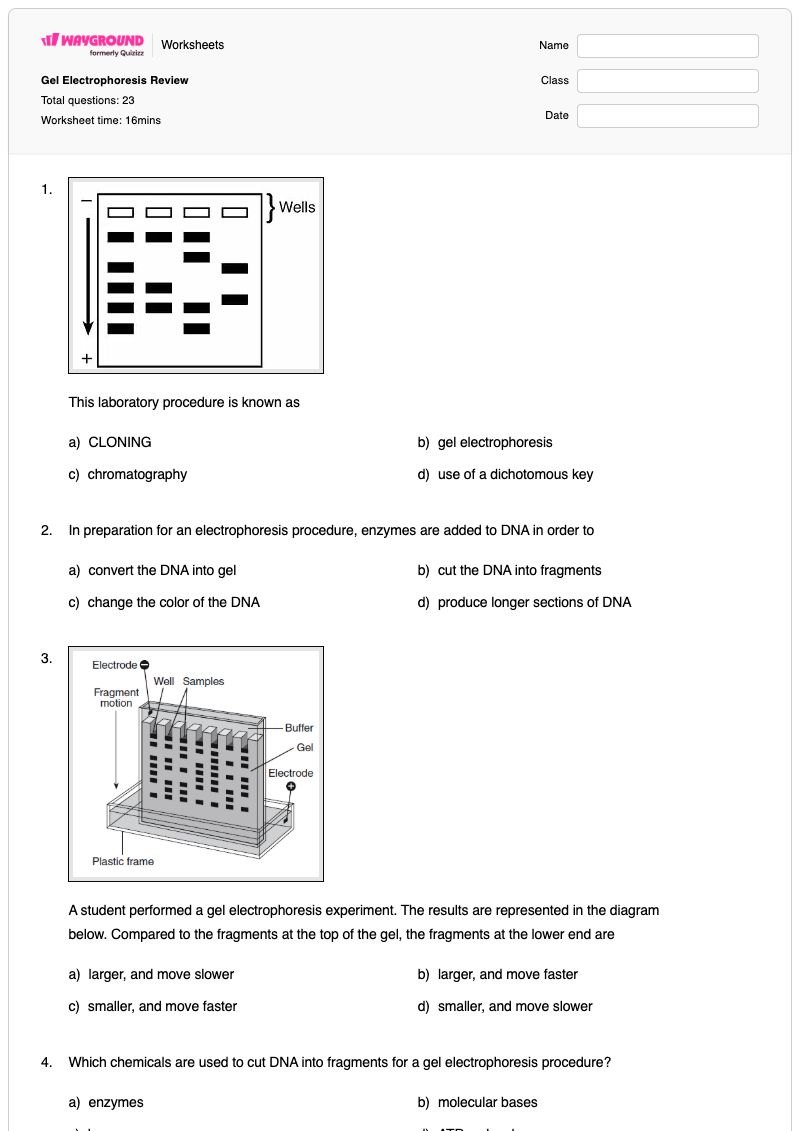
This laboratory procedure is known as

a)

CLONING

b)

gel electrophoresis

c)

chromatography

d)

use of a dichotomous key

2.

In preparation for an electrophoresis procedure, enzymes are added to DNA in order to

a)

convert the DNA into gel

b)

cut the DNA into fragments

c)

change the color of the DNA

d)

produce longer sections of DNA

3.

A student performed a gel electrophoresis experiment. The results are represented in the diagram

below. Compared to the fragments at the top of the gel, the fragments at the lower end are

a)

larger, and move slower

b)

larger, and move faster

c)

smaller, and move faster

d)

smaller, and move slower

4.

Which chemicals are used to cut DNA into fragments for a gel electrophoresis procedure?

a)

enzymes

b)

molecular bases

c)

hormones

d)

ATP molecules

5.

This technique used to analyze DNA involves the

a)

synthesis of new DNA strands from subunits

b)

separation of DNA fragments based on size

c)

production of genetically engineered DNA molecules

d)

removal of defective genes from DNA

6.
Based on these results whose blood was found in the blood stain at the crime scene?
a)
Bob
b)
Sue
c)
John
d)
Lisa
7.
Which suspect is likely guilty?
a)
Suspect #1
b)
Suspect #2
c)
Suspect #3
8.
DNA fingerprinting works because
a)
Most genes are dominant
b)
All organisms contain RNA
c)
The most important genes are different among most people
d)
No two people, except identical twins, have exactly the same DNA 
9.
What is the purpose of gel electrophoresis?
a)
helps cut DNA
b)
count the genes in DNA
c)
separates DNA based on size
d)
allows for an exact replicated organism
10.
Why do the fragments of DNA in gel electrophoresis travel away from the negative electrode?
a)
DNA is negatively charged so attracted to the positive end of the unit
b)
DNA is positively charged to attracted to the negative end of the unit
c)
the agarose gel in negatively charged
d)
the agarose gel is positively charged
11.
In gel electrophoresis, the largest DNA fragment will appear
a)
closest to the starting wells
b)
farthest from the starting wells
c)
three quarters away from the starting wells
d)
it depends on how many fragments there are
12.
Which is the primary purpose of using restriction enzymes in gel electrophoresis?
a)
It allows the strands of DNA to be cut into various lengths for testing
b)
It restricts the number of base pairs that can be tested in a sample
c)
It makes the testing simpler by moving the strands into the gel faster
d)
It charges the DNA strands
13.

Once DNA has been extracted from the nucleus of a cell, it is exposed to ______ ______ that act like biochemical scissors to cut the DNA.

a)

restriction enzymes

b)

gel agarose

c)

clotting factors

d)

electric shock

14.
Which two bat species are most closely related?
a)
 Bat 1 and Bat 2
b)
Bat 1 and Bat 3
c)
Bat 2 and Bat 3
d)
There’s no way to tell
15.
a)

micropipette

b)

transfer pipette

c)

pipette pump

d)

serological pipette

16.
When using a micropipettor, if you push to the second stop to fill it you will get ____________
a)
the correct amount of solution
b)
too much solution
c)
too little solution
d)
either too much or too little solution
17.
The best tool to measure 146 uL (microliters) ______________.
a)
A PTP (plastic transfer pipette)
b)
A 5 - 50 uL micropipettor
c)
A 2 - 200 uL micropipettor
d)
A graduated cylinder
18.
In order to accurately fill a micropipettor you must ______________?
a)
Add a tip and push the button to the first stop.
b)
Add a tip and push the button to the second stop
c)
Turn the white wheel upward
d)
Push the eject button
19.
This equipment is used to 
a)
measure & transfer large volumes
b)
measure & transfer small volumes
c)
spin chemicals/tubes
d)
sterilize equipment
20.

Micropipettes are very accurate tools of measurement, but they are only as accurate as the person using it.

a)

true

b)

false

21.

Always change out the micropipette tip when changing reagents.

a)

true

b)

false

22.

This is a p20 micropipette.

How many microliters will this micropipette take up?

a)

500 uL

b)

50 uL

c)

5.0 uL

d)

0.5 uL

23.

This is a p200 micropipette.

How many microliters will this micropipette take up?

a)

500 uL

b)

50 uL

c)

5.0 uL

d)

0.5 uL

Answer Key

Gel Electrophoresis Review

Total questions: 23

1.
b)

gel electrophoresis

2.
b)

cut the DNA into fragments

3.
c)

smaller, and move faster

4.
a)

enzymes

5.
b)

separation of DNA fragments based on size

6.
c) John
7.
b) Suspect #2
8.
d) No two people, except identical twins, have exactly the same DNA 
9.
c) separates DNA based on size
10.
a) DNA is negatively charged so attracted to the positive end of the unit
11.
a) closest to the starting wells
12.
a) It allows the strands of DNA to be cut into various lengths for testing
13.
a)

restriction enzymes

14.
b) Bat 1 and Bat 3
15.
a)

micropipette

16.
b) too much solution
17.
c) A 2 - 200 uL micropipettor
18.
a) Add a tip and push the button to the first stop.
19.
b) measure & transfer small volumes
20.
a)

true

21.
a)

true

22.
c)

5.0 uL

23.
b)

50 uL

FAQs

What does the Gel Electrophoresis Review worksheet cover?

This Grade 9 biology worksheet uses 23 multiple-choice questions to assess how gel electrophoresis separates DNA fragments by size. Students apply concepts involving restriction enzymes, DNA charge, fragment movement from the wells, DNA fingerprinting, and interpreting electrophoresis results to identify samples or suspects.

How can I use this worksheet to teach gel electrophoresis?

Introduce the procedure by reviewing how restriction enzymes cut DNA into fragments and how an electric field moves negatively charged DNA through agarose gel. Then have students complete the multiple-choice items, asking them to explain why smaller fragments travel farther and how matching fragment patterns supports sample identification.

What mistakes should I watch for when students complete this worksheet?

Students may confuse restriction enzymes with the gel or electric current, or reverse the relationship between fragment size and distance traveled. Watch for errors in identifying the largest fragment near the starting wells, the direction DNA moves toward, and the evidence needed to match a blood sample or suspect.

How do I assign and grade this Gel Electrophoresis Review worksheet?

The worksheet is available as a printable PDF and as a digital quiz on Wayground, and it includes a complete answer key for all 23 multiple-choice questions. Printable student work can be graded by scanning it with the Wayground for Teachers app, while the digital version can be completed and assessed online.

How does this worksheet help students apply gel electrophoresis to DNA evidence?

Several multiple-choice items move beyond vocabulary by asking students to use electrophoresis results to identify whose blood was found, determine which suspect is likely guilty, and compare bat species. These applications help students connect fragment-size patterns and DNA uniqueness to biological evidence and relatedness.

Where can I find more free printable worksheets like this on Wayground?

Wayground offers a broad collection of free printable worksheets and practice problems across subjects, with downloadable PDFs and answer keys to help students build essential skills and concepts. Browse more resources at https://wayground.com/en-us/worksheets.