

Cell Membrane and Cell Transport is a Grade 9 biology worksheet that helps students review how cell membranes regulate movement and maintain homeostasis. Across 15 multiple-choice questions, students distinguish passive transport from active transport, identify the hydrophobic phospholipid tails, recognize selective permeability, and apply the fluid mosaic model.
The worksheet also asks students to reason about osmosis in hypotonic, hypertonic, and isotonic solutions, including predicting water movement, cell size changes, and equilibrium. Additional questions address facilitated diffusion, endocytosis, concentration gradients, and the ATP requirement for active transport. This free printable worksheet with an answer key is useful for guided practice, independent review, or a formative Grade 9 biology check on cell transport vocabulary and applications.
Worksheet settings
Font size
S
M
L
XL
Worksheets
Cell Membrane and Cell Transport
Total questions: 15
Name
Class
Date
1.
True or False: Regulating what enters and leaves the cell helps the cell maintain homeostasis.
a)
True
b)
False
2.
What is one major difference between passive and active transport?
a)
Passive transport uses energy; active transport does not.
b)
Both types of transport use energy.
c)
Active transport uses energy; passive transport does not.
d)
No difference. They are both the same.
3.
Which part of the phospholipid is hydrophobic?
a)
The head
b)
The tails
c)
Only one tail
d)
The heart
4.
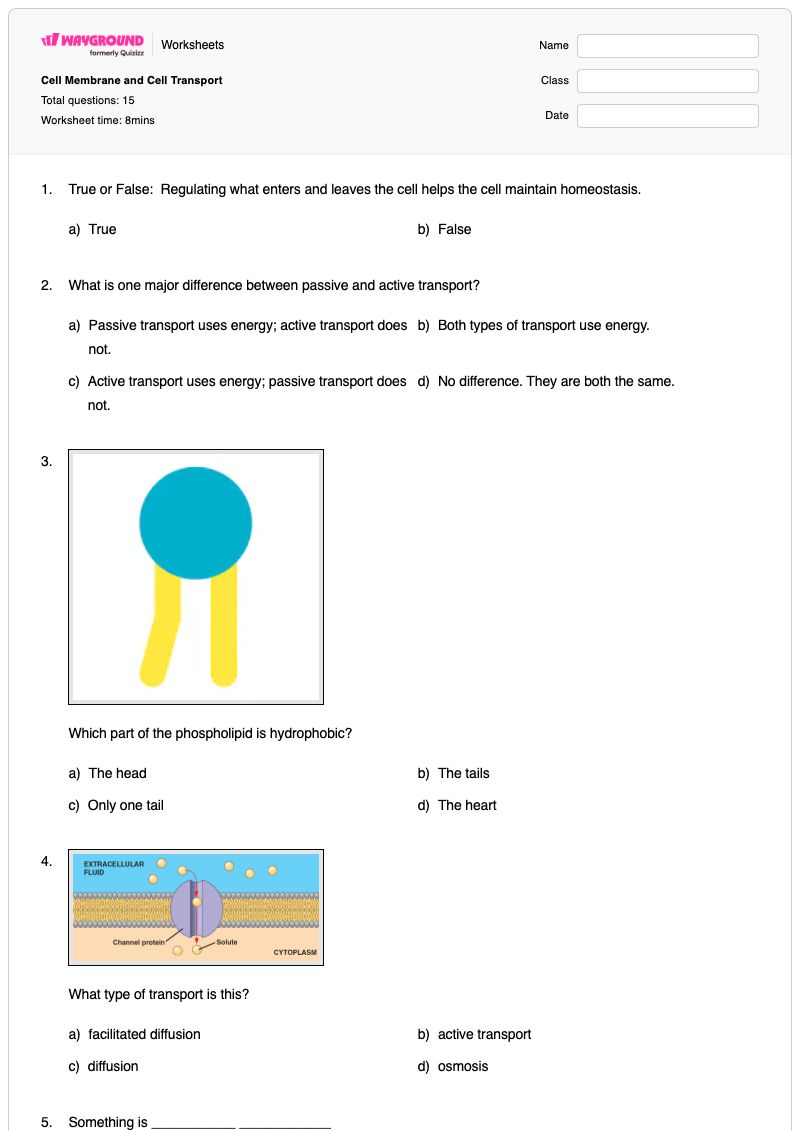
What type of transport is this?
a)
facilitated diffusion
b)
active transport
c)
diffusion
d)
osmosis
5.
Something is ___________ ____________ when some molecules can cross the membrane while others cannot.
a)
Selectively (or Semi) Permeable
b)
Totally Transparent
c)
Liquid Licorice
d)
Heavily Patrolled
6.
Nemo and other ocean dwelling fish cannot survive in freshwater because......
a)
freshwater is hypertonic to Nemo's cells and will result in water leaving them causing the cells to shrink
b)
freshwater is hypotonic to Nemo's cells and will result in water leaving them causing the cells to shrink
c)
freshwater is hypertonic to Nemo's cells and will result in water entering them causing the cells to swell and burst
d)
freshwater is hypotonic to Nemo's cells and will result in water enter them causing the cells to swell and burst
7.
In an isotonic solution which way will the water flow
a)
it will not flow at all
b)
it will flow into the cell
c)
it will flow both ways at equal rates
d)
out of the cell
8.
What would happen to a cell placed in a hypertonic solution
a)
The cell would shrink
b)
The cell would expand and possibly burst
c)
The cell would remain the same
d)
The cell would dance and do the Nay Nay!
9.
Which molecule is in equilibrium? How can you tell?
a)
Molecule A; equal amounts inside and outside
b)
Molecule B; passive movement into the cell
c)
Molecule C; equal amounts inside and outside
d)
Molecule C; all molecules are inside the cell
10.
In this picture, which way will the water move?
a)
Water will move into the cell
b)
Water will move out of the cell
c)
Water will move in and out of the cell
d)
Water will not move
11.
In this picture, how do you classify the solution?
a)
The solution is hypotonic
b)
The solution is hypertonic
c)
The solution is isotonic
d)
The solution is my tonic
12.
When cells form a vesicle to take in materials, which form of transport is occurring?
a)
Endocytosis
b)
Exocytosis
c)
Facilitated Diffusion
d)
Osmosis
13.
Active transport is the movement of large materials across a cell membrane from ______ to ______ concentration
a)
high to low
b)
low to high
c)
high to high
d)
low to low
14.
Active transport across a cell membrane from low to high concentration, requires
a)
energy (ATP)
b)
no energy
c)
water
d)
oxygen
15.
Describes the arrangement of the cell membrane as bendable and made of many parts.
a)
The Fluid Mosaic Model
b)
The Major Mobility Model
c)
The Crazy Cell Model
d)
The Maze Model
Answer Key
Cell Membrane and Cell Transport
Total questions: 15
1.
a) True
2.
c) Active transport uses energy; passive transport does not.
3.
b)
The tails
4.
a) facilitated diffusion
5.
a) Selectively (or Semi) Permeable
6.
d)
freshwater is hypotonic to Nemo's cells and will result in water enter them causing the cells to swell and burst
7.
c)
it will flow both ways at equal rates
8.
a)
The cell would shrink
9.
a)
Molecule A; equal amounts inside and outside
10.
a) Water will move into the cell
11.
a) The solution is hypotonic
12.
a) Endocytosis
13.
b)
low to high
14.
a)
energy (ATP)
15.
a) The Fluid Mosaic Model
140 %
Browse by subjects
Browse by grades
Browse by format
FAQs
What does the Cell Membrane and Cell Transport worksheet cover?
This Grade 9 biology worksheet uses 15 multiple-choice questions to assess cell membrane structure and transport processes. Students classify passive and active transport, identify phospholipid features, interpret hypotonic, hypertonic, and isotonic conditions, predict water movement and cell responses, and distinguish processes such as facilitated diffusion and endocytosis.
How can I use this worksheet to teach cell membrane transport?
Introduce the worksheet by reviewing selective permeability, the phospholipid bilayer, and the difference between movement with and against a concentration gradient. As students work through the osmosis and transport questions, have them explain the direction of water or molecule movement before choosing an answer, then use the active transport and ATP items to connect uphill movement with energy use.
What mistakes should I watch for when students complete this cell transport worksheet?
Watch for students reversing the meanings of hypertonic and hypotonic or predicting water movement without comparing solute concentrations. They may also confuse passive transport with active transport, overlook that active transport requires ATP and moves from low to high concentration, or mix up endocytosis with exocytosis. The phospholipid structure and equilibrium questions can reveal confusion between hydrophobic tails and membrane balance.
How do I assign and grade this Cell Membrane and Cell Transport worksheet?
The worksheet is available as a printable PDF and as a digital quiz on Wayground, with a complete answer key for all 15 multiple-choice questions. Printable submissions can be graded by scanning student work with the Wayground for Teachers app, while the digital version supports online completion and grading.
How can I differentiate this cell transport worksheet for my students?
Use the worksheet’s Advanced Settings to adjust font spacing and font size so the 15 multiple-choice items and transport scenarios are easier to read. You can also apply a dyslexia-friendly font or translate the worksheet into another language, depending on students’ reading needs.
Where can I find more worksheets like this on Wayground?
Wayground offers a comprehensive collection of free printable worksheets and practice problems across all subjects, with downloadable PDFs and answer keys to support essential skill and concept mastery. Browse more resources at https://wayground.com/en-us/worksheets.