

WorksheetsCell Membrane and Transport
Total questions: 17
Answer KeyCell Membrane and Transport
Total questions: 17
phopholipid
proteins

By Ashley Osborne
17 questions
9th - 9th Grade
Science
706 plays
Updated Sept 2026
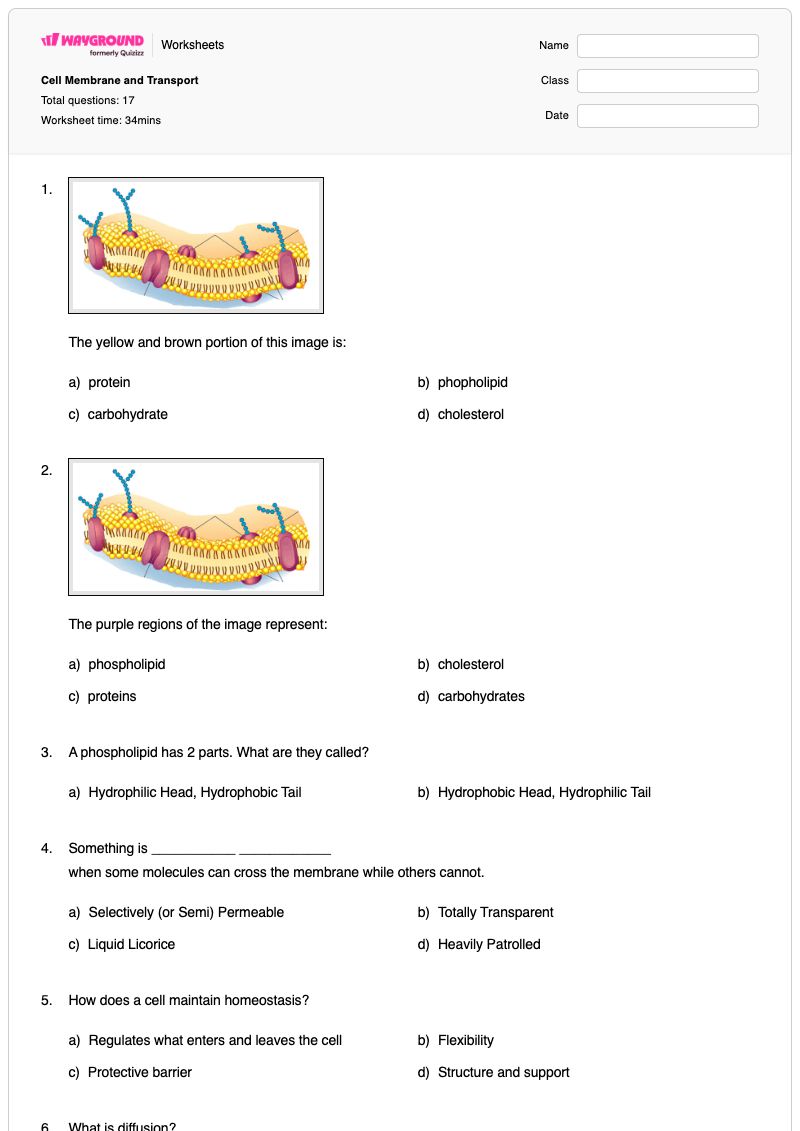
Cell Membrane and Transport is a Grade 9 biology worksheet with 17 multiple-choice questions on how cell membranes are structured and how substances move across them. Students identify phospholipids, proteins, and the hydrophilic head and hydrophobic tail; define selective permeability and homeostasis; and distinguish diffusion, osmosis, facilitated diffusion, and other transport processes. The worksheet also asks students to classify active and passive transport, identify endocytosis and exocytosis, and use cell diagrams and an egg-shrinkage example to recognize hypotonic and hypertonic solutions. These questions help students connect membrane structure with the movement of water, particles, and larger materials across the cell membrane. It is a free printable worksheet with a complete answer key, suitable for Grade 9 biology practice, review, or assessment.
Worksheet settings
Font size
Worksheets
Answer Keyphopholipid
proteins
This Grade 9 biology worksheet uses 17 multiple-choice questions to assess cell membrane structure, selective permeability, homeostasis, and transport processes. Students identify membrane components from diagrams, distinguish diffusion, osmosis, facilitated diffusion, endocytosis, and exocytosis, and classify cells or examples in hypotonic and hypertonic solutions.
Introduce the worksheet by reviewing the phospholipid bilayer, including the hydrophilic head and hydrophobic tail, then model how concentration differences drive diffusion and osmosis. As students complete the multiple-choice items, ask them to explain why facilitated diffusion is passive and how endocytosis and exocytosis move larger materials. Use the solution and egg-shrinkage questions as a discussion prompt about how tonicity affects cells.
Students may confuse phospholipids with membrane proteins or reverse the hydrophilic head and hydrophobic tail. Watch for confusion between diffusion and osmosis, especially forgetting that osmosis refers specifically to water, and between facilitated diffusion and protein pumps because both involve membrane proteins. The tonicity items may also reveal that students are not connecting a shrunken cell or egg with a hypertonic solution.
You can assign it as a printable PDF or as a digital quiz on Wayground, and it includes a complete answer key for the 17 multiple-choice questions. For printable submissions, scan student work with the Wayground for Teachers app to help grade responses efficiently.
In the worksheet’s Advanced Settings, adjust font spacing or font size to make the membrane diagrams, transport terms, and multiple-choice options easier to read. You can also enable a dyslexia-friendly font or translate the worksheet into another language while keeping its cell transport format.
Wayground offers a broad collection of free printable worksheets and practice problems across subjects, with downloadable PDFs and answer keys to support mastery of essential skills and concepts. Browse more resources at https://wayground.com/en-us/worksheets.