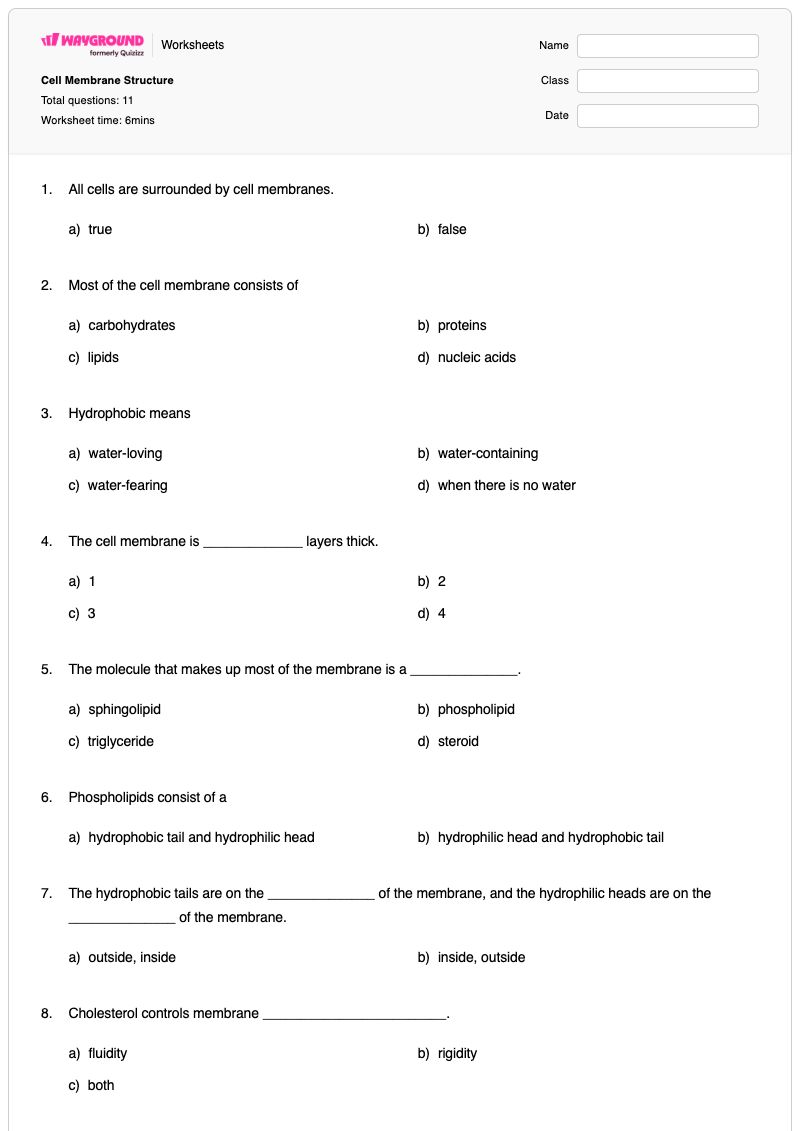
Cell Membrane Structure is a Grade 10 biology worksheet that builds foundational knowledge of the cell membrane’s composition, organization, and associated proteins. In 11 multiple-choice questions, students identify lipids and phospholipids as key membrane components, define hydrophobic, recognize the membrane’s two-layer structure, and distinguish hydrophilic heads from hydrophobic tails. They also review cholesterol’s relationship to membrane fluidity and rigidity, compare integral and peripheral proteins, and interpret the meaning of semi-permeable.
This worksheet works well for introducing or reviewing membrane structure before lessons on transport across membranes. The focused question set helps teachers check whether students can connect scientific vocabulary to structural features rather than rely on broad recognition of the term “cell membrane.” It is a free printable worksheet with a complete answer key, and its multiple-choice format supports independent practice, bell-ringer review, or a quick formative assessment.
Worksheet settings
Font size
S
M
L
XL
Worksheets
Cell Membrane Structure
Total questions: 11
Name
Class
Date
1.
All cells are surrounded by cell membranes.
a)
true
b)
false
2.
Most of the cell membrane consists of
a)
carbohydrates
b)
proteins
c)
lipids
d)
nucleic acids
3.
Hydrophobic means
a)
water-loving
b)
water-containing
c)
water-fearing
d)
when there is no water
4.
The cell membrane is _____________ layers thick.
a)
1
b)
2
c)
3
d)
4
5.
The molecule that makes up most of the membrane is a ______________.
a)
sphingolipid
b)
phospholipid
c)
triglyceride
d)
steroid
6.
Phospholipids consist of a
a)
hydrophobic tail and hydrophilic head
b)
hydrophilic head and hydrophobic tail
7.
The hydrophobic tails are on the ______________ of the membrane, and the hydrophilic heads are on the ______________ of the membrane.
_______________________ proteins are wedged into the cell membrane.
a)
peripheral
b)
integral
10.
Peripheral proteins sit ___________________________ the cell membrane
a)
atop/outside of
b)
within
11.
Membranes are semi-permeable, which means they allow nothing in or out of the cell.
a)
true
b)
false
Answer Key
Cell Membrane Structure
Total questions: 11
1.
a)
true
2.
c)
lipids
3.
c)
water-fearing
4.
b)
2
5.
b)
phospholipid
6.
a)
hydrophobic tail and hydrophilic head
7.
a)
outside, inside
8.
c)
both
9.
b)
integral
10.
a)
atop/outside of
11.
b)
false
140 %
Browse by subjects
Browse by grades
Browse by format
FAQs
What does the Cell Membrane Structure worksheet cover?
This Grade 10 biology worksheet uses 11 multiple-choice questions to assess cell membrane structure and vocabulary. Students identify lipids and phospholipids, define hydrophobic, recognize the two-layer organization, distinguish integral from peripheral proteins, connect cholesterol with fluidity and rigidity, and interpret semi-permeability.
How can I use this worksheet to teach cell membrane structure?
Introduce the worksheet after students have seen a labeled membrane diagram, then have them use each multiple-choice item to connect terms such as phospholipid, hydrophobic, integral, and peripheral to structural features. Pause after questions about phospholipid parts and protein location to ask students to explain why the options differ, rather than treating the activity as answer selection only.
What mistakes should I watch for on this cell membrane worksheet?
Students may confuse lipids with the more specific term phospholipid, reverse the hydrophobic and hydrophilic descriptions, or mix up integral proteins with peripheral proteins. Also watch for students choosing “nothing in or out” for semi-permeable, or treating cholesterol as affecting only one membrane property instead of recognizing the worksheet’s “both” answer.
How do I assign and grade the Cell Membrane Structure worksheet?
The worksheet is available as a printable PDF and as a digital quiz on Wayground, and it includes a complete answer key for all 11 multiple-choice questions. For printable submissions, you can scan student work with the Wayground for Teachers app to support grading and review.
How can I differentiate this cell membrane worksheet for my students?
In the worksheet’s Advanced Settings, adjust font spacing or font size to make the multiple-choice options easier to scan. You can also enable a dyslexia-friendly font or translate the worksheet into another language when students need a different text presentation for the membrane vocabulary.
Where can I find more worksheets like this on Wayground?
Wayground offers a comprehensive collection of free printable worksheets and practice problems across subjects, with downloadable PDFs and answer keys to help students master essential skills and concepts. Browse more resources at https://wayground.com/en-us/worksheets.


 Worksheets