

Wayground
Cell Transport - Printable Science Worksheets 9th - 9th Grade - Wayground

Cell Transport

Candace Parr

By Candace Parr

20 questions

9th - 9th Grade

Science

1.3K plays

Updated Oct 2026

Cell Transport is a Grade 9 Biology worksheet that helps students explain how the cell membrane’s phospholipids, proteins, and carbohydrates support selective movement and homeostasis. Students identify membrane components, connect biomolecules to membrane functions, interpret the hydrophilic and hydrophobic structure of phospholipids, and distinguish diffusion, facilitated diffusion, active transport, endocytosis, and exocytosis. This free printable worksheet includes 20 mixed-format questions, including multiple-choice, multiple-select, hotspot, matching, dropdown, classification, and fill-in-the-blank items. Students compare movement with and against a concentration gradient, determine whether transport requires energy, and use diagrams to identify transport processes. It is designed for Grade 9 biology instruction, independent practice, or formative assessment, and includes a complete answer key for efficient review and grading.

Worksheet settings

Font size

S
M
L
XL
WaygroundWorksheets

Cell Transport

Total questions: 20

Name
Class
Date
1.

Which biomolecules (THREE) are found in the cell membrane?

a)

lipids

b)

proteins

c)

nucleic acids

d)

carbohydrates

2.

Which biomolecule makes up MOST of the cell membrane?

a)

proteins

b)

carbohydrates

c)

phospholipids

d)

nucleic acids

3.

Which biomolecule helps LARGE molecules cross the membrane?

a)

phospholipids

b)

carbohydrates

c)

nucleic acids

d)

proteins

4.

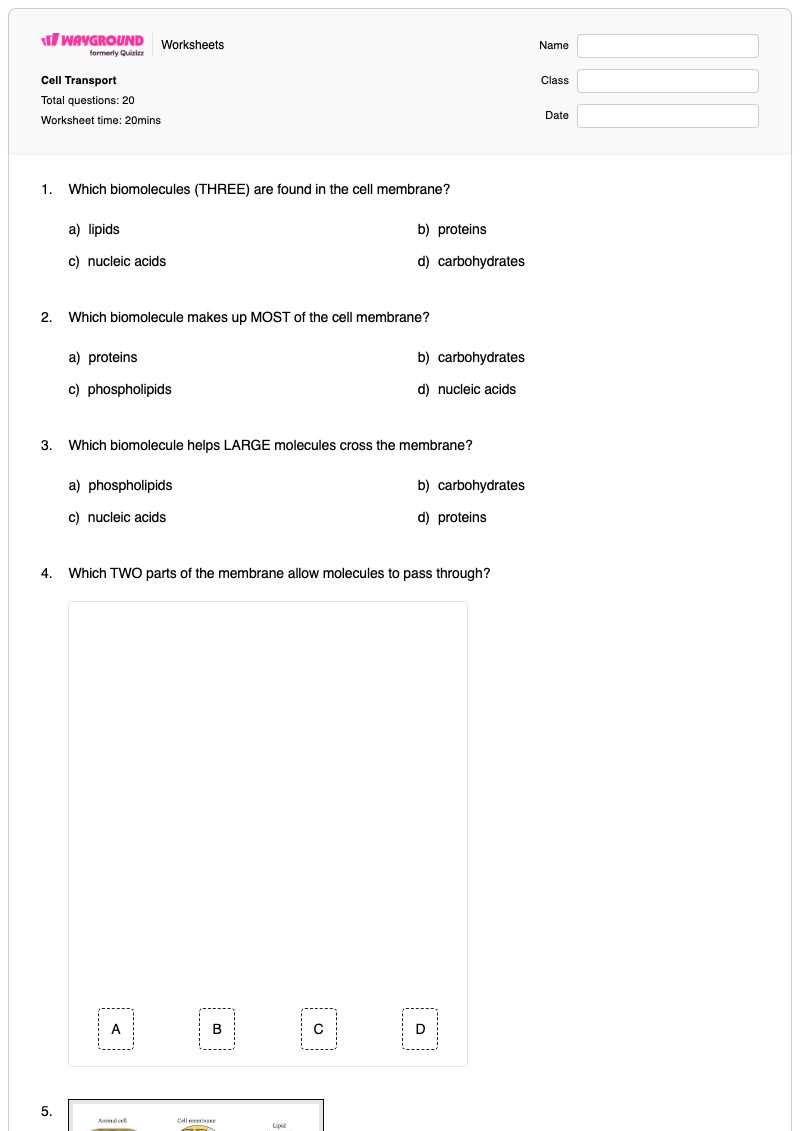
Which TWO parts of the membrane allow molecules to pass through?

5.
The cell membrane can separate the inside of the cell from the outside because of its phospholipids, which are

The cell membrane can separate the inside of the cell from the outside because of its phospholipids, which are

a)
hydrophilic on both sides
b)
hydrophobic on both sides
c)
hydrophilic on one side and hydrophobic on the other
6.
Match the following functions to each biomolecule in the cell membrane:

Match the following functions to each biomolecule in the cell membrane:

cell recognition

carbohydrates

transport LARGE/charged molecules through the membrane

proteins

allow small molecules to pass through the membrane

phospholipids

7.

How does the cell membrane help maintain homeostasis in each cell?

a)

The cell membrane allows all substances to pass through freely

b)

The cell membrane controls the movement of substances in and out of the cell

c)

The cell membrane provides energy for the cell

d)

The cell membrane produces proteins necessary for cell function

8.

Passive transport ​ (a)   require energy because it moves ​ (b)   the concentration gradient, from ​ (c)   .

Choose from the below words
does NOT
does
with
against
high to low
low to high
9.

Active transport ​ (a)   require energy because it moves ​ (b)   the concentration gradient, from ​ (c)   .

Choose from the below words
does NOT
does
with
against
high to low
low to high
10.
What is the correct description of the transport in the image?

What is the correct description of the transport in the image?

a)

small molecules crossing the lipid bilayer (diffusion)

b)

large molecules crossing through a protein (facilitated diffusion)

c)

many molecules coming into the cell using a membrane vesicle (endocytosis)

d)

many molecules coming out of the cell using a vesicle to fuse with the membrane (exocytosis)

11.
What is the correct description of the transport in the image?

What is the correct description of the transport in the image?

a)

small molecules crossing the lipid bilayer (diffusion)

b)

large molecules crossing through a protein (facilitated diffusion)

c)

many molecules coming into the cell using a membrane vesicle (endocytosis)

d)

many molecules coming out of the cell using a vesicle to fuse with the membrane (exocytosis)

12.

Facilitated diffusion and protein pumps are similar because

a)
They both require energy to function
b)
They both move molecules from high to low concentration
c)

They both involve the movement of molecules through proteins

d)
They both can only move molecules in one direction
13.

Facilitated diffusion and protein pumps are different because

a)

Both move movement of molecules from high concentration to low concentration

b)
Facilitated diffusion requires energy while protein pumps do not
c)
Protein pumps require energy while facilitated diffusion does not
d)

Both move molecules from low to high concentration

14.
Using the image, choose the correct form of transport and explanation of how you know:

Using the image, choose the correct form of transport and explanation of how you know:

a)

Active transport, because the molecules are crossing the membrane using a protein

b)

Passive transport because the molecules are crossing the membrane using a protein

c)

Active transport because the molecules are moving from low to high concentration

d)

Passive transport because the molecules are moving from high to low concentration

15.

Organize these options into the right type of transport:

Categorize the following

does NOT require energy

requires energy

molecules move WITH the gradient

molecules move AGAINST the gradient

molecules move from high concentration to low

molecules move from low concentration to high

Passive Transport
Active Transport
16.

What happens during osmosis?

a)
Transfer of energy from one place to another
b)

Movement of small molecules from high concentration to low concentration

c)

Movement of water molecules from an area of high water concentration to an area of low water concentration

d)
Process of breaking down food into simpler substances
17.

Which TWO of the following can be used to identify ACTIVE transport?

a)
Movement of molecules from high to low concentration
b)
Movement of molecules from low to high concentration
c)
Does not require energy
d)

Requires energy (ATP!)

18.

Which of the following images show transport that REQUIRES ENERGY? (more than one answer is correct!)

a)
Which of the following images show transport that REQUIRES ENERGY? (more than one answer is correct!)

b)
Which of the following images show transport that REQUIRES ENERGY? (more than one answer is correct!)

c)
Which of the following images show transport that REQUIRES ENERGY? (more than one answer is correct!)

d)
Which of the following images show transport that REQUIRES ENERGY? (more than one answer is correct!)

19.

Which of the following images show transport that DOES NOT require energy? (more than one answer is correct!)

a)
Which of the following images show transport that DOES NOT require energy? (more than one answer is correct!)

b)
Which of the following images show transport that DOES NOT require energy? (more than one answer is correct!)

c)
Which of the following images show transport that DOES NOT require energy? (more than one answer is correct!)

d)
Which of the following images show transport that DOES NOT require energy? (more than one answer is correct!)

20.

The main difference between passive and active transport is that one requires (a)   , while the other does not.

WaygroundAnswer Key

Cell Transport

Total questions: 20

1.
a)

lipids

, b)

proteins

, d)

carbohydrates

2.
c)

phospholipids

3.
d)

proteins

4.
5.
c) hydrophilic on one side and hydrophobic on the other
6.

cell recognition

 - 

carbohydrates

, 

transport LARGE/charged molecules through the membrane

 - 

proteins

, 

allow small molecules to pass through the membrane

 - 

phospholipids

7.
b)

The cell membrane controls the movement of substances in and out of the cell

8.
does NOT, with, high to low
9.
does, against, low to high
10.
c)

many molecules coming into the cell using a membrane vesicle (endocytosis)

11.
a)

small molecules crossing the lipid bilayer (diffusion)

12.
c)

They both involve the movement of molecules through proteins

13.
c) Protein pumps require energy while facilitated diffusion does not
14.
d)

Passive transport because the molecules are moving from high to low concentration

15.
Passive Transport

does NOT require energy

molecules move WITH the gradient

molecules move from high concentration to low

Active Transport

requires energy

molecules move AGAINST the gradient

molecules move from low concentration to high

16.
c)

Movement of water molecules from an area of high water concentration to an area of low water concentration

17.
b) Movement of molecules from low to high concentration, d)

Requires energy (ATP!)

18.
b)

, d)

19.
a)

, c)

20.
energy

FAQs

What does this Cell Transport worksheet cover, and how does it build students’ understanding?

This Grade 9 Biology worksheet covers cell membrane structure, biomolecule functions, selective permeability, homeostasis, and passive versus active transport. Its 20 mixed-format questions require students to identify membrane components, complete gradient-and-energy statements, classify transport characteristics, match functions to biomolecules, and interpret transport diagrams for diffusion and endocytosis. These tasks build the skill of using membrane structure, concentration gradients, and energy requirements to explain how substances cross the cell membrane.

How can I use this worksheet to teach cell membrane transport?

Introduce the worksheet by reviewing the membrane’s phospholipids and proteins, focusing on how hydrophilic and hydrophobic regions affect movement through the membrane. Then have students complete the biomolecule and membrane-function items before moving to the dropdown and classification questions about energy and concentration gradients. Use the diagram-based questions as discussion prompts: ask students what direction molecules move, whether a protein or vesicle is involved, and what evidence identifies diffusion, facilitated diffusion, or endocytosis.

What mistakes should I watch for when students complete this Cell Transport worksheet?

Watch for students confusing phospholipids, which make up most of the membrane, with proteins, which help large or charged molecules cross it. Students may also reverse the relationships between passive transport, energy, and concentration gradients, or assume that every process using a membrane protein requires energy. In the image-based and classification items, check that students distinguish movement from high to low concentration from movement from low to high and recognize vesicle-based transport as different from diffusion.

How do I assign and grade this Cell Transport worksheet?

The worksheet is available as a printable PDF and as a digital quiz on Wayground, with a complete answer key for checking responses across its multiple-select, multiple-choice, hotspot, matching, dropdown, classification, and fill-in-the-blank items. For printable submissions, you can grade student work by scanning it with the Wayground for Teachers app. The PDF option can also support schools that are reducing screen time.

How can I differentiate this Cell Transport worksheet for my students?

Use the worksheet’s Advanced Settings to adjust font spacing and font size so the mixed-format membrane and transport questions are easier to read and complete. You can also enable a dyslexia-friendly font or translate the worksheet into another language, which may support access to the concentration-gradient statements, classifications, and diagram-based transport items.

Where can I find more worksheets like this on Wayground?

Wayground offers a comprehensive collection of free printable worksheets and practice problems across subjects, with downloadable PDFs and answer keys to help students master essential skills and concepts. Browse more resources at https://wayground.com/en-us/worksheets.