

Wayground
Osmosis and Diffusion - Printable Science Worksheets 6th - 6th Grade - Wayground

Osmosis and Diffusion

Simon Dowle

By Simon Dowle

10 questions

6th - 6th Grade

Science

606 plays

Updated Jan 2026

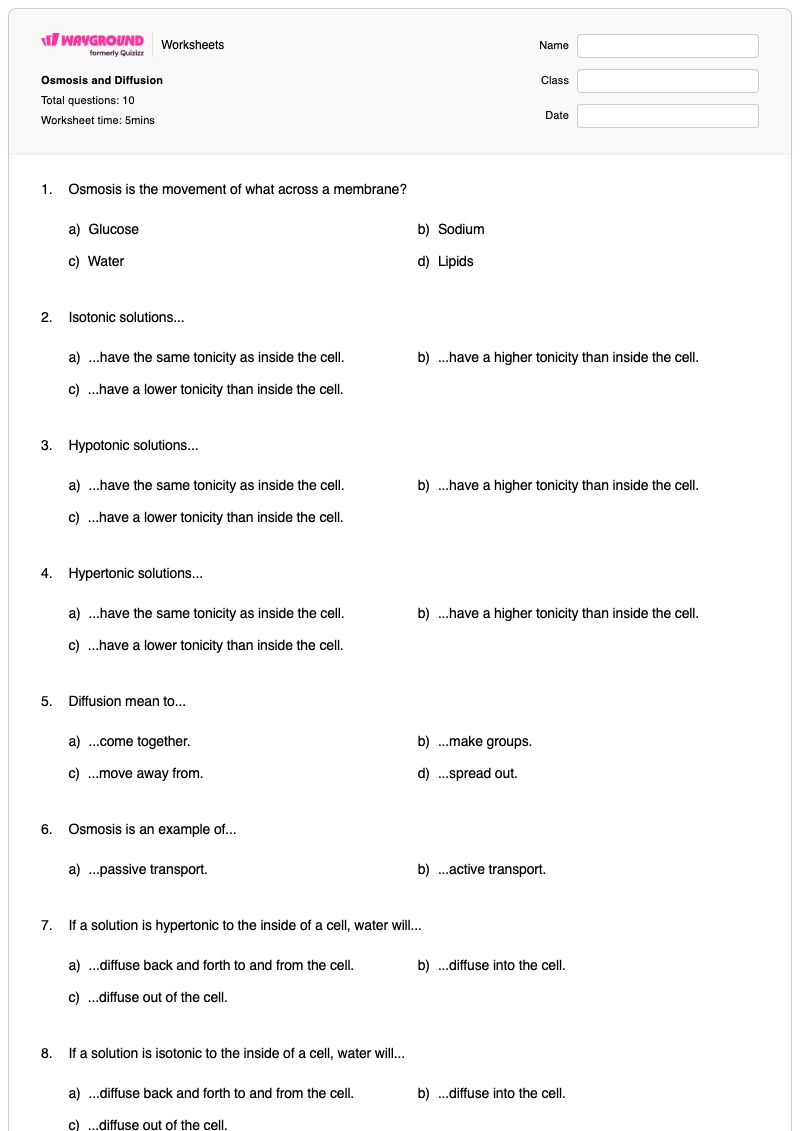
The Osmosis and Diffusion worksheet is a Grade 6 Biology resource with 10 multiple-choice questions focused on how water and substances move across cell membranes. Students identify osmosis as the movement of water and a form of passive transport, define diffusion as spreading out, and distinguish isotonic, hypotonic, and hypertonic solutions by comparing them with the inside of a cell. The questions also ask students to predict whether water will move into a cell, out of a cell, or back and forth when solutions have different tonicities. Completing this free printable worksheet helps students connect tonicity vocabulary to water movement and recognize equilibrium when tonicity is the same on both sides of a membrane. It includes a complete answer key for efficient review, independent practice, or assessment.

Worksheet settings

Font size

S
M
L
XL
WaygroundWorksheets

Osmosis and Diffusion

Total questions: 10

Name
Class
Date
1.

Osmosis is the movement of what across a membrane?

a)

Glucose

b)

Sodium

c)

Water

d)

Lipids

2.

Isotonic solutions...

a)

...have the same tonicity as inside the cell.

b)

...have a higher tonicity than inside the cell.

c)

...have a lower tonicity than inside the cell.

3.

Hypotonic solutions...

a)

...have the same tonicity as inside the cell.

b)

...have a higher tonicity than inside the cell.

c)

...have a lower tonicity than inside the cell.

4.

Hypertonic solutions...

a)

...have the same tonicity as inside the cell.

b)

...have a higher tonicity than inside the cell.

c)

...have a lower tonicity than inside the cell.

5.

Diffusion mean to...

a)

...come together.

b)

...make groups.

c)

...move away from.

d)

...spread out.

6.

Osmosis is an example of...

a)

...passive transport.

b)

...active transport.

7.

If a solution is hypertonic to the inside of a cell, water will...

a)

...diffuse back and forth to and from the cell.

b)

...diffuse into the cell.

c)

...diffuse out of the cell.

8.

If a solution is isotonic to the inside of a cell, water will...

a)

...diffuse back and forth to and from the cell.

b)

...diffuse into the cell.

c)

...diffuse out of the cell.

9.

If a solution is hypotonic to the inside of a cell, water will...

a)

...diffuse back and forth to and from the cell.

b)

...diffuse into the cell.

c)

...diffuse out of the cell.

10.

When the tonicty is the same either side of a membrane, we refer to this a reaching...

a)

...equilibrium

b)

...diffusion.

c)

...isolation.

d)

...hybernation.

WaygroundAnswer Key

Osmosis and Diffusion

Total questions: 10

1.
c)

Water

2.
a)

...have the same tonicity as inside the cell.

3.
c)

...have a lower tonicity than inside the cell.

4.
b)

...have a higher tonicity than inside the cell.

5.
d)

...spread out.

6.
a)

...passive transport.

7.
c)

...diffuse out of the cell.

8.
a)

...diffuse back and forth to and from the cell.

9.
b)

...diffuse into the cell.

10.
a)

...equilibrium

FAQs

What does the Osmosis and Diffusion worksheet cover?

This Grade 6 Biology worksheet uses 10 multiple-choice questions to check whether students can identify osmosis as water moving across a membrane and as passive transport, define diffusion as spreading out, and classify isotonic, hypotonic, and hypertonic solutions. Students then apply those definitions to predict whether water moves into a cell, out of a cell, or back and forth, and connect equal tonicity with equilibrium.

How can I use this worksheet to teach osmosis and diffusion?

Introduce the worksheet by reviewing the meaning of diffusion, osmosis, and passive transport, then have students compare each solution type with the inside of a cell. Before students answer the directional questions, ask them to explain how hypertonic, isotonic, and hypotonic conditions should affect water movement; use the multiple-choice responses to discuss why water moves out, moves in, or moves in both directions.

What mistakes should I watch for when students complete this worksheet?

Students may reverse hypotonic and hypertonic, leading them to choose water moving into the cell when the solution is hypertonic or out when it is hypotonic. They may also confuse isotonic conditions with no movement instead of the worksheet’s answer that water diffuses back and forth, or mistake diffusion for active transport rather than passive transport.

How do I assign and grade the Osmosis and Diffusion worksheet?

You can assign this worksheet as a printable PDF or as a digital quiz on Wayground, and it includes a complete answer key for checking the 10 multiple-choice responses. For printable submissions, scan student work with the Wayground for Teachers app to help grade it efficiently.

How can I differentiate this osmosis and diffusion worksheet for my students?

Use the worksheet’s Advanced Settings to adjust font spacing or increase the font size so the 10 multiple-choice items are easier to read. You can also enable a dyslexia-friendly font or translate the osmosis, diffusion, and tonicity questions into another language when that better supports access to the content.

Where can I find more worksheets like this on Wayground?

Wayground offers a broad collection of free printable worksheets and practice problems across subjects, with downloadable PDFs and answer keys to support essential skills and concepts. Browse more resources at https://wayground.com/en-us/worksheets.