

Wayground
U4 Quizizz: Amoeba Sisters: Cell Membrane - Printable Science Worksheets 9th - 12th Grade - Wayground

U4 Quizizz: Amoeba Sisters: Cell Membrane

Christopher Powers

By Christopher Powers

12 questions

9th - 12th Grade

Science

Updated Sept 2026

U4 Quizizz: Amoeba Sisters: Cell Membrane is a free printable Biology worksheet for students in Grades 9–12. It checks understanding of the plasma membrane’s structure and functions through 11 multiple-choice questions and one open-ended item. Students identify osmosis, explain why surface area matters, and recognize what the Fluid Mosaic Model describes. The questions also review how phospholipids, cholesterol, proteins, glycoproteins, and glycolipids contribute to membrane structure and function. Students distinguish polar heads from nonpolar tails, compare peripheral and integral proteins, identify proteins as the main components of channels and pumps, and select the membrane component involved in moving large or charged molecules. A complete answer key is included for efficient review, independent practice, or assessment.

Worksheet settings

Font size

S
M
L
XL
WaygroundWorksheets

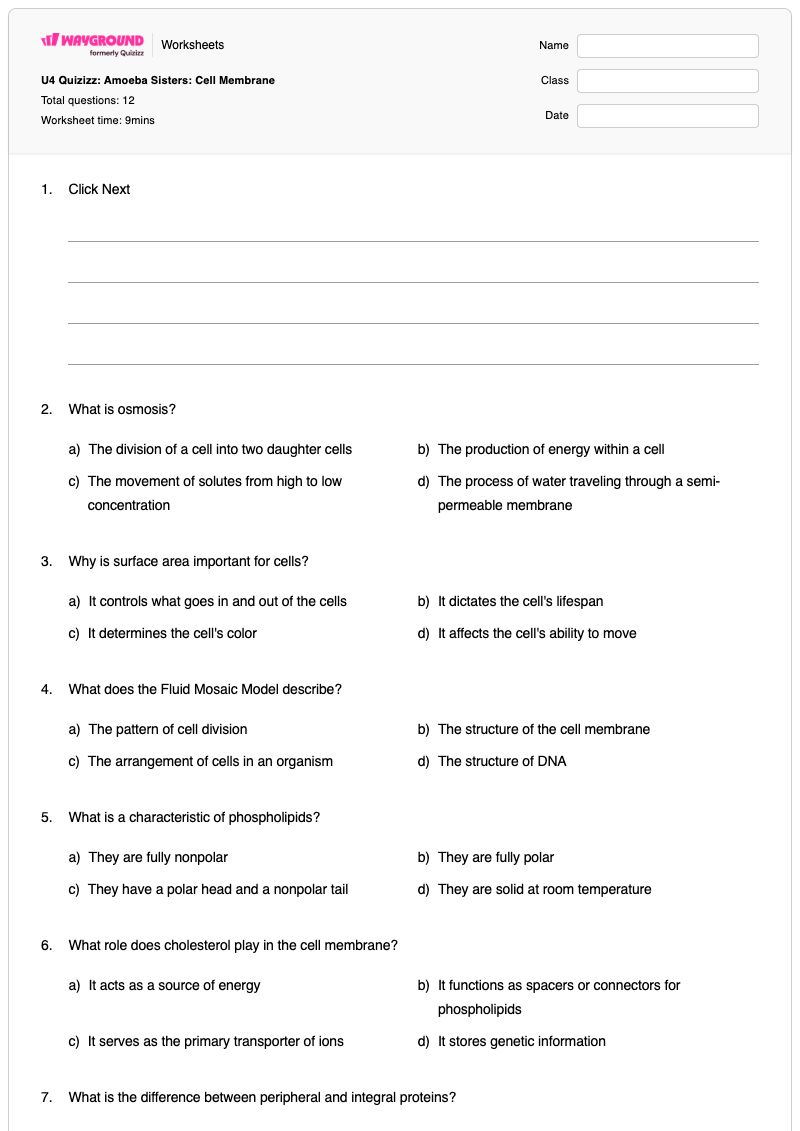
U4 Quizizz: Amoeba Sisters: Cell Membrane

Total questions: 12

Name
Class
Date
1.

Click Next

4 lines
2.

What is osmosis?

a)

The division of a cell into two daughter cells

b)

The production of energy within a cell

c)

The movement of solutes from high to low concentration

d)

The process of water traveling through a semi-permeable membrane

3.

Why is surface area important for cells?

a)

It controls what goes in and out of the cells

b)

It dictates the cell's lifespan

c)

It determines the cell's color

d)

It affects the cell's ability to move

4.

What does the Fluid Mosaic Model describe?

a)

The pattern of cell division

b)

The structure of the cell membrane

c)

The arrangement of cells in an organism

d)

The structure of DNA

5.

What is a characteristic of phospholipids?

a)

They are fully nonpolar

b)

They are fully polar

c)

They have a polar head and a nonpolar tail

d)

They are solid at room temperature

6.

What role does cholesterol play in the cell membrane?

a)

It acts as a source of energy

b)

It functions as spacers or connectors for phospholipids

c)

It serves as the primary transporter of ions

d)

It stores genetic information

7.

What is the difference between peripheral and integral proteins?

a)

There is no difference; they are the same

b)

Peripheral proteins are on the exterior areas of the membrane, while integral proteins go through the membrane

c)

Peripheral proteins can go through the membrane, while integral proteins cannot

d)

Peripheral proteins are found inside the cell, while integral proteins are on the surface

8.

What is the significance of glycoproteins and glycolipids in the cell membrane?

a)

They replicate genetic material

b)

They make the cell membrane rigid

c)

They are involved in cell signaling and recognition

d)

They provide energy for the cell

9.

Which type of biological macromolecule is the main component of the plasma membrane?

a)

carbohydrate

b)

lipid

c)

protein

d)

nucleic acid

10.
What forms the channels and pumps in the phospholipid bilayer?
a)
carbohydrates
b)
proteins
c)
hydrophilic heads 
d)
lipids
11.
___________ have 2 functions in the cell membrane.
1.) They act like gatekeepers, only let certain things in. 
2.) Enzyme receptors embedded in the membrane.
a)
Carbohydrates 
b)
Proteins 
c)
Phospholipids 
d)
Cholesterol
12.
Which of the following is responsible for getting large or charged (polar) molecules across the cell membrane?
a)
E
b)
B
c)
C
d)
D
WaygroundAnswer Key

U4 Quizizz: Amoeba Sisters: Cell Membrane

Total questions: 12

1.
n/a
2.
d)

The process of water traveling through a semi-permeable membrane

3.
a)

It controls what goes in and out of the cells

4.
b)

The structure of the cell membrane

5.
c)

They have a polar head and a nonpolar tail

6.
b)

It functions as spacers or connectors for phospholipids

7.
b)

Peripheral proteins are on the exterior areas of the membrane, while integral proteins go through the membrane

8.
c)

They are involved in cell signaling and recognition

9.
b)

lipid

10.
b) proteins
11.
b) Proteins 
12.
c) C

FAQs

What does this cell membrane worksheet cover?

This Grade 9–12 Biology worksheet uses 11 multiple-choice questions and one open-ended item to assess cell membrane structure and function. Students practice identifying osmosis, explaining the Fluid Mosaic Model, distinguishing phospholipid parts and membrane proteins, and connecting membrane components with transport, signaling, and recognition roles.

How can I use this worksheet to teach cell membrane structure and transport?

Introduce the worksheet after students have learned the phospholipid bilayer, then ask them to explain their reasoning for each choice rather than relying on vocabulary recognition alone. Use the questions about polar heads and nonpolar tails, peripheral versus integral proteins, channels and pumps, and movement of large or charged molecules to connect membrane structure to transport function.

What mistakes should I watch for when students complete this cell membrane worksheet?

Watch for students confusing osmosis with the movement of solutes, or treating phospholipids as entirely polar or entirely nonpolar instead of recognizing their two-part structure. Students may also reverse peripheral and integral proteins, identify lipids rather than proteins as the material forming channels and pumps, or overlook the roles of glycoproteins and glycolipids in cell signaling and recognition.

How do I assign and grade this cell membrane worksheet?

The worksheet is available as a printable PDF and as a digital quiz on Wayground, and it includes a complete answer key for all 12 items. Printable submissions can be graded by scanning student work with the Wayground for Teachers app, while the digital version supports online assignment and grading.

How can I differentiate this cell membrane worksheet for my students?

In the worksheet’s Advanced Settings, adjust font spacing or font size to make the membrane terminology and answer choices easier to read. You can also enable a dyslexia-friendly font or translate the worksheet into another language, depending on students’ needs.

Where can I find more worksheets like this on Wayground?

Wayground offers a broad collection of free printable worksheets and practice problems across subjects, with downloadable PDFs and answer keys to support essential skills and concepts. Browse more resources at https://wayground.com/en-us/worksheets.