Understanding the Cell Membrane-Structure and Function
By John Hazell
3 questions
9th - 9th Grade
Science
20 plays
Updated Oct 2026
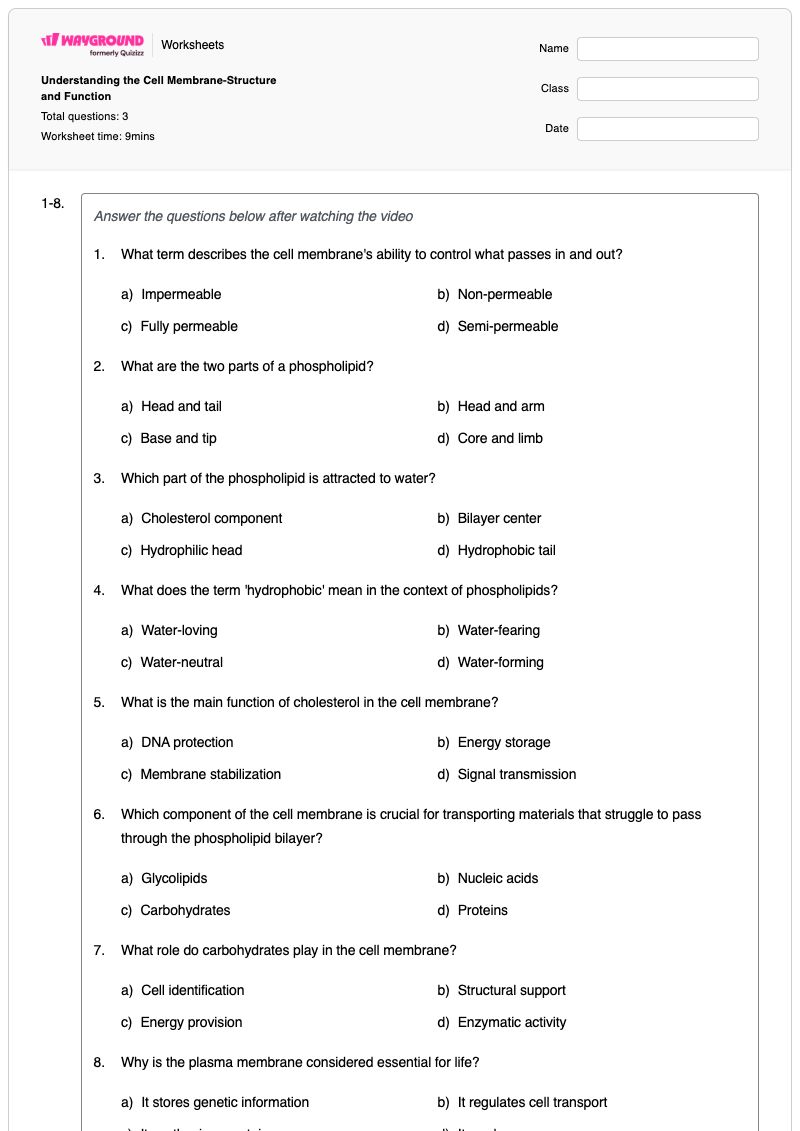
This Grade 9 biology worksheet builds understanding of the cell membrane’s structure and function through 11 questions. Students identify the membrane as semi-permeable, distinguish the hydrophilic head from the hydrophobic tail of a phospholipid, and connect membrane components—including cholesterol, proteins, and carbohydrates—to stabilization, transport, and cell identification. The worksheet includes a comprehension-video item, eight multiple-choice questions, and two drag-and-drop labeling tasks.
Students apply vocabulary and component-function knowledge before labeling the hydrophilic and hydrophobic regions of a phospholipid and phospholipid bilayer. It is useful for introducing or reviewing plasma membrane organization and checking whether students can connect molecular structure to the regulation of cell transport. This free printable worksheet includes a complete answer key for efficient review and grading.
Worksheet settings
Font size
S
M
L
XL
Worksheets
Understanding the Cell Membrane-Structure and Function
Total questions: 3
Name
Class
Date
1-8.
Answer the questions below after watching the video
1.
What term describes the cell membrane's ability to control what passes in and out?
a)
Impermeable
b)
Non-permeable
c)
Fully permeable
d)
Semi-permeable
2.
What are the two parts of a phospholipid?
a)
Head and tail
b)
Head and arm
c)
Base and tip
d)
Core and limb
3.
Which part of the phospholipid is attracted to water?
a)
Cholesterol component
b)
Bilayer center
c)
Hydrophilic head
d)
Hydrophobic tail
4.
What does the term 'hydrophobic' mean in the context of phospholipids?
a)
Water-loving
b)
Water-fearing
c)
Water-neutral
d)
Water-forming
5.
What is the main function of cholesterol in the cell membrane?
a)
DNA protection
b)
Energy storage
c)
Membrane stabilization
d)
Signal transmission
6.
Which component of the cell membrane is crucial for transporting materials that struggle to pass through the phospholipid bilayer?
a)
Glycolipids
b)
Nucleic acids
c)
Carbohydrates
d)
Proteins
7.
What role do carbohydrates play in the cell membrane?
a)
Cell identification
b)
Structural support
c)
Energy provision
d)
Enzymatic activity
8.
Why is the plasma membrane considered essential for life?
a)
It stores genetic information
b)
It regulates cell transport
c)
It synthesizes proteins
d)
It produces energy
9.
Label the regions of the phospholipid.
a)hydrophobic
b)hydrophilic
1
2
1)
2)
10.
Label the parts of the phospholipid bilayer
a)
Hydrophobic
b)
Hydrophilic
1
2
1)
2)
Answer Key
Understanding the Cell Membrane-Structure and Function
Total questions: 3
1-8.
1.
d)
Semi-permeable
2.
a)
Head and tail
3.
c)
Hydrophilic head
4.
b)
Water-fearing
5.
c)
Membrane stabilization
6.
d)
Proteins
7.
a)
Cell identification
8.
b) It regulates cell transport
9.
a
b
10.
b
a
140 %
Browse by subjects
Browse by grades
Browse by format
FAQs
What does this cell membrane worksheet cover?
This Grade 9 biology worksheet covers how cell membrane components contribute to structure and function. Its multiple-choice questions ask students to identify semi-permeability, phospholipid heads and tails, hydrophilic and hydrophobic regions, and the roles of cholesterol, proteins, and carbohydrates; the drag-and-drop items then have students label those phospholipid regions. Together, the items connect membrane structure with transport, stabilization, and cell identification.
How can I use this worksheet to teach cell membrane structure and function?
Use the comprehension-video item to introduce the plasma membrane, then model how phospholipid heads and tails arrange into a bilayer. Have students complete the multiple-choice questions while discussing why proteins help transport materials through the bilayer and why cholesterol stabilizes the membrane. Finish with the two drag-and-drop labeling tasks so students apply the hydrophilic and hydrophobic vocabulary to the membrane diagram.
What mistakes should I watch for when students complete this cell membrane worksheet?
Students may confuse hydrophilic and hydrophobic, selecting the water-loving head for the bilayer’s interior instead of the water-fearing tail. They may also assign transport to cholesterol or carbohydrates, although this worksheet distinguishes proteins as the components that help move materials through the bilayer and carbohydrates as involved in cell identification. Review the difference between a semi-permeable membrane and a fully permeable one, especially when students answer the function question or label the bilayer.
How do I assign and grade this cell membrane worksheet?
The worksheet is available as a printable PDF and as a digital quiz on Wayground, so you can choose paper-based practice or online completion. It includes a complete answer key for the multiple-choice and phospholipid-labeling items. For printable submissions, you can scan student work with the Wayground for Teachers app to help grade responses efficiently.
How can I differentiate this cell membrane worksheet for my students?
In the worksheet’s Advanced Settings, adjust font spacing or choose a larger font size to make the phospholipid and bilayer labeling tasks easier to read. You can also enable a dyslexia-friendly font for students who benefit from that presentation, or translate the worksheet into another language while students learn terms such as hydrophilic, hydrophobic, and semi-permeable.
Where can I find more free worksheets like this on Wayground?
Wayground offers a broad collection of free printable worksheets and practice problems across subjects, with downloadable PDFs and answer keys to support essential skills and concepts. Browse more resources at https://wayground.com/en-us/worksheets.


 Worksheets