

Wayground
Dilations and Translations Review - Printable Mathematics Worksheets class 7 - Wayground

Dilations and Translations Review

6 questions

7th - 7th Grade

Mathematics

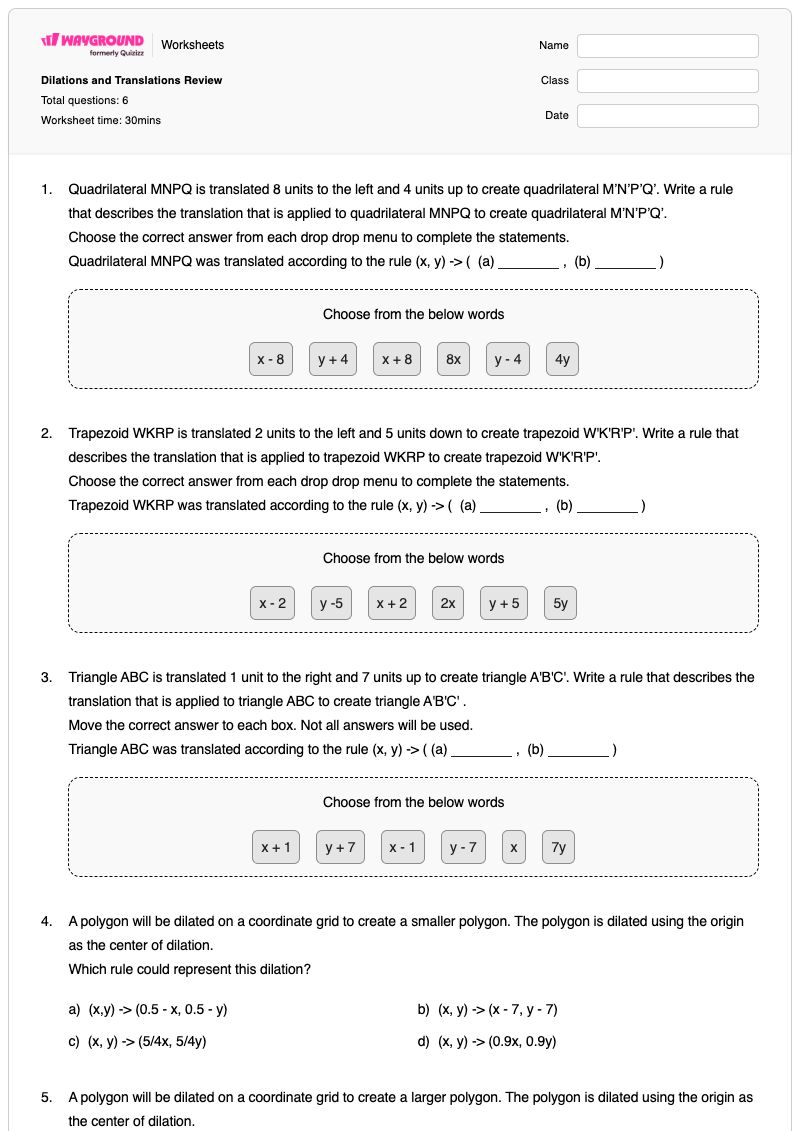
Dilations and Translations Review is a Grade 7 mathematics worksheet that helps students represent and interpret coordinate-plane transformations. Students complete six questions using dropdown selections, drag-and-drop responses, and multiple-choice items. The worksheet focuses on writing translation rules in the form (x, y) → (x + a, y + b), including horizontal and vertical movements, and identifying dilation rules centered at the origin. Students also determine whether a scale factor creates a larger or smaller figure and classify a transformation such as (x, y) → (3/5x, 3/5y) as a dilation. These varied response formats give teachers a focused way to check whether students can distinguish additive coordinate changes from multiplicative scale changes. This free printable worksheet includes a complete answer key and is designed for Grade 7 math review, independent practice, or a quick formative assessment.

Worksheet settings

Font size

S
M
L
XL
Worksheets

Dilations and Translations Review

Total questions: 6

Name
Class
Date
1.

Quadrilateral MNPQ is translated 8 units to the left and 4 units up to create quadrilateral M’N’P’Q’. Write a rule that describes the translation that is applied to quadrilateral MNPQ to create quadrilateral M’N’P’Q’.

Choose the correct answer from each drop drop menu to complete the statements.

Quadrilateral MNPQ was translated according to the rule (x, y) -> (​ ​​ (a)   , ​ (b)   ) ​

Choose from the below words
x - 8
y + 4
x + 8
8x
y - 4
4y
2.

Trapezoid WKRP is translated 2 units to the left and 5 units down to create trapezoid W'K'R'P'. Write a rule that describes the translation that is applied to trapezoid WKRP to create trapezoid W'K'R'P'.

Choose the correct answer from each drop drop menu to complete the statements.

Trapezoid WKRP was translated according to the rule (x, y) -> (​ ​​ (a)   , ​ (b)   ) ​

Choose from the below words
x - 2
y -5
x + 2
2x
y + 5
5y
3.

Triangle ABC is translated 1 unit to the right and 7 units up to create triangle A'B'C'. Write a rule that describes the translation that is applied to triangle ABC to create triangle A'B'C' .

Move the correct answer to each box. Not all answers will be used.

Triangle ABC was translated according to the rule (x, y) -> (​ (a)   , ​ (b)   )

Choose from the below words
x + 1
y + 7
x - 1
y - 7
x
7y
4.

A polygon will be dilated on a coordinate grid to create a smaller polygon. The polygon is dilated using the origin as the center of dilation.

Which rule could represent this dilation?

a)

(x,y) -> (0.5 - x, 0.5 - y)

b)

(x, y) -> (x - 7, y - 7)

c)

(x, y) -> (5/4x, 5/4y)

d)

(x, y) -> (0.9x, 0.9y)

5.

A polygon will be dilated on a coordinate grid to create a larger polygon. The polygon is dilated using the origin as the center of dilation.

Which rule could represent this dilation?

a)

(x,y) -> (0.5 - x, 0.5 - y)

b)

(x, y) -> (x - 7, y - 7)

c)

(x, y) -> (5/4x, 5/4y)

d)

(x, y) -> (0.9x, 0.9y)

6.

On a coordinate grid, triangle PQR is transformed by the rule (x, y) -> (3/5x, 3/5y) to create triangle P’Q’R’. Create true statements about the relationship between triangle PQR and triangle P'Q'R'.

Choose the correct answer from each drop down menu to complete the statements.

The transformation used to create triangle PQR to P'Q'R' is a ​ (a)   .

The trianlge P'Q'R' is ​ (b)   than triangle PQR.

Choose from the below words
dilation
smaller
translation
rotation
larger
Answer Key

Dilations and Translations Review

Total questions: 6

1.
x - 8, y + 4
2.
x - 2, y -5
3.
x + 1, y + 7
4.
d)

(x, y) -> (0.9x, 0.9y)

5.
c)

(x, y) -> (5/4x, 5/4y)

6.
dilation, smaller

FAQs

What does the Dilations and Translations Review worksheet cover?

This Grade 7 worksheet practices writing coordinate rules for translations and identifying dilations centered at the origin. Its six items use dropdowns, drag-and-drop, and multiple-choice responses to assess horizontal and vertical movement, scale factors that make figures larger or smaller, and recognizing a rule such as (x, y) → (3/5x, 3/5y) as a dilation.

How can I use this worksheet to teach translation and dilation rules?

Introduce translations by having students connect each movement to the coordinate changes: left or down uses subtraction, while right or up uses addition. Then use the dilation items to contrast additive rules with multiplication by a scale factor, asking students to predict whether factors such as 0.9 and 5/4 produce smaller or larger figures before completing the multiple-choice questions.

What mistakes should I watch for on this transformations worksheet?

Students may reverse the signs when writing translation rules, such as using y − 4 for a figure moved 4 units up or x + 8 for a figure moved 8 units left. They may also confuse translation with dilation by choosing an additive rule instead of a multiplicative scale factor, or misidentify 3/5 as making the image larger rather than smaller.

How do I assign and grade this worksheet?

The Dilations and Translations Review worksheet is available as a printable PDF and as a digital quiz on Wayground, with a complete answer key for checking the six responses. Printable submissions can be graded by scanning student work with the Wayground for Teachers app.

How can I differentiate this coordinate transformations worksheet for my students?

Use the worksheet’s Advanced Settings to adjust font spacing or increase the font size around the coordinate-rule prompts and answer choices. You can also enable a dyslexia-friendly font or translate the worksheet into another language when those changes will help students read the transformation rules and response options more independently.

Where can I find more worksheets like this on Wayground?

Wayground offers a comprehensive collection of free printable worksheets and practice problems across all subjects, with downloadable PDFs and answer keys to support mastery of essential skills and concepts. Browse more resources at https://wayground.com/en-us/worksheets.