Quadratics:Transforming Standard to Vertex Form (Honors)
Created by KATIE KENNEDY
10 questions
9th - 12th Grade
Math
Updated Oct 2026
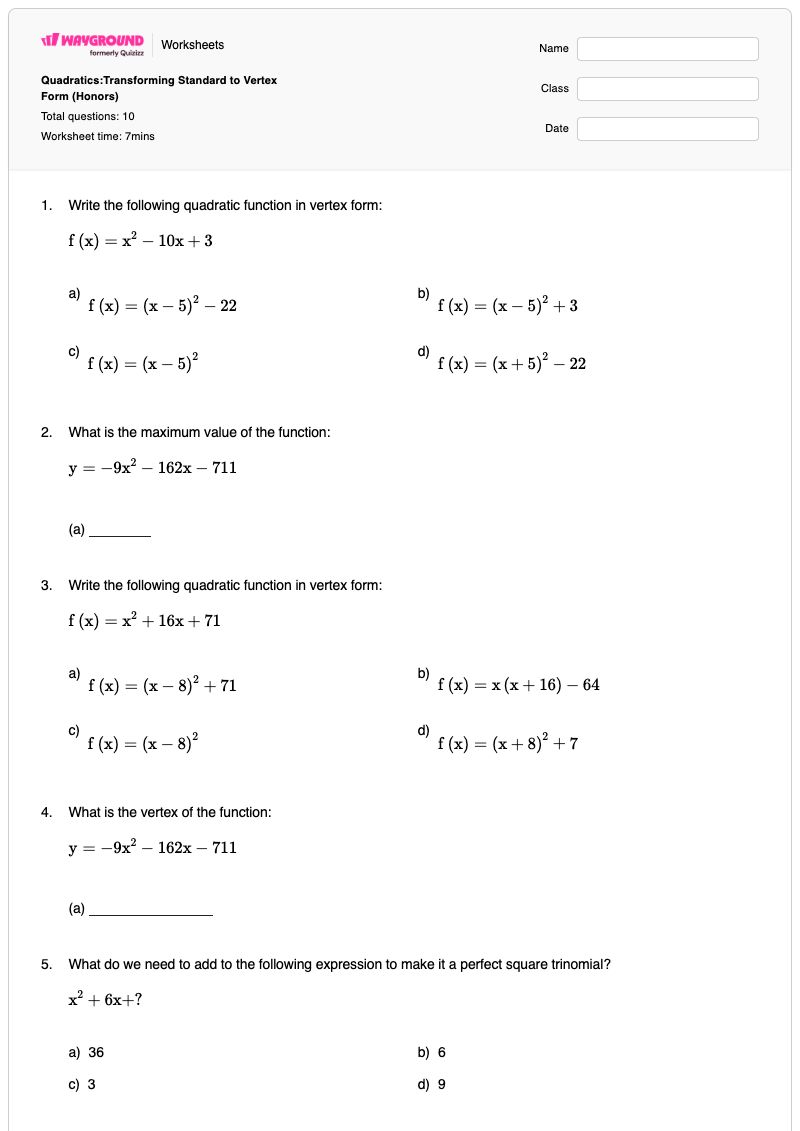
This honors-level mathematics worksheet helps students in Grades 9–12 transform quadratic functions from standard form to vertex form. Across 10 items—5 multiple-choice questions, 3 fill-in-the-blank questions, and 2 multiple-select questions—students rewrite quadratic equations, identify vertices and maximum values, determine what must be added to create perfect square trinomials, and recognize transformation features such as horizontal or vertical shifts and changes in stretch or reflection. The worksheet also asks students to identify the processes used in the transformation, including completing the square and the quadratic formula.
Use it to reinforce algebraic reasoning and connect symbolic work with graph interpretation. Students must attend to the coefficient of the linear term when completing the square, then interpret the resulting vertex form to identify key features of the parabola. This free printable worksheet includes a complete answer key for checking independent practice, homework, review, or assessment.
Worksheet settings
Font size
S
M
L
XL
Worksheets
Quadratics:Transforming Standard to Vertex Form (Honors)
Total questions: 10
Name
Class
Date
1.
Write the following quadratic function in vertex form:
f(x)=x2−10x+3
a)
f(x)=(x−5)2−22
b)
f(x)=(x−5)2+3
c)
f(x)=(x−5)2
d)
f(x)=(x+5)2−22
2.
What is the maximum value of the function:
y=−9x2−162x−711
(a)
3.
Write the following quadratic function in vertex form:
f(x)=x2+16x+71
a)
f(x)=(x−8)2+71
b)
f(x)=x(x+16)−64
c)
f(x)=(x−8)2
d)
f(x)=(x+8)2+7
4.
What is the vertex of the function:
y=−9x2−162x−711
(a)
5.
What do we need to add to the following expression to make it a perfect square trinomial?
x2+6x+?
a)
36
b)
6
c)
3
d)
9
6.
What do we need to add to the following expression to make it a perfect square trinomial?
9x2−30x+?
a)
225
b)
15
c)
25
d)
100
7.
What do we need to add to the following expression to make it a perfect square trinomial?
x2+5x+?
(a)
8.
The 2 processes we used to transform a quadratic standard to vertex form included:
a)
The quadratic formula
b)
Completing the square
c)
Factoring
d)
Foil
9.
Write the following quadratic function in vertex form:
f(x)=2x2+10x−6
a)
f(x)=2(x+25)2−37
b)
f(x)=2(x+25)2−237
c)
f(x)=(2x+5)2−237
d)
f(x)=(2x+5)2
10.
Which of the following are true about the following function:
f(x)=x2+10x+33
(Select All That Apply)
a)
The vertex is a maximum
b)
There is no vertical stretch/compress/reflect
c)
This graph is found to the left of the parent function
d)
This graph is found 8 units lower than the parent function
e)
The vertex form of the equation is:
y=(x+5)2+8
Answer Key
Quadratics:Transforming Standard to Vertex Form (Honors)
Total questions: 10
1.
a)
f(x)=(x−5)2−22
2.
18
3.
d)
f(x)=(x+8)2+7
4.
(-9, 18), (-9,18)
5.
d)
9
6.
c)
25
7.
25/4
8.
a)
The quadratic formula
, b)
Completing the square
9.
b)
f(x)=2(x+25)2−237
10.
b)
There is no vertical stretch/compress/reflect
, c)
This graph is found to the left of the parent function
, e)
The vertex form of the equation is:
y=(x+5)2+8
140 %
Browse by subjects
Browse by grades
Browse by format
FAQs
What does this quadratics worksheet cover?
This worksheet focuses on transforming quadratic functions from standard form to vertex form through completing the square and related algebraic steps. Its 10 questions have students rewrite equations, find vertices and maximum values, determine the value needed to form perfect square trinomials, and identify graph transformations using multiple-choice, fill-in-the-blank, and multiple-select formats.
How can I use this worksheet to teach transforming quadratics to vertex form?
First model how the linear coefficient determines the number added to create a perfect square trinomial, then connect that completed-square expression to vertex form and the vertex coordinates. Have students explain how the vertex form reveals maximum or minimum values and graph shifts before assigning the worksheet’s equation-rewriting and transformation-identification items for guided or independent practice.
What mistakes should I watch for when students complete this quadratics worksheet?
Watch for students adding the linear coefficient itself instead of half of it squared when creating a perfect square trinomial. Students may also reverse the sign of the horizontal vertex coordinate, confuse a maximum with a minimum, or select graph features without accounting for the horizontal and vertical shifts shown in vertex form. In the multiple-select items, remind students to evaluate every statement rather than choosing only one answer.
How do I assign and grade this quadratics worksheet?
The worksheet is available as a printable PDF and as a digital quiz on Wayground, and it includes a complete answer key for the vertex-form, perfect-square, maximum-value, and transformation questions. Printable submissions can be graded by scanning student work with the Wayground for Teachers app. The printable option can also support schools that are reducing screen time.
How can I differentiate this quadratic transformations worksheet?
Use the worksheet’s Advanced Settings to adjust font spacing or font size so the equation-rewriting and fill-in-the-blank items are easier to read. You can also enable a dyslexia-friendly font or translate the worksheet into another language when that better supports access to the vertex-form and perfect-square-trinomial tasks.
Where can I find more worksheets like this on Wayground?
Wayground offers a comprehensive collection of free printable worksheets and practice problems across subjects, with downloadable PDFs and answer keys to help students master essential skills and concepts. Browse more resources at https://wayground.com/en-us/worksheets.


 Worksheets