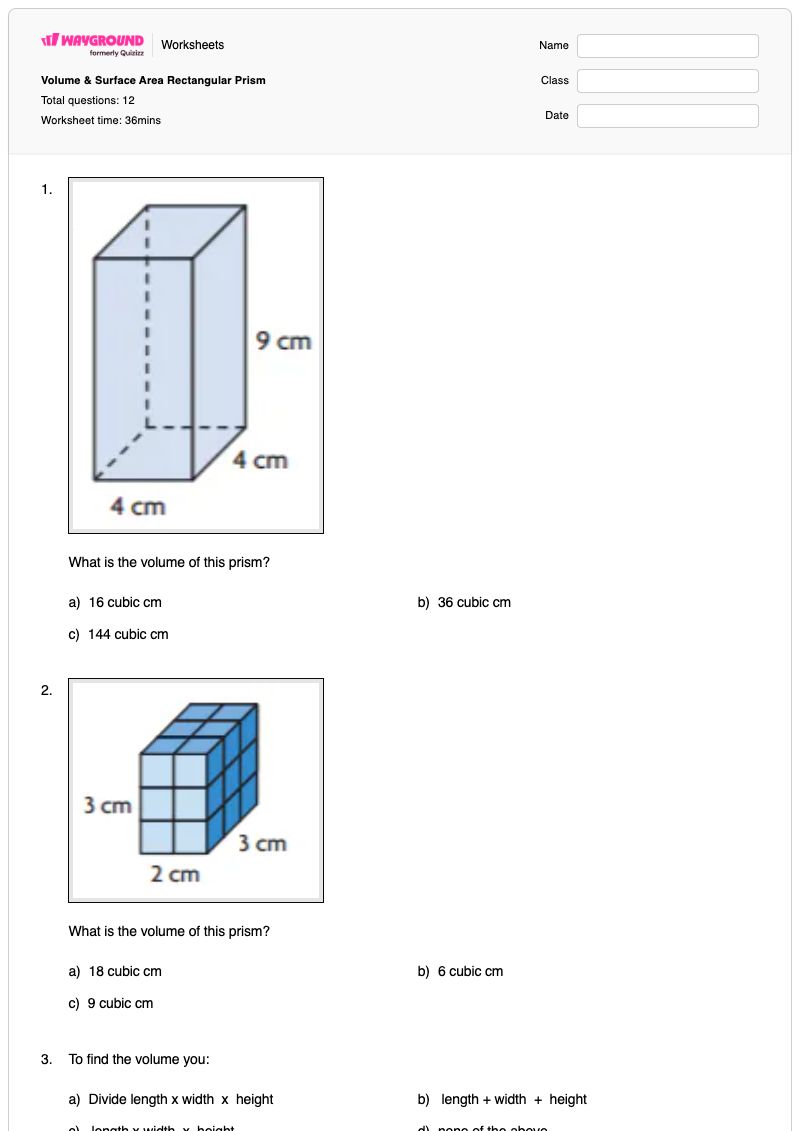
This Grade 7 mathematics worksheet gives students focused practice finding the volume and surface area of rectangular prisms. Across 12 multiple-choice questions, students calculate volume from prism dimensions, select the volume formula, solve surface-area problems using measurements in centimeters and meters, and identify whether a situation calls for area, volume, or surface area.
The worksheet also reinforces measurement language by asking students to distinguish square units from cubic units and recognize appropriate labels for volume and surface area. Context-based items, such as covering an object with cloth, help students connect surface area to real-world applications while the answer choices provide opportunities to analyze common calculation and unit errors. This free printable worksheet is designed for Grade 7 math instruction, independent practice, review, or assessment, and includes a complete answer key for efficient checking.
Worksheet settings
Font size
S
M
L
XL
Worksheets
Volume & Surface Area Rectangular Prism
Total questions: 12
Name
Class
Date
1.
What is the volume of this prism?
a)
16 cubic cm
b)
36 cubic cm
c)
144 cubic cm
2.
What is the volume of this prism?
a)
18 cubic cm
b)
6 cubic cm
c)
9 cubic cm
3.
To find the volume you:
a)
Divide length x width x height
b)
length + width + height
c)
length x width x height
d)
none of the above
4.
A rectangular brick has a length of 5 centimeters, a width of 9 centimeters and a height of 20 centimeters. What is the surface area of that brick?
a)
650 cm2
b)
600 cm2
c)
525 cm2
d)
450 cm2
5.
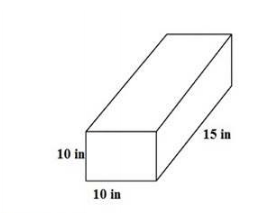
What is the surface area of this figure?
a)
200 cm 2
b)
800 cm 2
c)
400 cm 2
d)
100 cm 2
6.
Find the surface area of the rectangular prism with the following dimensions:
length = 11 m
height = 7 m
width = 2 m
a)
226 m2
b)
220 m2
c)
150 m2
d)
154 m2
7.
Terri finds the sum of the areas of each side of a box. Based on her calculations, Terri is finding the - -
a)
area of the box
b)
perimeter of the box
c)
volume of the box
d)
surface area of the box
8.
Which label would NOT be appropriate for volume.
a)
square miles
b)
inches3
c)
cm3
d)
cubic feet
9.
Sara wanted to use a paper towel tube for her project. She needed to cover the tube with cloth first. Which of the following, would Sara be calculating?
a)
Area
b)
Volume
c)
Surface Area
d)
Perimeter
10.
Find the surface area of the rectangular prism with the following dimensions:
length = 4 m
height = 3 m
width = 8 m
a)
130 m squared
b)
125 m squared
c)
136 m squared
d)
96 m squared
11.
Find the Surface Area
a)
556 cm2
b)
278 cm2
c)
680 cm2
d)
340 cm2
12.
Which label would NOT be appropriate for Surface Area.
a)
square miles
b)
inches2
c)
cm3
d)
square feet
Answer Key
Volume & Surface Area Rectangular Prism
Total questions: 12
1.
c) 144 cubic cm
2.
a) 18 cubic cm
3.
c) length x width x height
4.
a)
650 cm2
5.
b) 800 cm 2
6.
a)
226 m2
7.
d)
surface area of the box
8.
a) square miles
9.
c)
Surface Area
10.
c)
136 m squared
11.
a)
556 cm2
12.
c)
cm3
140 %
Browse by subjects
Browse by grades
Browse by format
FAQs
What does this volume and surface area worksheet cover?
This Grade 7 worksheet uses 12 multiple-choice questions to practice finding the volume and surface area of rectangular prisms. Students multiply length, width, and height to determine volume, calculate the total area of a prism’s faces for surface area, interpret real-world situations, and distinguish square units from cubic units.
How can I use this worksheet to teach volume and surface area of rectangular prisms?
Introduce the worksheet by reviewing how length, width, and height describe a rectangular prism, then model the volume calculation before comparing it with the total area of its faces. As students work through the multiple-choice items, ask them to explain why a result uses square units or cubic units and why contexts such as covering an object with cloth require surface area.
What mistakes should I watch for on this rectangular prism worksheet?
Watch for students adding the three dimensions instead of multiplying them when finding volume, or choosing a surface-area answer without accounting for all faces of the prism. Students may also confuse square units with cubic units, such as labeling volume in square miles or surface area in cubic centimeters, and may select area, perimeter, or volume for a covering scenario that requires surface area.
How do I assign and grade this volume and surface area worksheet?
You can assign this worksheet as a printable PDF or as a digital quiz on Wayground, with both formats covering the same 12 multiple-choice questions. A complete answer key is included, and printable student work can be graded by scanning it with the Wayground for Teachers app.
How can I differentiate this rectangular prism worksheet for my students?
Use the worksheet’s Advanced Settings to adjust font spacing or choose a larger font size so the dimension lists, unit labels, and multiple-choice options are easier to read. You can also apply a dyslexia-friendly font or translate the worksheet into another language while preserving its volume, surface-area, and square-versus-cubic-unit practice.
Where can I find more worksheets like this on Wayground?
Wayground offers a broad collection of free printable worksheets and practice problems across subjects, with downloadable PDFs and answer keys to support essential skills and concepts. Browse more resources at https://wayground.com/en-us/worksheets.


 Worksheets