Volume with Fractional Edges Checkpoint is a free printable Grade 6 mathematics worksheet that helps students find and interpret the volume of rectangular prisms and cubes when dimensions include fractions or mixed numbers. The 14 questions ask students to choose valid volume expressions, calculate volume, identify appropriate cubic units, and determine a missing dimension using the volume formula.
Students also solve practical problems involving fractional-edge cubes, including finding how many cubes fit inside a prism and selecting dimensions that produce a stated volume. The worksheet combines 4 multiple-choice questions, 8 fill-in-the-blank questions, and 2 multiple-select questions, giving students practice with multiplication, division, fraction operations, and volume notation. It is a free printable worksheet with a complete answer key for checking student work.
Worksheet settings
Font size
S
M
L
XL
Worksheets
Volume with Fractional edges checkpoint
Total questions: 14
Name
Class
Date
1.
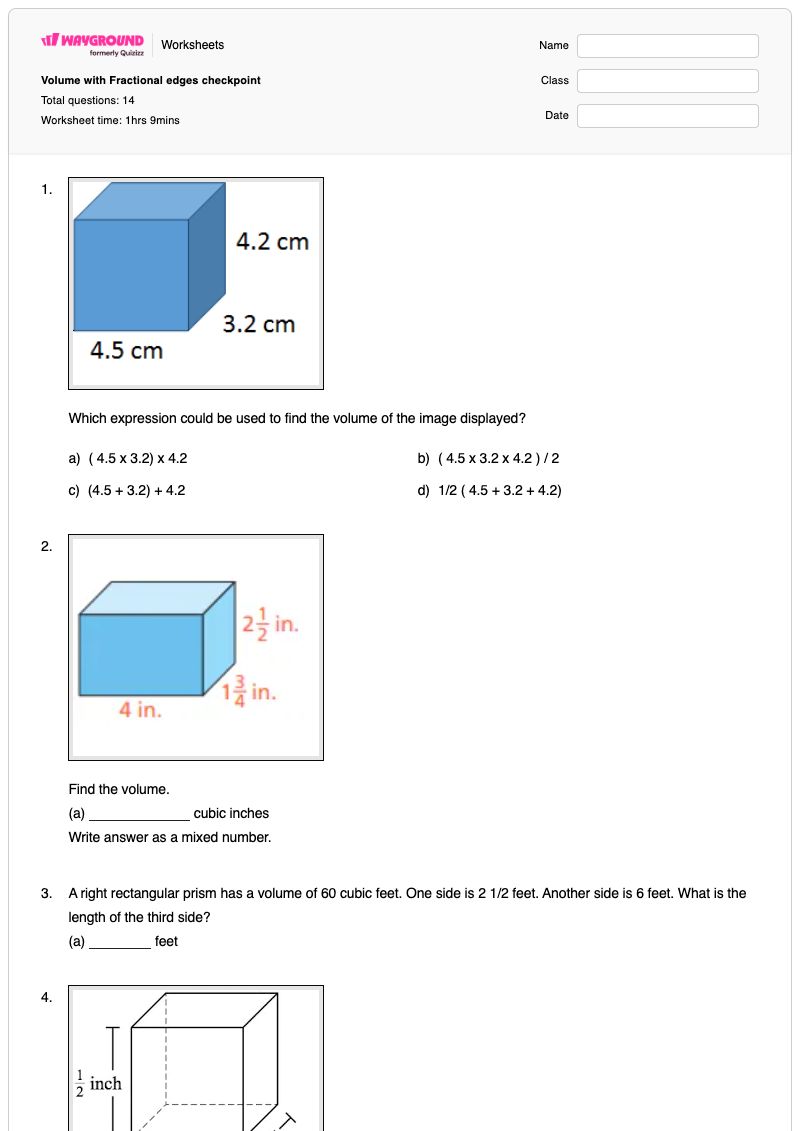
Which expression could be used to find the volume of the image displayed?
a)
( 4.5 x 3.2) x 4.2
b)
( 4.5 x 3.2 x 4.2 ) / 2
c)
(4.5 + 3.2) + 4.2
d)
1/2 ( 4.5 + 3.2 + 4.2)
2.
Find the volume.
(a) cubic inches
Write answer as a mixed number.
3.
A right rectangular prism has a volume of 60 cubic feet. One side is 2 1/2 feet. Another side is 6 feet. What is the length of the third side?
(a) feet
4.
If this right rectangular prism were filled with cubes that had 1/4 side length, how many cubes would it take?
(a) cubes
5.
Which expressions can be used to find the volume?
(There is more than one answer.)
a)
LWH
b)
Base Area X H
c)
2(LWH)
d)
1/2 ( LWH)
6.
How many 1/2 - cm cubes does it take to fill the prism?
(a) cubes
7.
Find the volume.
(a) cubic meters
8.
Which label would NOT be appropriate for volume.
a)
square miles
b)
inches3
c)
cm3
d)
cubic feet
9.
A right rectangular prism has a volume of 3/8 cubic meters. The length is 3 m. The width is 1/2 m. What is the depth?
(a) meters
10.
A cereal box is 12cm tall. The area of the base is 7cm. What is the volume?
a)
84 cm2
b)
84 cm3
c)
83 cm
d)
84
11.
What is the volume of a cube with edge length 2/3 yard?
(a) cubic yards
12.
he volume of a rectangular prism is 12 cubic inches. One of the dimensions of the prism is a fraction.
What could the dimensions of the prism be?
Select the 2 possible answers.
a)
2/3 in by 3 in by 6 in
b)
4/6 in by 6 in by 2 in
c)
10 in by 2 in by 3/5 in
d)
15/25 in by 20 in by 3 in
13.
Which expression represents the volume of the rectangular prism?
a)
3 + 4 + 11/2
b)
3 • 4 • 11/2
c)
3 + 4 + 1/2
d)
3 • 4 • 1/2
14.
Determine the number of 1/2in. by 1/2 in. by 1/2 in. cubes that can fit in the rectangular prism.
(a) cubes
Answer Key
Volume with Fractional edges checkpoint
Total questions: 14
1.
a)
( 4.5 x 3.2) x 4.2
2.
17 1/2
3.
4
4.
4
5.
a)
LWH
, b)
Base Area X H
6.
40
7.
48
8.
a) square miles
9.
1/4
10.
b) 84 cm3
11.
8/27
12.
a)
2/3 in by 3 in by 6 in
, c)
10 in by 2 in by 3/5 in
13.
b)
3 • 4 • 11/2
14.
1250
140 %
Browse by subjects
Browse by grades
Browse by format
FAQs
What does this volume with fractional edges worksheet cover?
This Grade 6 worksheet focuses on finding the volume of rectangular prisms and cubes when dimensions include fractions or mixed numbers. Its 14 questions use multiple choice, fill-in-the-blank, and multiple-select formats to have students choose valid formulas, calculate volumes, solve for missing dimensions, identify cubic units, and determine how many fractional-edge cubes fit in a prism.
How can I use this worksheet to teach volume with fractional dimensions?
Introduce the worksheet by reviewing that rectangular-prism volume can be found with length × width × height or base area × height, then model how to multiply fractional and mixed-number dimensions. Use the expression-selection questions to discuss why addition, doubling, or dividing the product does not represent the volume of the prism. After modeling one missing-dimension problem, have students explain how division isolates the unknown side before completing the fill-in-the-blank items.
What mistakes should I watch for on this fractional-edge volume worksheet?
Watch for students adding dimensions instead of multiplying them, choosing half of a product without a stated reason, or using square units rather than cubic units. Students may also forget to write products such as 8/27 as a volume, mishandle mixed numbers, or divide incorrectly when finding a missing side. In the cube-count items, check that they use the volume of each small cube rather than simply dividing by one edge length.
How do I assign and grade this volume worksheet?
This worksheet is available as a printable PDF and as a digital quiz on Wayground, with a complete answer key for all 14 questions. You can assign the digital version for automatic grading or print it for handwritten calculations and selected responses. Printable submissions can be graded by scanning student work with the Wayground for Teachers app.
How can I differentiate this worksheet for my students?
Use the worksheet’s Advanced Settings to adjust font spacing and font size so the formulas, fractional dimensions, and answer choices are easier to read. You can also apply a dyslexia-friendly font or translate the worksheet into another language. These options can make the mixed-number volume problems and cube-count questions more accessible without changing the mathematical skill being assessed.
Where can I find more worksheets like this on Wayground?
Wayground has a comprehensive collection of free printable worksheets and practice problems across all subjects, with downloadable PDFs and answer keys to support mastery of essential skills and concepts. Browse more resources at https://wayground.com/en-us/worksheets.


 Worksheets


