
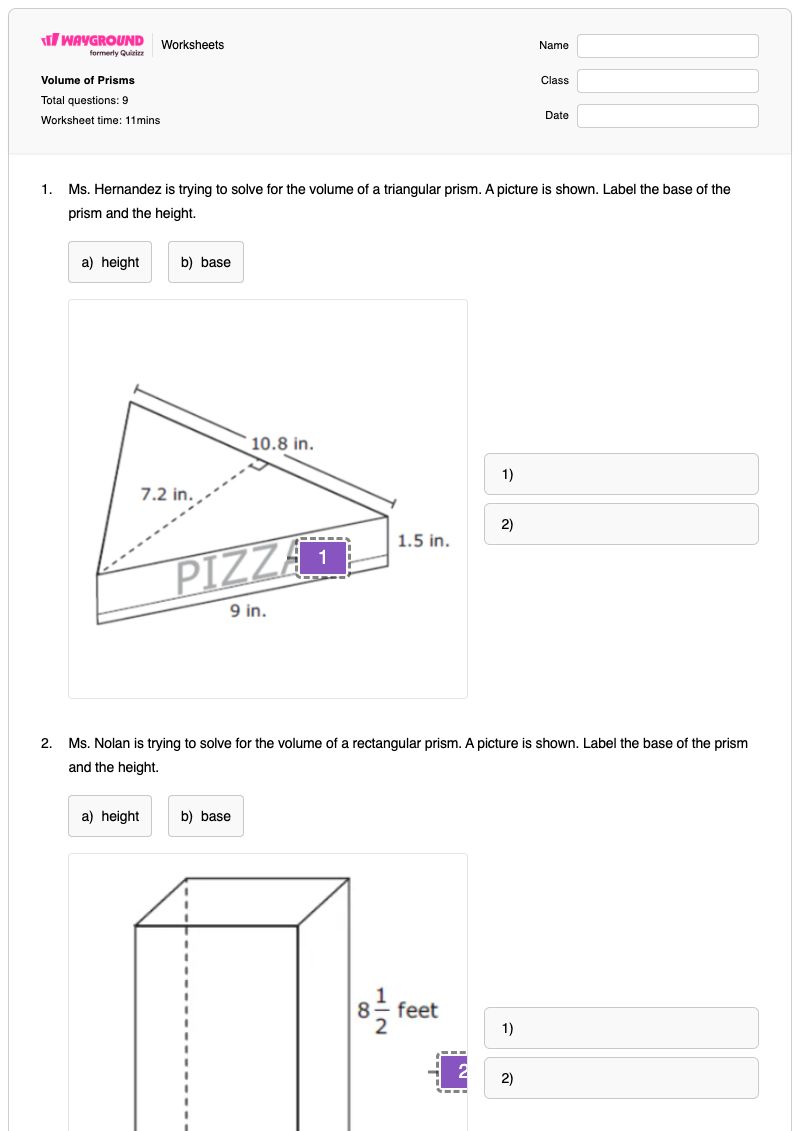

Volume of Prisms is a Grade 7 mathematics worksheet that helps students identify the base and height of triangular and rectangular prisms, then use those dimensions to calculate volume. Across 9 questions, students label diagrams, complete volume equations by dragging values into place, match prisms with appropriate formulas, determine the area of a prism’s base, and solve multiple-choice volume problems involving a flowerbed, triangular prism, and fish tank.
This free printable worksheet gives students practice connecting visual features of a prism to the correct calculation rather than relying only on memorized formulas. The mix of drag-and-drop, matching, and multiple-choice items lets teachers check whether students can recognize dimensions, apply the one-half factor for triangular bases, and calculate volume in real-world contexts. It includes an answer key for efficient review, reteaching, or independent practice.
Worksheet settings
Font size
S
M
L
XL
Worksheets
Volume of Prisms
Total questions: 9
Name
Class
Date
1.
Ms. Hernandez is trying to solve for the volume of a triangular prism. A picture is shown. Label the base of the prism and the height.
a)
height
b)
base
1
2
1)
2)
2.
Ms. Nolan is trying to solve for the volume of a rectangular prism. A picture is shown. Label the base of the prism and the height.
a)
height
b)
base
1
2
1)
2)
3.
Ms. Blancarte is trying to solve for the volume of a rectangular prism. The length of the base is 14 inches and the width is 5cm. The height of the prism is 11 cm. Drag and drop values to complete the equation to solve for volume. Pay attention to what values are currently there.
a)
70
b)
5
c)
11
d)
30
e)
14
1
2
1)
2)
4.
Ms. Johnson is trying to solve for the volume of a triangular prism. The height of the triangular base is 8 inches and the base is 4 inches. The height of the prism is 10 inches. Drag and drop a value to complete the equation. Pay attention to what values are there.
a)
16
b)
10
c)
8
d)
4
e)
½
1
2
1)
2)
5.
Match each prism to the formula that would be used to calculate the volume.
V= (½ × 6 × 4) 16
V= (½ × 8 × 3) 13
A cereal box has a base that is 5 inches wide and 8 inches long. The height of this box is 17 inches.
V= ( 8 × 5) 17
V= ( 1.4 × 4) 3
6.
Solve for area of the base of the following prisms.
B= 12 cm ²
B= 48 cm ²
A cereal box has a base that is 5 centimeters wide and 8 cm long. The height of this box is 17 cm.
B= 40 cm ²
B= 5.6 cm ²
7.
Kayla plants to fill her flowerbed with soil. A picture is shown. What is the volume of this flower bed?
a)
12 ft ³
b)
14.5 ft³
c)
30 ft³
d)
15 ft³
8.
A triangular prism figure is shown. What is the volume of the shape?
a)
42 cm³
b)
35 cm³
c)
21 cm³
d)
3 cm³
9.
An fish tank is in the shape of a rectangular prism. The base of the fish tank is 3 feet by 8 feet. The height of the fish tank is 10 feet. What is the volume of the fish tank in cubic feet?
a)
240 cubic feet
b)
15 cubic feet
c)
64 cubic feet
d)
30 cubic feet
Answer Key
Volume of Prisms
Total questions: 9
1.
b
a
2.
b
a
3.
b
c
4.
e
c
5.
-
V= (½ × 6 × 4) 16
, -
V= (½ × 8 × 3) 13
,
A cereal box has a base that is 5 inches wide and 8 inches long. The height of this box is 17 inches.
-
V= ( 8 × 5) 17
, -
V= ( 1.4 × 4) 3
6.
-
B= 12 cm ²
, -
B= 48 cm ²
,
A cereal box has a base that is 5 centimeters wide and 8 cm long. The height of this box is 17 cm.
-
B= 40 cm ²
, -
B= 5.6 cm ²
7.
c)
30 ft³
8.
c)
21 cm³
9.
a) 240 cubic feet
140 %
Browse by subjects
Browse by grades
Browse by format
FAQs
What does the Volume of Prisms worksheet cover?
This Grade 7 worksheet covers identifying the base and height of triangular and rectangular prisms and using those dimensions to calculate volume. Its 9 items include diagram labeling, drag-and-drop equation completion, formula and base-area matching, and multiple-choice applications such as a flowerbed and fish tank.
How can I use this worksheet to teach students to find the volume of prisms?
Begin by having students label the base and height in the first diagram items, then use those labels to discuss how the base area and prism height determine volume. Next, model one rectangular-prism equation and one triangular-prism equation, emphasizing the one-half factor for a triangular base, before assigning the drag-and-drop, matching, and application questions.
What mistakes should I watch for when students complete this prism volume worksheet?
Watch for students confusing the base dimensions with the height of the prism when labeling diagrams or completing equations. Students may also choose a distractor dimension, omit the one-half factor for the triangular prism, or calculate only the base area instead of multiplying it by the prism height.
How do I assign and grade the Volume of Prisms worksheet?
On Wayground, you can assign this worksheet as a printable PDF or as a digital quiz, and it includes a complete answer key. Printable submissions can be graded by scanning student work with the Wayground for Teachers app, while the digital version supports online completion and review.
How can I differentiate this prism volume worksheet for my students?
Use the worksheet’s Advanced Settings to adjust font spacing or increase the font size so the prism diagrams, labels, and equations are easier to follow. You can also enable a dyslexia-friendly font or translate the worksheet into another language when that supports access to the drag-and-drop, matching, and volume problems.
Where can I find more worksheets like this on Wayground?
Wayground offers a broad collection of free printable worksheets and practice problems across subjects, with downloadable PDFs and answer keys to help students build essential skills. Browse more resources at https://wayground.com/en-us/worksheets.