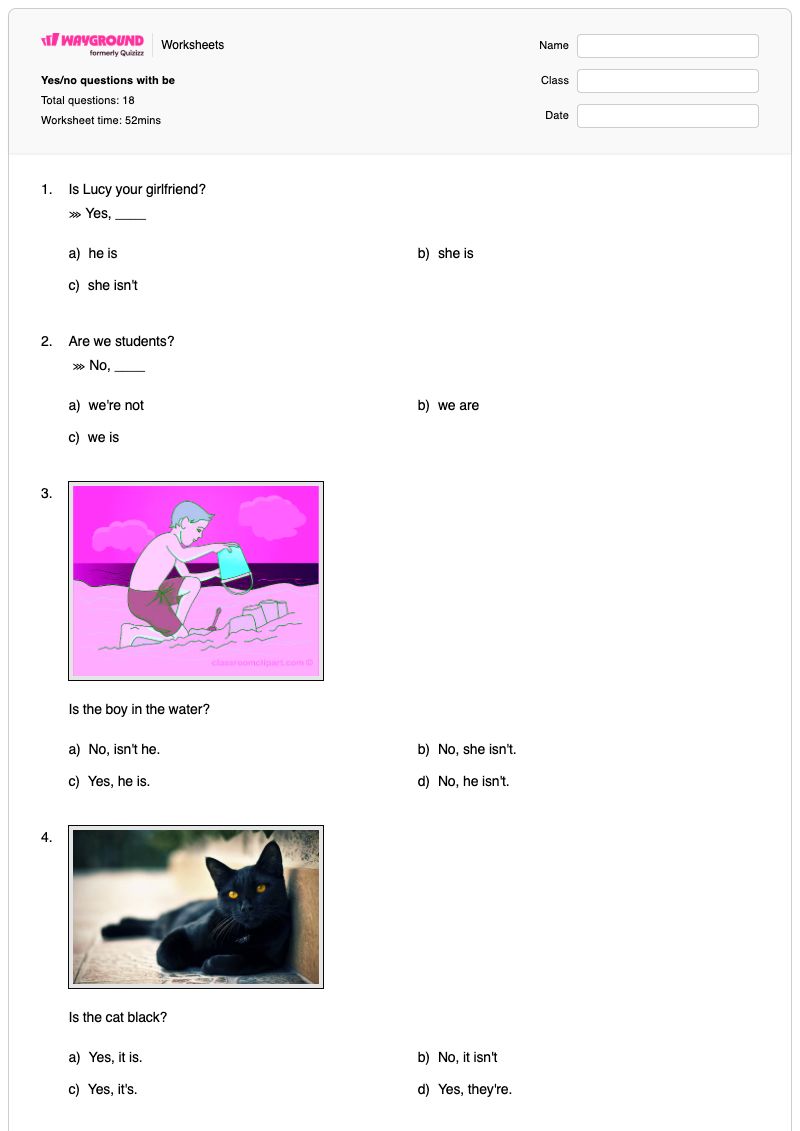

This free printable English worksheet helps students in Grades 1–5 practise forming and answering yes/no questions with the verb “be.” Across 18 multiple-choice items, students complete short answers, choose correct affirmative or negative responses, match subject pronouns with the correct forms of “be,” and identify questions formed from statements such as “She is happy” and “They are good hockey players.”
The worksheet reinforces the difference between “is” and “are,” correct pronoun agreement, negative forms such as “is not” and “are not,” and the word order used in yes/no questions. It is suitable for guided grammar instruction, independent practice, or a quick check of foundational English skills. The printable worksheet is free and includes a complete answer key for efficient review and grading.
Worksheet settings
Font size
S
M
L
XL
Worksheets
Yes/no questions with be
Total questions: 18
Name
Class
Date

1.
Is Lucy your girlfriend?
⋙ Yes, ____
a)
he is
b)
she is
c)
she isn't
2.
Are we students? ⋙ No, ____
a)
we're not
b)
we are
c)
we is
3.
Is the boy in the water?
a)
No, isn't he.
b)
No, she isn't.
c)
Yes, he is.
d)
No, he isn't.
4.
Is the cat black?
a)
Yes, it is.
b)
No, it isn't
c)
Yes, it's.
d)
Yes, they're.
5.
Is it a cake?
a)
Yes, It is.
b)
No, It is not.
c)
No, it aren't.
6.
Is it a house?
a)
Yes, It is.
b)
No, It is not.
c)
Yes, it's.
7.
Is she a baby?
a)
Yes, she is.
b)
No, she is not.
c)
No, is she not.
8.
Are your parents married?
a)
Yes, they are.
b)
No, they not.
c)
No, they are.
d)
Yes, they're.
9.
Is she your friend?
a)
Yes, we are.
b)
Yes, is she.
c)
Yes, she is.
d)
Yes, she's.
10.
Are they going to work?
a)
Yes, they are.
b)
No, they are.
c)
Yes, they're.
d)
No, they not.
11.
Make a question: She is happy.
a)
Is she happy?
b)
She is happy?
c)
Are she happy?
d)
Do she happy?
12.
Make a yes/no question: They are good hockey players.
a)
They are good hockey players?
b)
Do they good hockey players?
c)
Are they good hockey players?
d)
They good hockey players?
13.
Make a yes/no question: They are in Level 1.
a)
Are they in Level 1?
b)
They are in Level 1?
c)
They in Level 1?
d)
Are Level 1 they?
14.
Is Marc a fast runner?
a)
No, he is not
b)
Yes, he is.
c)
Yes, he does.
d)
Yes, he are.
15.
Are they good hockey players?
a)
No, they are not.
b)
Yes, they are.
c)
No, they not.
d)
No, they not are.
16.
Do you go to school by bus every day? (✓)
a)
Yes, I does.
b)
Yes, I do.
c)
Yes, I did.
17.
Does Damon like to play football? (✓)
a)
Yes, I does.
b)
Yes, he do.
c)
Yes, he does.
d)
Yes, she does.
18.
Does your sister cook a meal every day? (x)
a)
No, he does.
b)
No, he doesn't.
c)
No, she does.
d)
No, she doesn't.
Answer Key
Yes/no questions with be
Total questions: 18
1.
b)
she is
2.
a) we're not
3.
d)
No, he isn't.
4.
a)
Yes, it is.
5.
b)
No, It is not.
6.
a)
Yes, It is.
7.
b)
No, she is not.
8.
a)
Yes, they are.
9.
c)
Yes, she is.
10.
a)
Yes, they are.
11.
a)
Is she happy?
12.
c)
Are they good hockey players?
13.
a)
Are they in Level 1?
14.
b)
Yes, he is.
15.
a)
No, they are not.
16.
b)
Yes, I do.
17.
c)
Yes, he does.
18.
d)
No, she doesn't.
140 %
Browse by subjects
Browse by grades
Browse by format
FAQs
What does this worksheet cover?
This worksheet covers forming and answering yes/no questions with “be” through 18 multiple-choice items. Students select correct affirmative and negative responses, use “is” or “are” with the right subject pronoun, and change statements such as “She is happy” into questions such as “Is she happy?”
How can I use this worksheet to teach yes/no questions with “be”?
First, model the word-order change from a statement to a question, such as moving “is” before “she” in “Is she happy?” Then guide students through the items that practise “is” and “are,” followed by questions requiring affirmative or negative answers. Ask students to explain why an answer uses “he,” “she,” “it,” “we,” or “they” before they complete the remaining multiple-choice questions independently.
What mistakes should I watch for when students complete this worksheet?
Watch for students choosing “is” with plural subjects, using “are” with “she” or “he,” or selecting a response with the wrong pronoun, such as “Yes, we are” for a question about “she.” Students may also leave “be” after the subject when forming questions, write “Do she happy?”, or choose incomplete negatives such as “they not” instead of “they are not.”
How do I assign and grade this worksheet?
Wayground provides this worksheet as a printable PDF and as a digital quiz, and it includes a complete answer key. You can grade printable submissions by scanning student work with the Wayground for Teachers app, while digital responses can be reviewed in Wayground. The printable format also gives schools an option for reducing screen time.
How can I differentiate this worksheet for my students?
Use the worksheet’s Advanced Settings to adjust font spacing or choose a larger font size so the multiple-choice options and sentence-transformation items are easier to read. You can also apply a dyslexia-friendly font or translate the worksheet into another language when students need language-access support while practising the English forms of “is” and “are.”
Where can I find more worksheets like this on Wayground?
Wayground offers a broad collection of free printable worksheets and practice problems across subjects, with downloadable PDFs and answer keys to support essential skills and concepts. Browse more resources at https://wayground.com/en-us/worksheets.