

Wayground
Views on Zoos - Printable Science Worksheets kindergarten - Wayground

Views on Zoos

Jehan Saeddin

Created by Jehan Saeddin

11 questions

6th Grade

Science

Updated Mar 2026

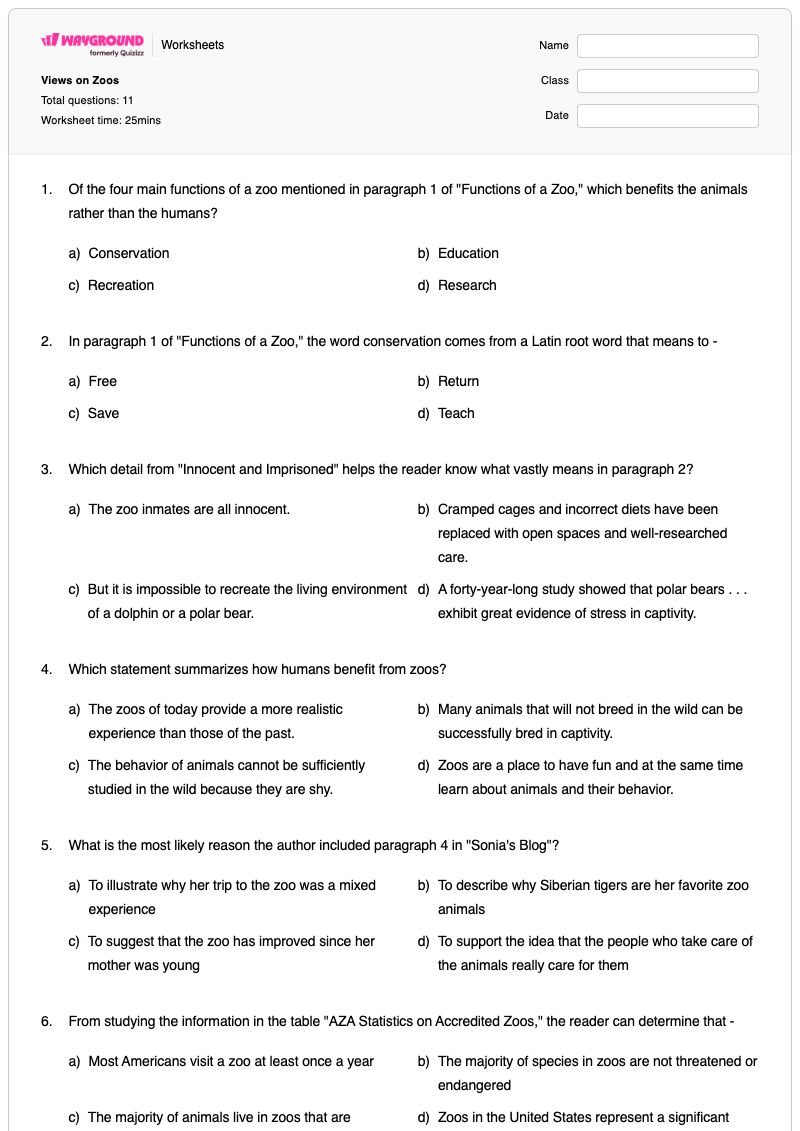
Views on Zoos is a Grade 6 English worksheet that develops reading comprehension through multiple texts about the purposes, benefits, and concerns surrounding zoos. Its 11 questions ask students to identify a central function, use a Latin root to determine meaning, infer word meaning from context, summarize information, analyze an author’s purpose, and interpret statistics in a table. Students work with passages including “Functions of a Zoo,” “Innocent and Imprisoned,” and “Sonia’s Blog.” The worksheet also asks students to select two details that provide evidence for a position, then apply vocabulary knowledge to words such as charisma, vastly, accredits, and advocates. These varied question types help students evaluate differing views about zoos while supporting evidence-based reading and precise word analysis. It is a free printable worksheet with a complete answer key, suitable for Grade 6 English instruction, independent practice, or reading comprehension review.

Worksheet settings

Font size

S
M
L
XL
WaygroundWorksheets

Views on Zoos

Total questions: 11

Name
Class
Date
1.

Of the four main functions of a zoo mentioned in paragraph 1 of "Functions of a Zoo," which benefits the animals rather than the humans?

a)

Conservation

b)

Education

c)

Recreation

d)

Research

2.

In paragraph 1 of "Functions of a Zoo," the word conservation comes from a Latin root word that means to -

a)

Free

b)

Return

c)

Save

d)

Teach

3.

Which detail from "Innocent and Imprisoned" helps the reader know what vastly means in paragraph 2?

a)

The zoo inmates are all innocent.

b)

Cramped cages and incorrect diets have been replaced with open spaces and well-researched care.

c)

But it is impossible to recreate the living environment of a dolphin or a polar bear.

d)

A forty-year-long study showed that polar bears . . . exhibit great evidence of stress in captivity.

4.

Which statement summarizes how humans benefit from zoos?

a)

The zoos of today provide a more realistic experience than those of the past.

b)

Many animals that will not breed in the wild can be successfully bred in captivity.

c)

The behavior of animals cannot be sufficiently studied in the wild because they are shy.

d)

Zoos are a place to have fun and at the same time learn about animals and their behavior.

5.

What is the most likely reason the author included paragraph 4 in "Sonia's Blog"?

a)

To illustrate why her trip to the zoo was a mixed experience

b)

To describe why Siberian tigers are her favorite zoo animals

c)

To suggest that the zoo has improved since her mother was young

d)

To support the idea that the people who take care of the animals really care for them

6.

From studying the information in the table "AZA Statistics on Accredited Zoos," the reader can determine that -

a)

Most Americans visit a zoo at least once a year

b)

The majority of species in zoos are not threatened or endangered

c)

The majority of animals live in zoos that are accredited by the AZA

d)

Zoos in the United States represent a significant share of the nation's economy

7.

Which two sentences from "Innocent and Imprisoned" provide strong evidence to support the position that zoos do not benefit animals?

a)

A forty-year-long study showed that polar bears-along with lions, tigers, and cheetahs-exhibit great evidence of stress in captivity.

b)

During the twentieth century, there were 145 attempts to reintroduce populations into the wild, and only 16 of them were successful.

c)

In some cases, [research conducted in zoos] may be helpful to the animal populations as a whole, but to me it seems unscientific.

d)

In most cases, however, the information given about an animal is very brief and presented on a small sign that few people bother to read.

8.

Charisma means..................

a)

greatly

b)

charm

c)

guarantees that something conforms to certain rules and standards.

d)

supporters

9.

Vastly means..................

a)

greatly

b)

charm

c)

guarantees that something conforms to certain rules and standards.

d)

supporters

10.

Accredits means..................

a)

greatly

b)

charm

c)

guarantees that something conforms to certain rules and standards.

d)

supporters

11.

Advocates means..................

a)

greatly

b)

charm

c)

guarantees that something conforms to certain rules and standards.

d)

supporters

WaygroundAnswer Key

Views on Zoos

Total questions: 11

1.
a)

Conservation

2.
c)

Save

3.
b)

Cramped cages and incorrect diets have been replaced with open spaces and well-researched care.

4.
d)

Zoos are a place to have fun and at the same time learn about animals and their behavior.

5.
a)

To illustrate why her trip to the zoo was a mixed experience

6.
b)

The majority of species in zoos are not threatened or endangered

7.
a)

A forty-year-long study showed that polar bears-along with lions, tigers, and cheetahs-exhibit great evidence of stress in captivity.

, b)

During the twentieth century, there were 145 attempts to reintroduce populations into the wild, and only 16 of them were successful.

8.
b)

charm

9.
a)

greatly

10.
c)

guarantees that something conforms to certain rules and standards.

11.
d)

supporters

FAQs

What does the Views on Zoos worksheet cover?

This Grade 6 English worksheet uses 10 multiple-choice questions and one multiple-select question to assess reading comprehension across passages, a blog, and an AZA statistics table about zoos. Students identify functions of zoos, analyze an author’s purpose, interpret data, determine word meanings from context and roots, summarize ideas, and select evidence supporting the position that zoos may not benefit animals.

How can I use this worksheet to teach students to evaluate different views on zoos?

Introduce the worksheet by having students identify whether each source presents benefits, concerns, or a mixed experience of zoos. Before students answer, ask them to underline evidence in “Innocent and Imprisoned,” “Sonia’s Blog,” and the AZA statistics table, then discuss how the evidence supports a summary, author’s purpose, or position. Use the multiple-select evidence question to model why two details can support the same claim.

What mistakes should I watch for when students complete this worksheet?

Students may confuse conservation with the human-focused functions of education, recreation, and research, or choose a definition for a vocabulary word without using its sentence context. They may also select a detail that mentions zoo conditions but does not directly support the position that zoos do not benefit animals. When analyzing “Sonia’s Blog” or the AZA table, watch for answers that state a related detail rather than the author’s purpose or the conclusion supported by the data.

How do I assign and grade the Views on Zoos worksheet?

You can assign this worksheet as a printable PDF or as a digital quiz on Wayground, and it includes a complete answer key for the 10 multiple-choice and one multiple-select item. For printed submissions, scan student work with the Wayground for Teachers app to support grading. The printable option also gives schools a way to reduce screen time while students analyze the zoo-related texts and data.

How can I differentiate this worksheet for my students?

Use the worksheet’s Advanced Settings to adjust font spacing or font size so the reading passages, vocabulary items, and AZA statistics table are easier to navigate. You can also apply a dyslexia-friendly font or translate the worksheet into another language when appropriate for your learners. These options can make the evidence-selection and context-clue questions more accessible without changing the assessed skills.

Where can I find more worksheets like this on Wayground?

Wayground offers a comprehensive collection of free printable worksheets and practice problems across subjects, with downloadable PDFs and answer keys to help students master essential skills and concepts. Browse more resources at https://wayground.com/en-us/worksheets.