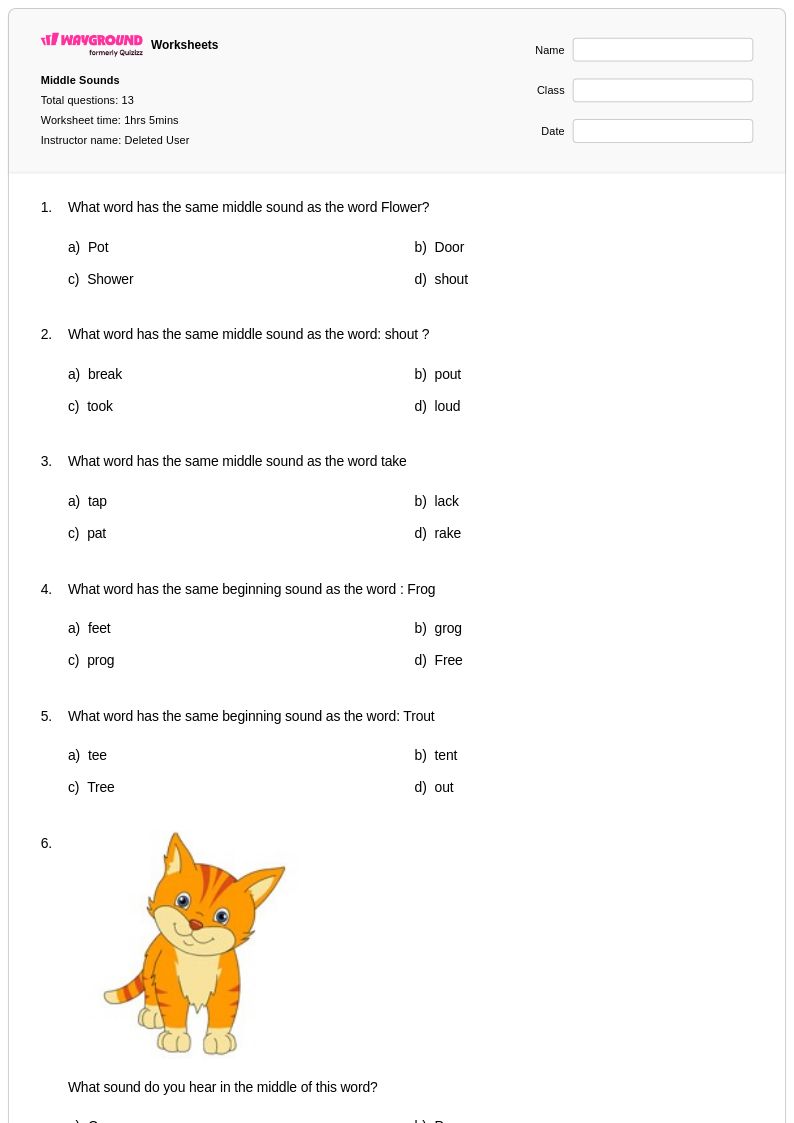
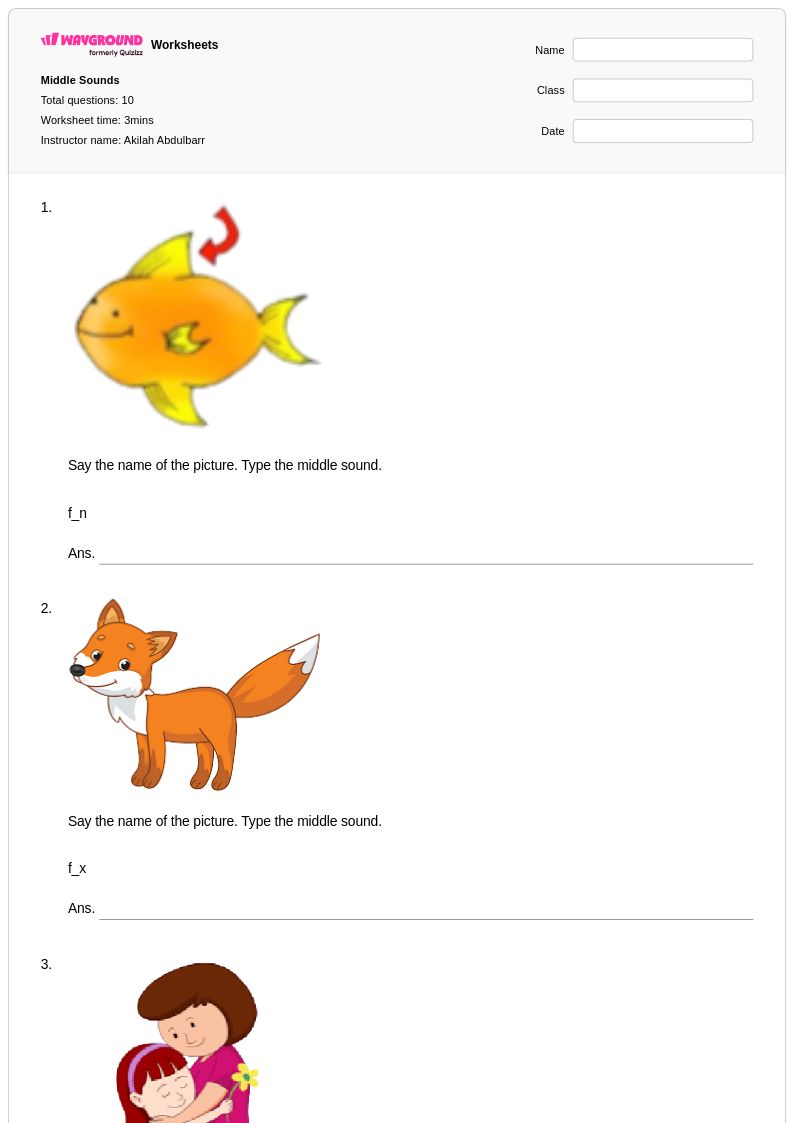
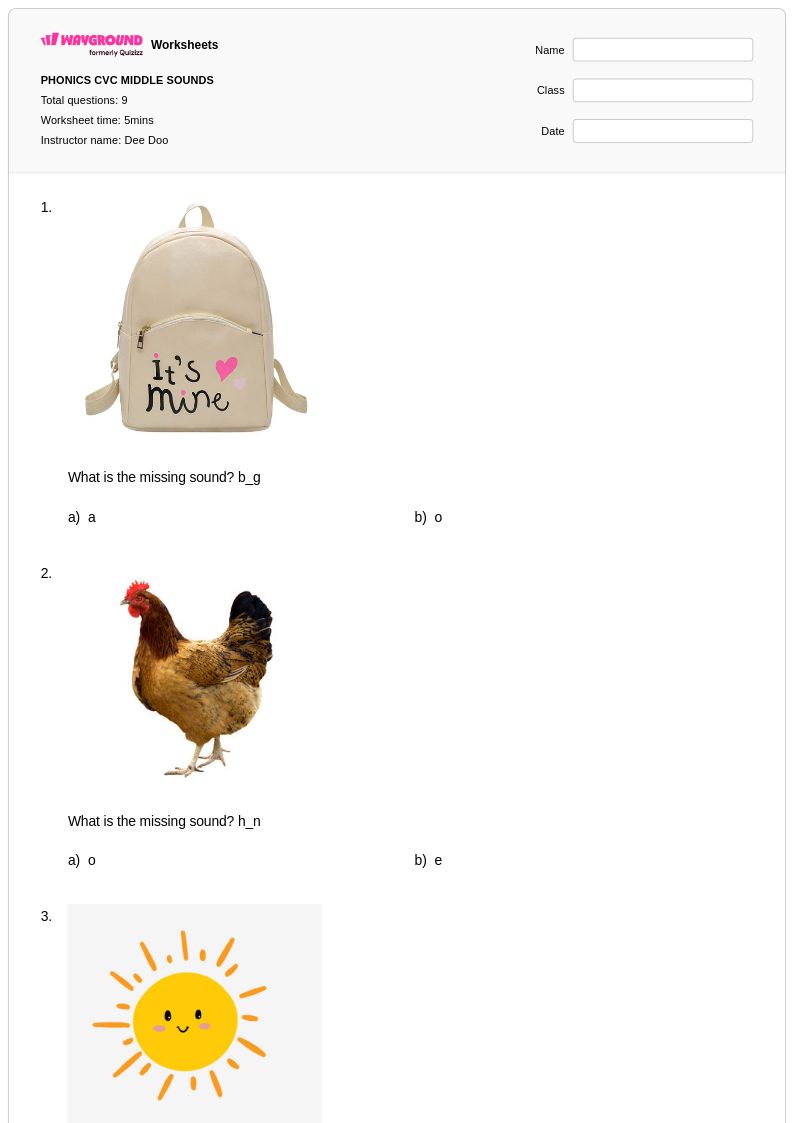
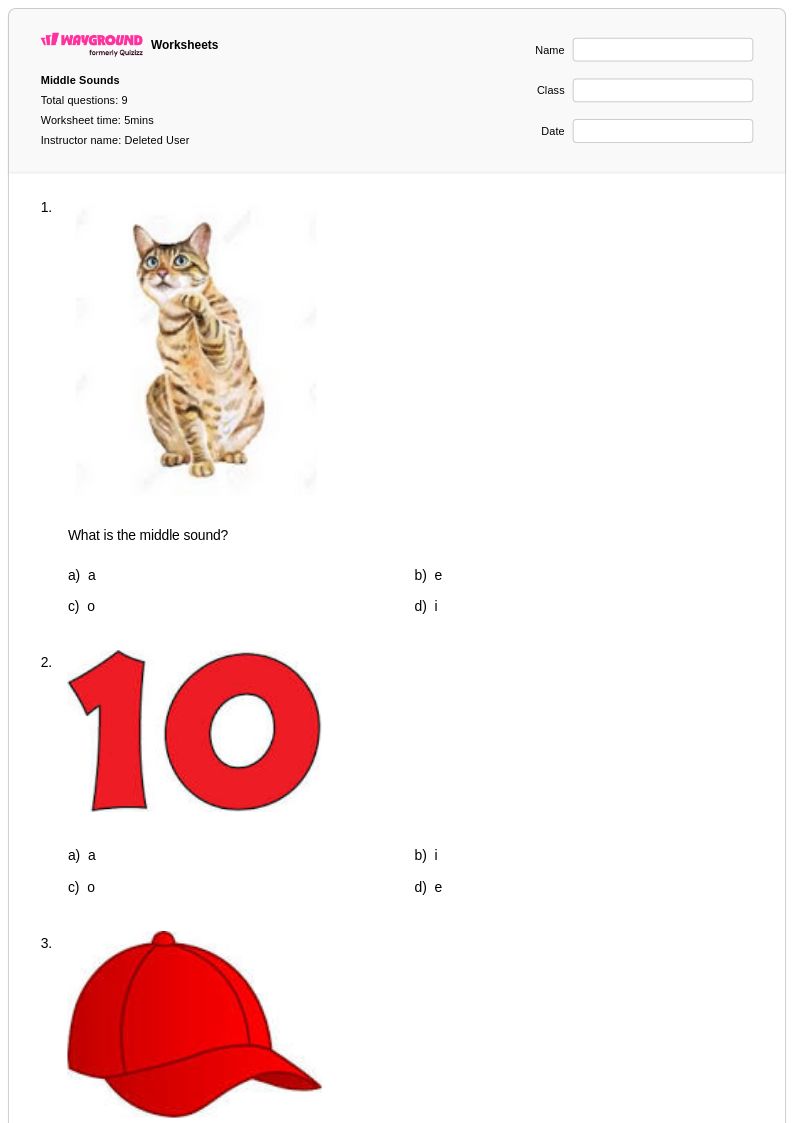
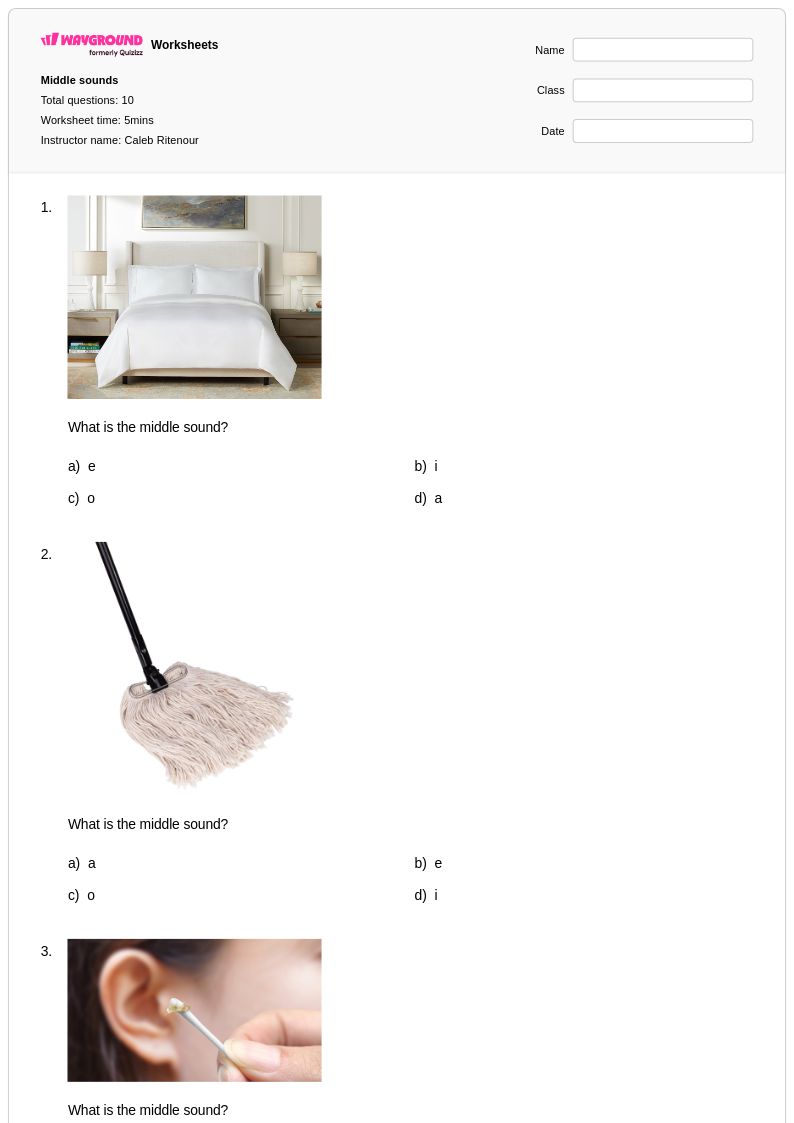
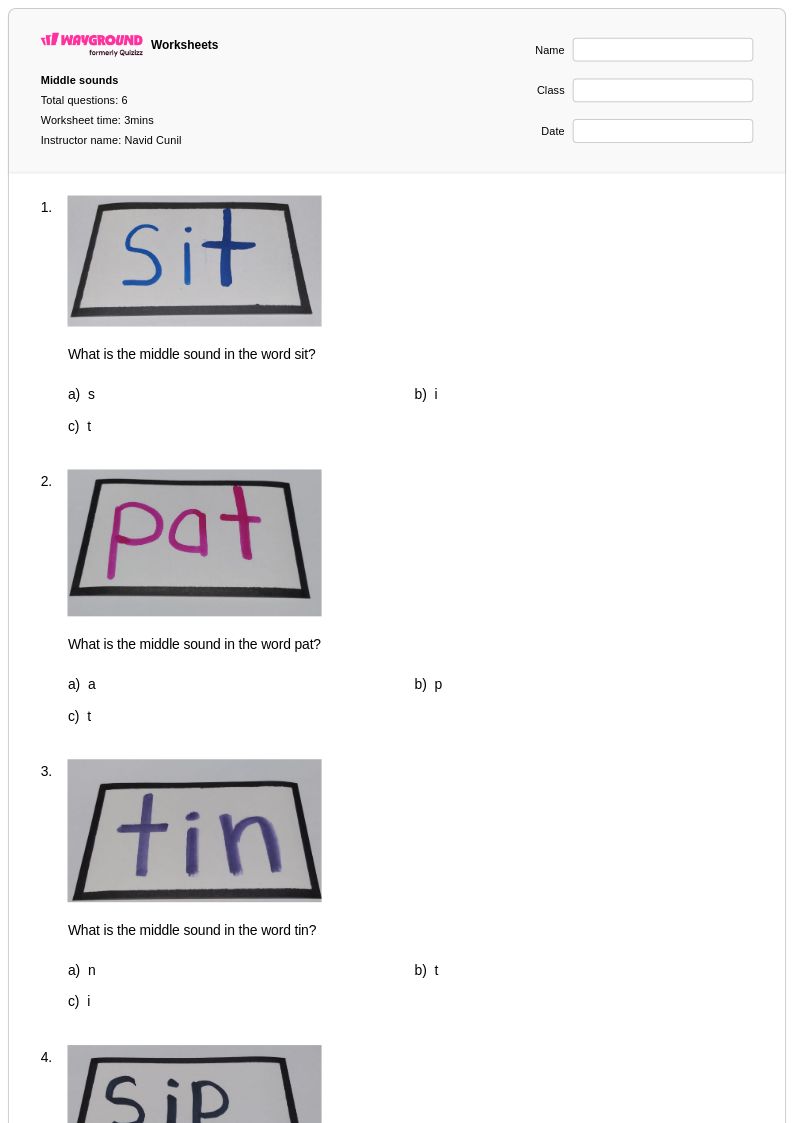
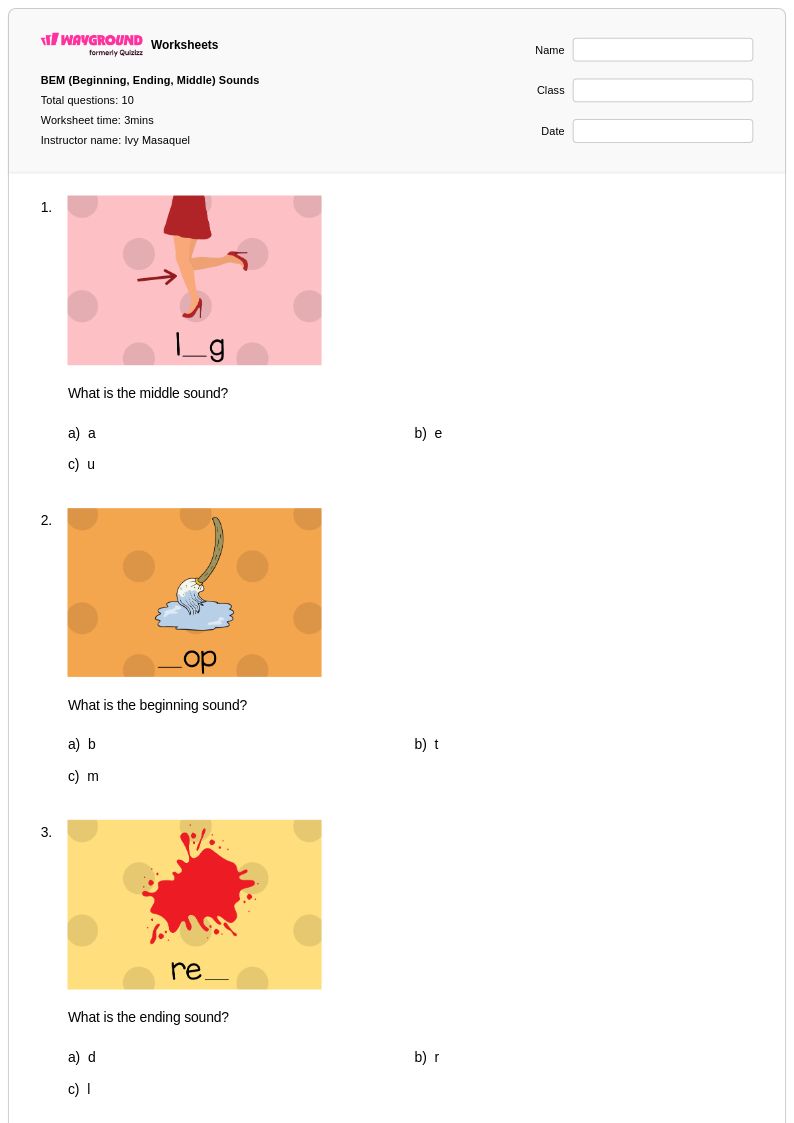
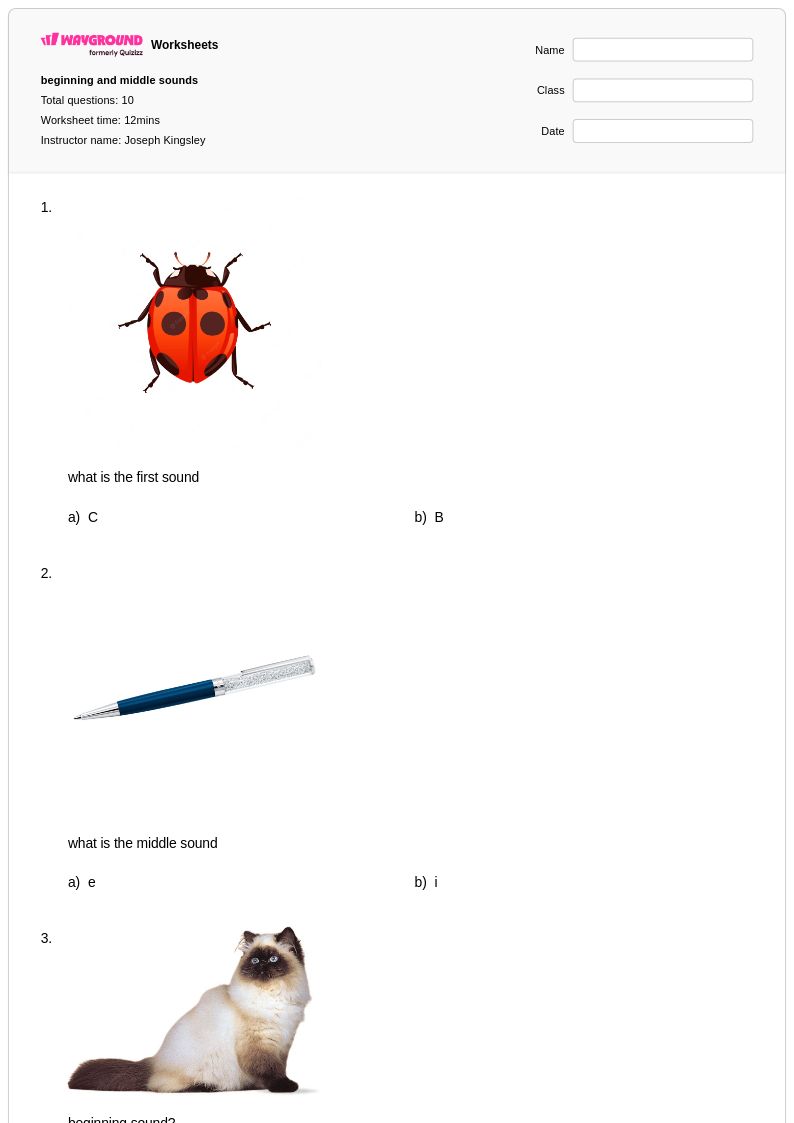
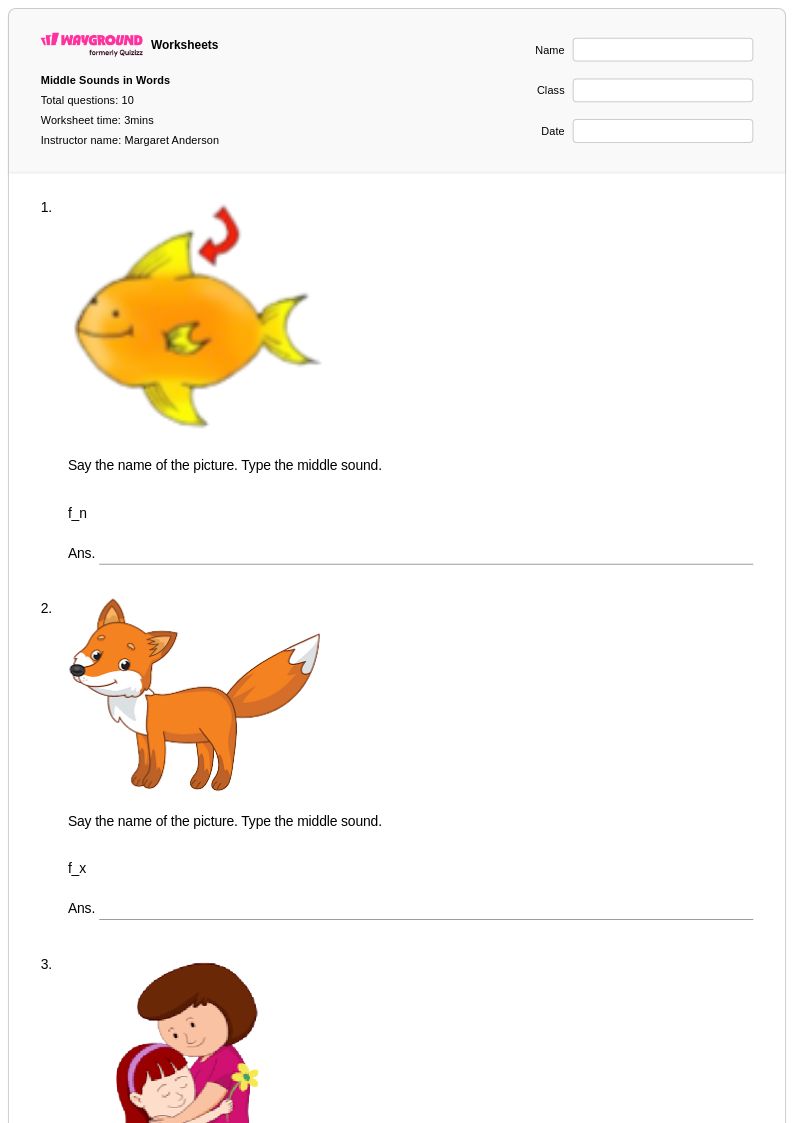
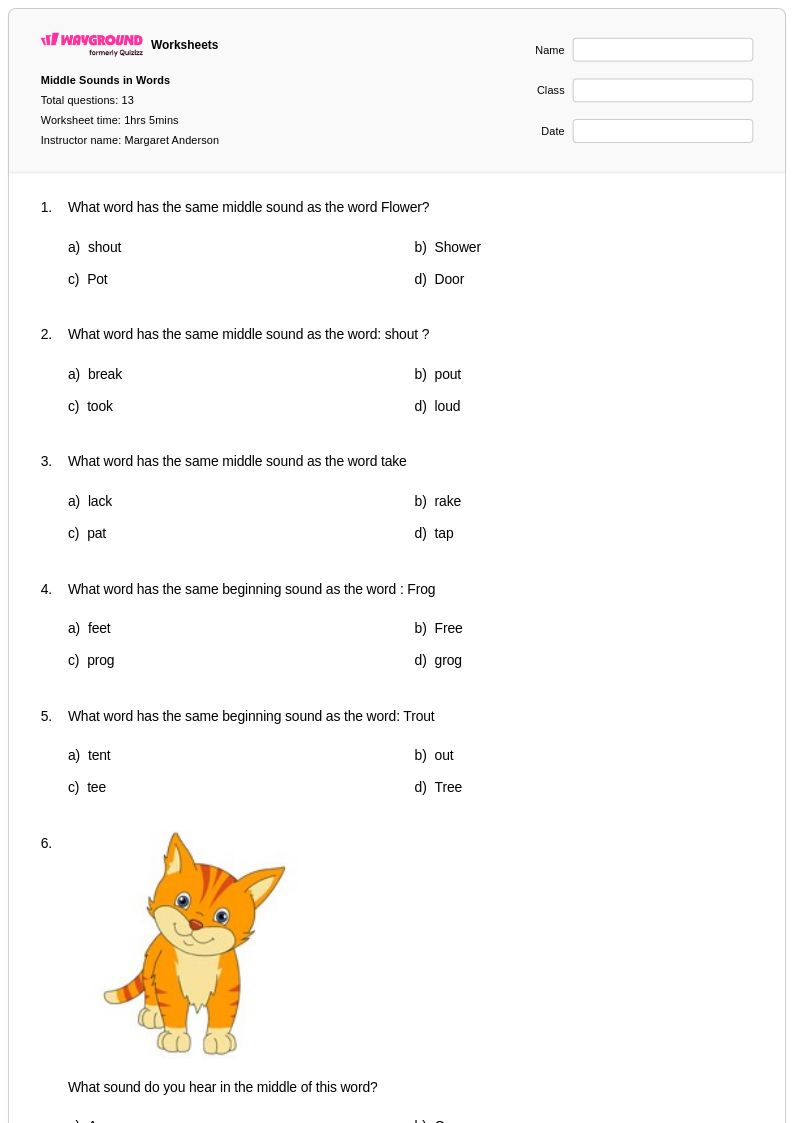
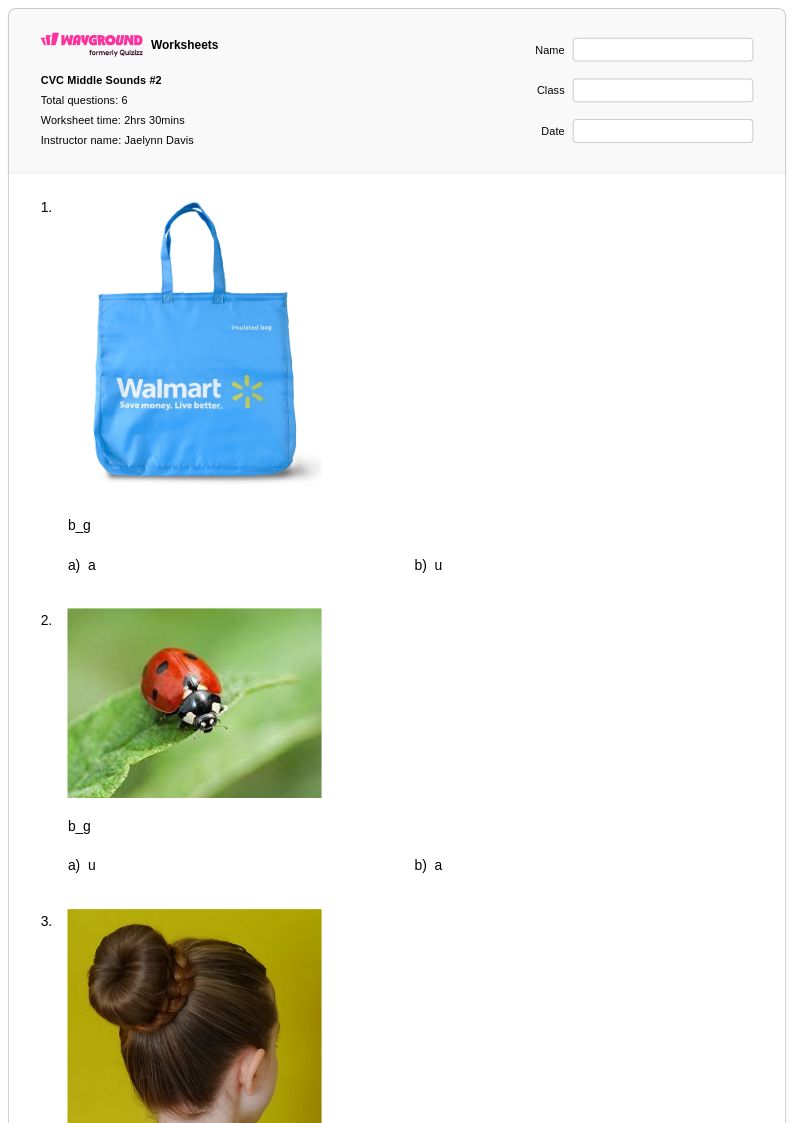
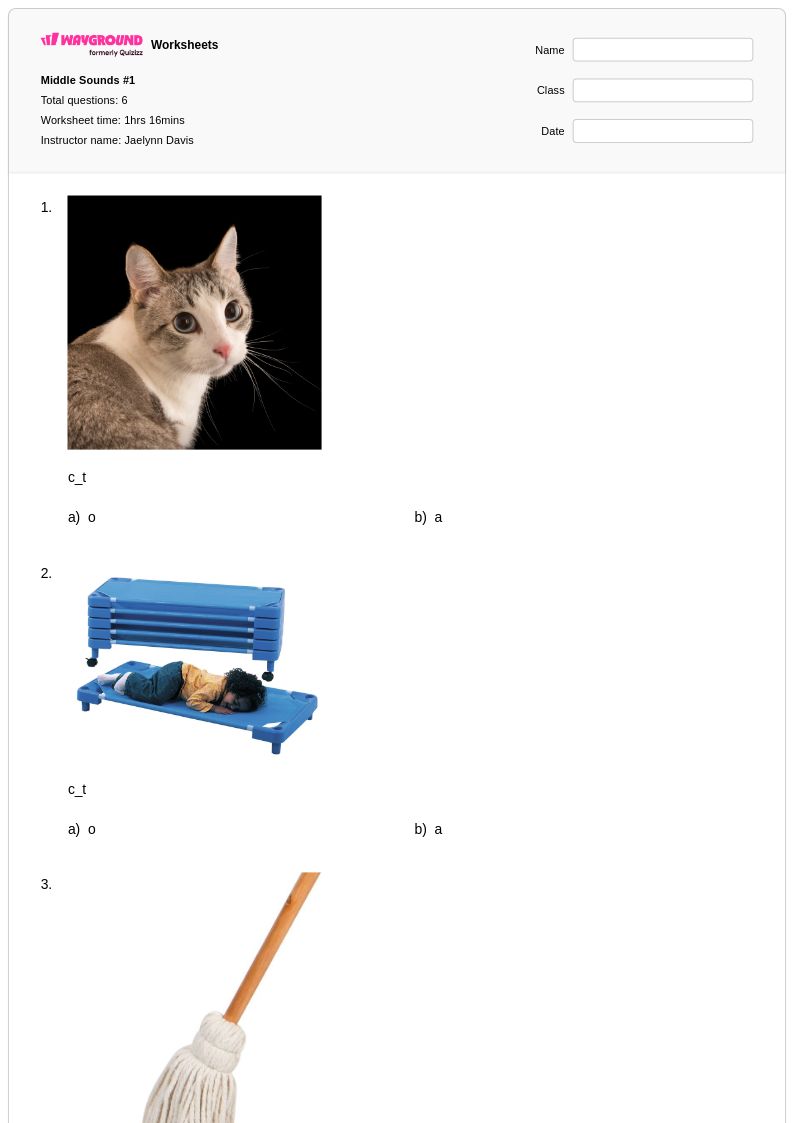
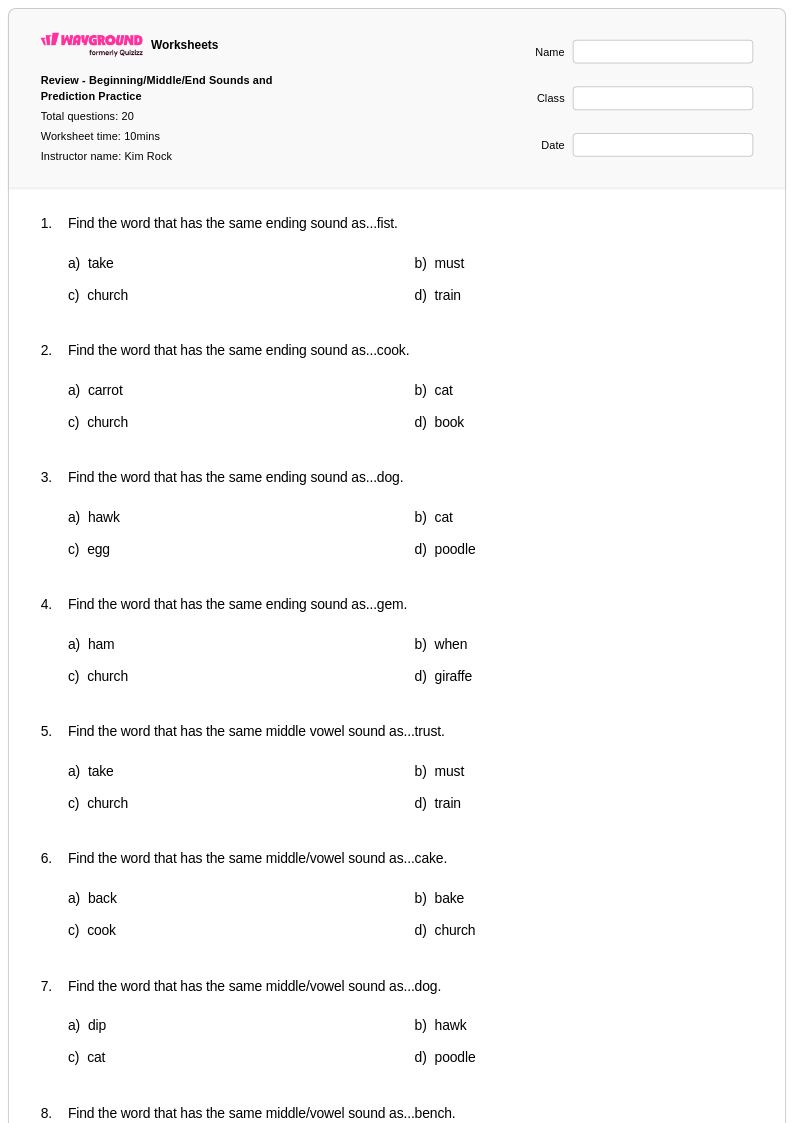
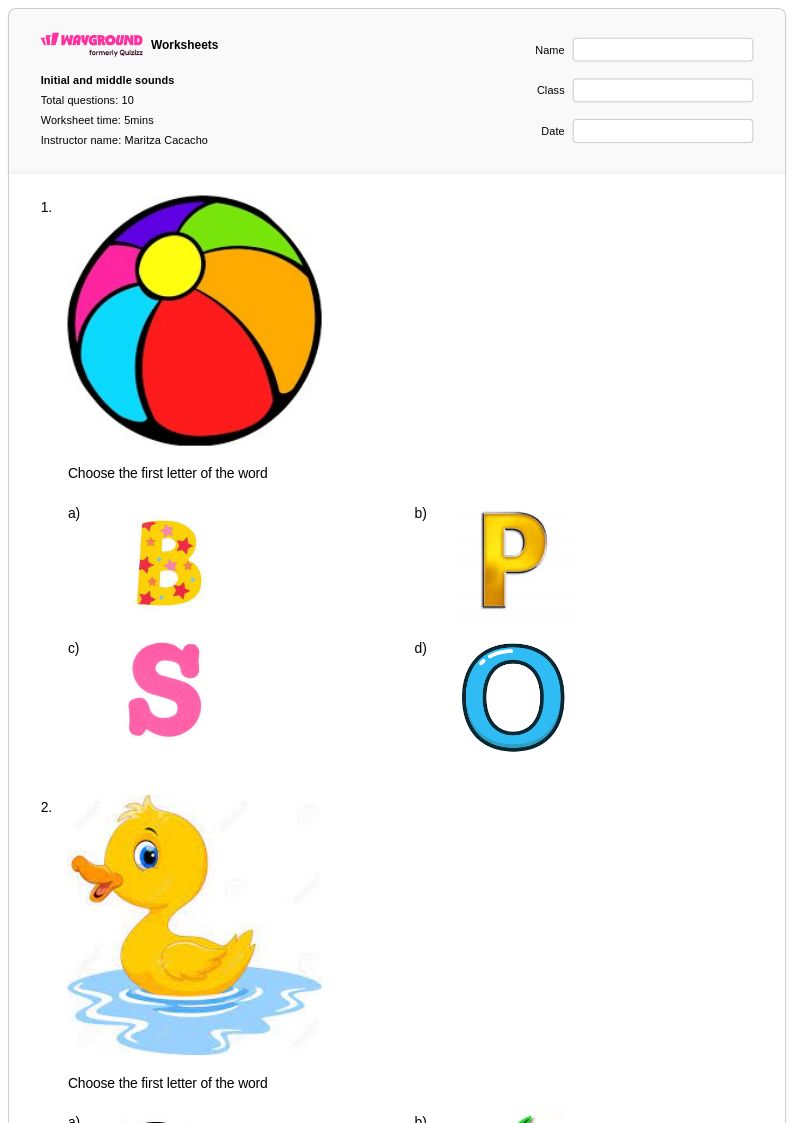
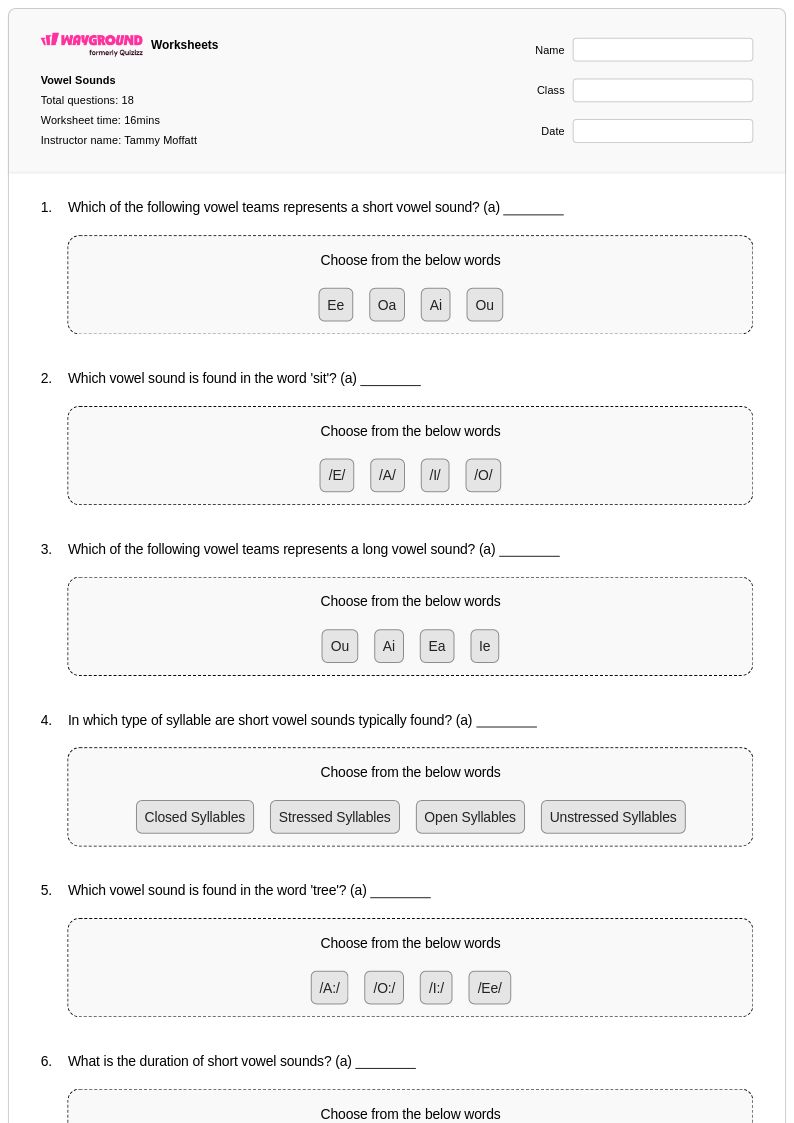
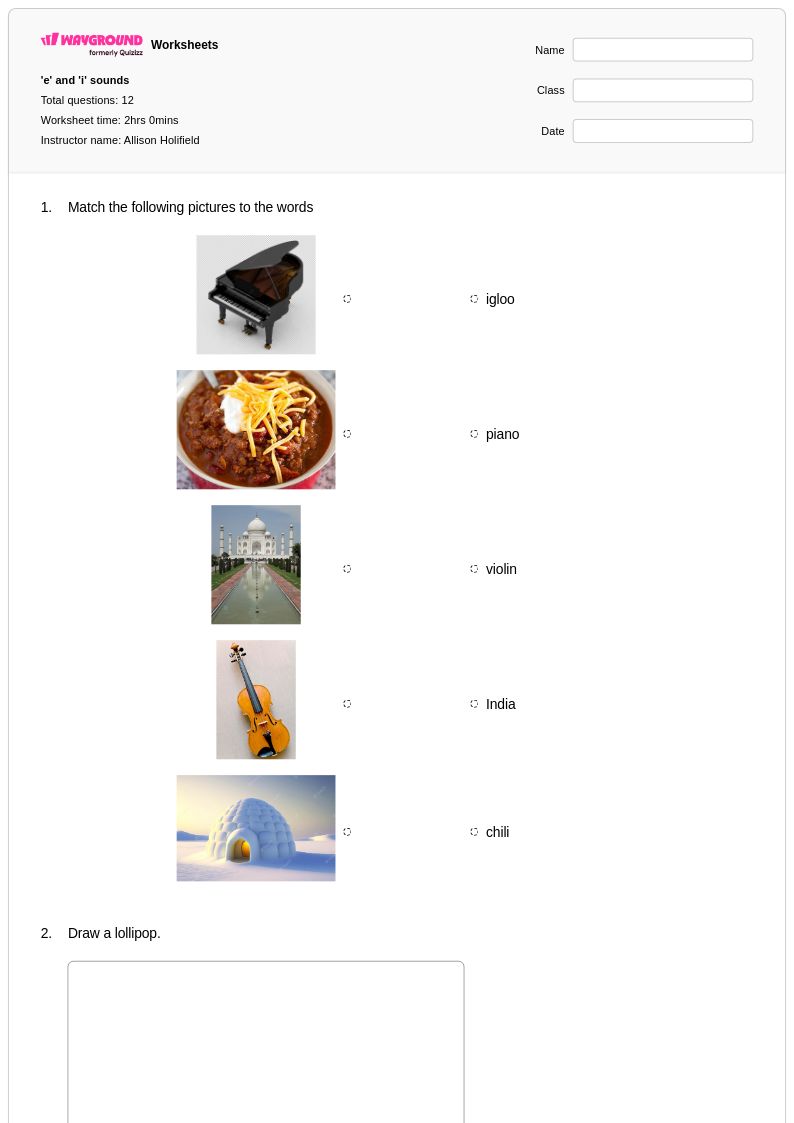
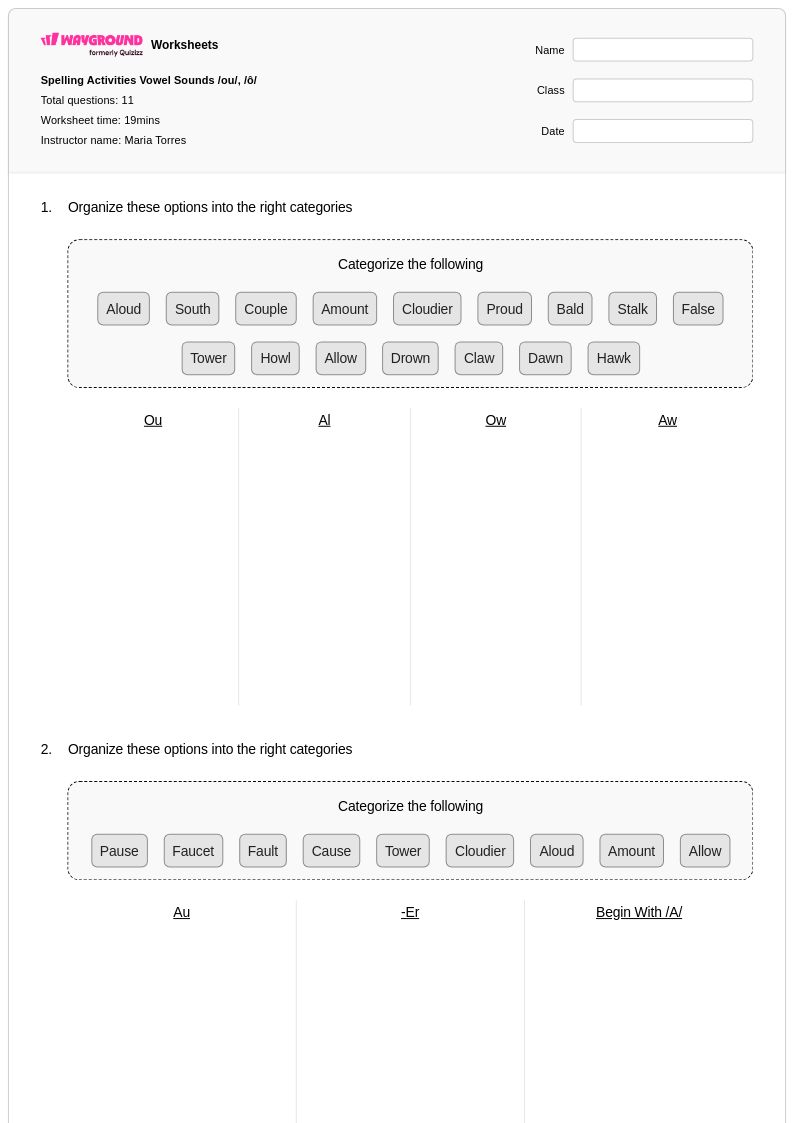
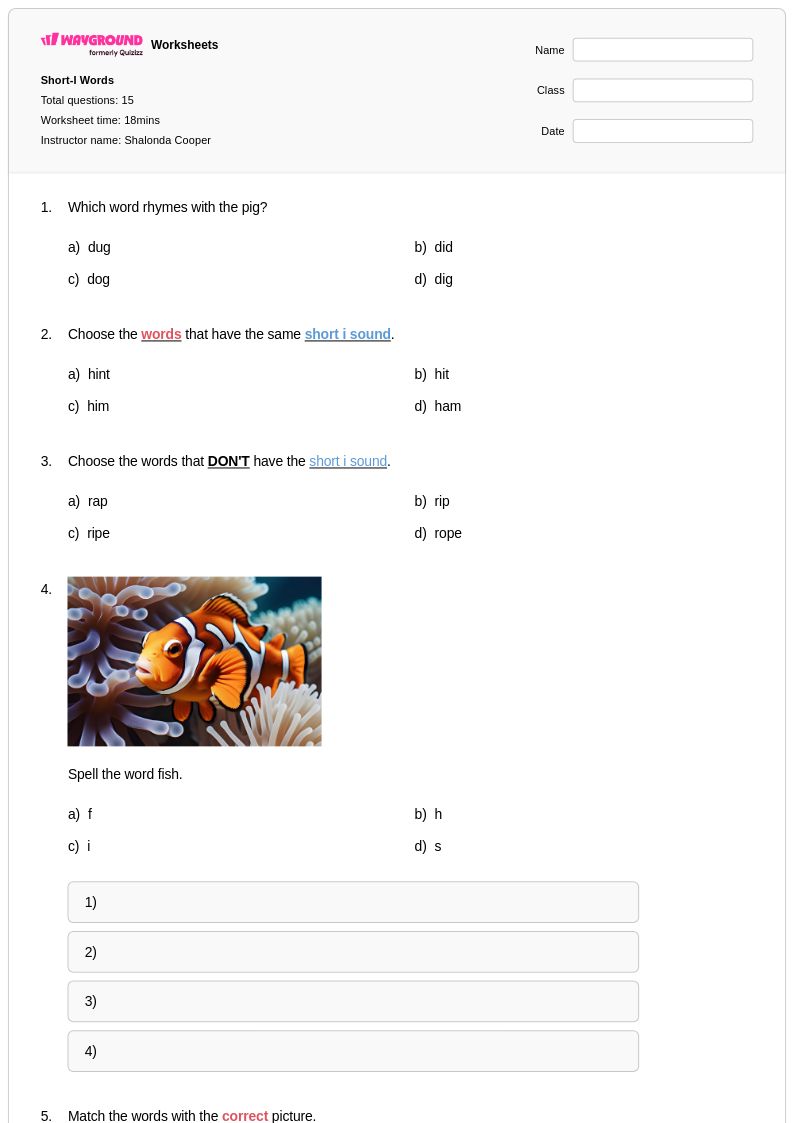
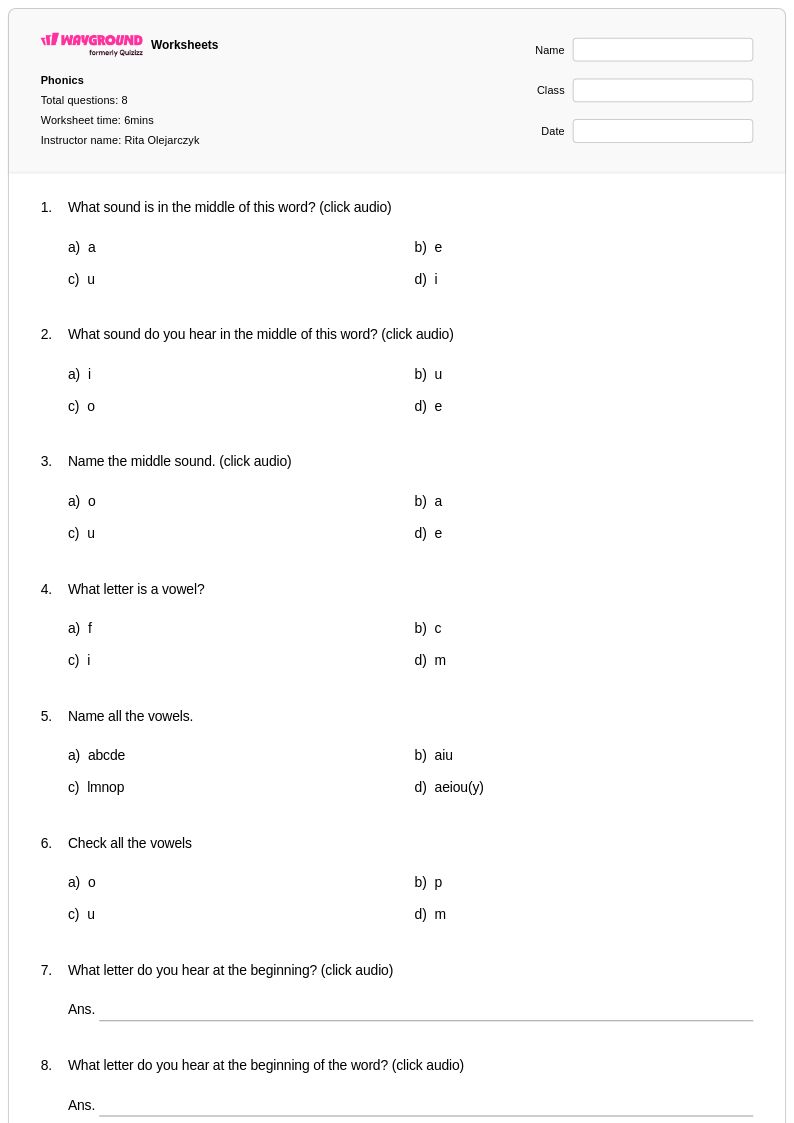
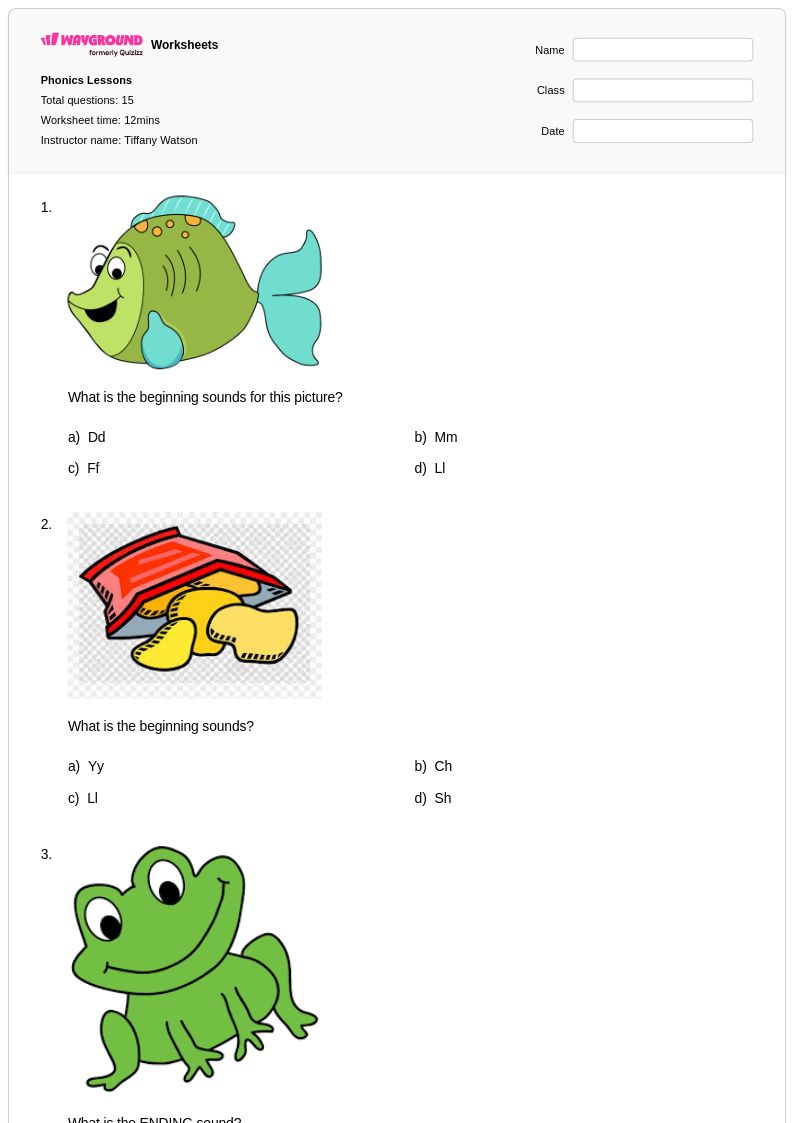
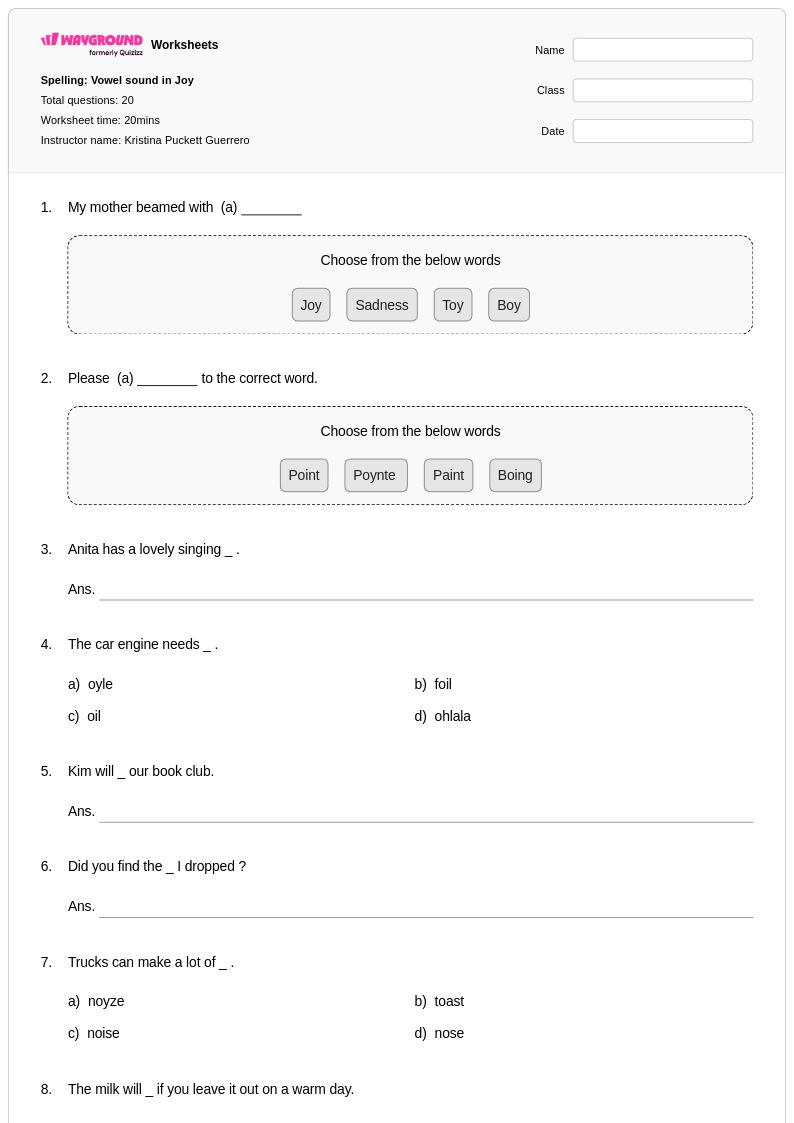
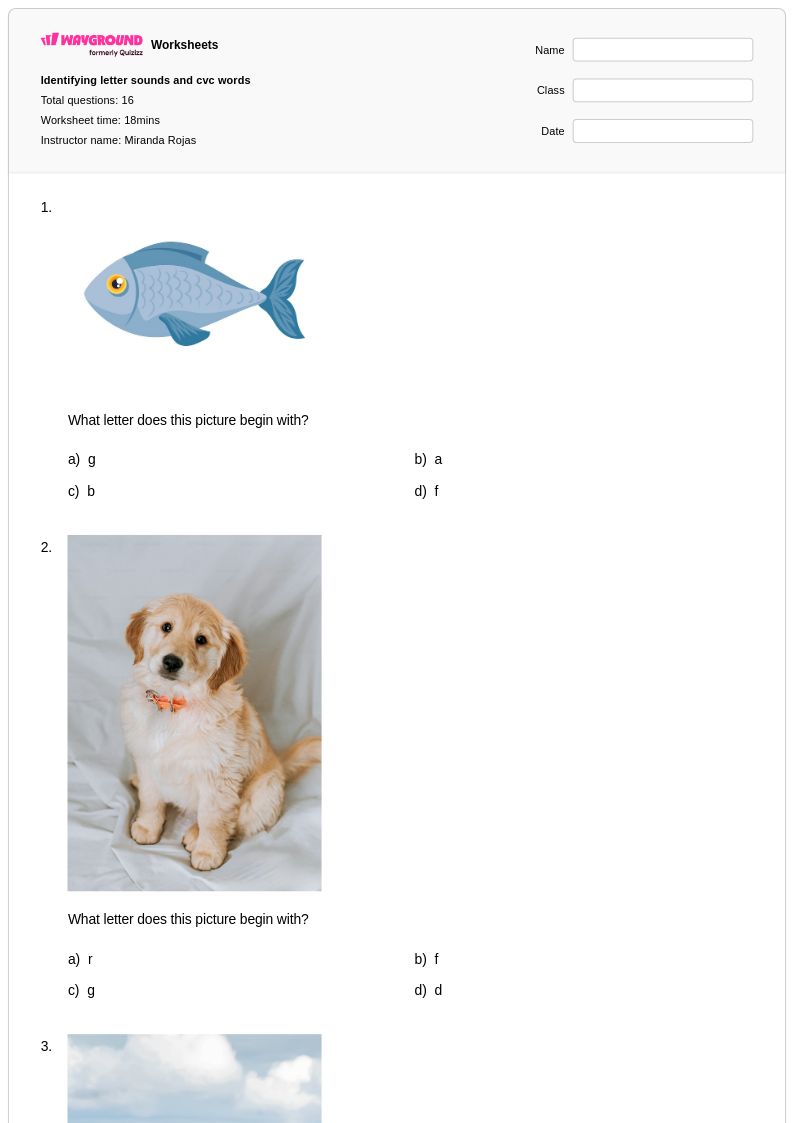
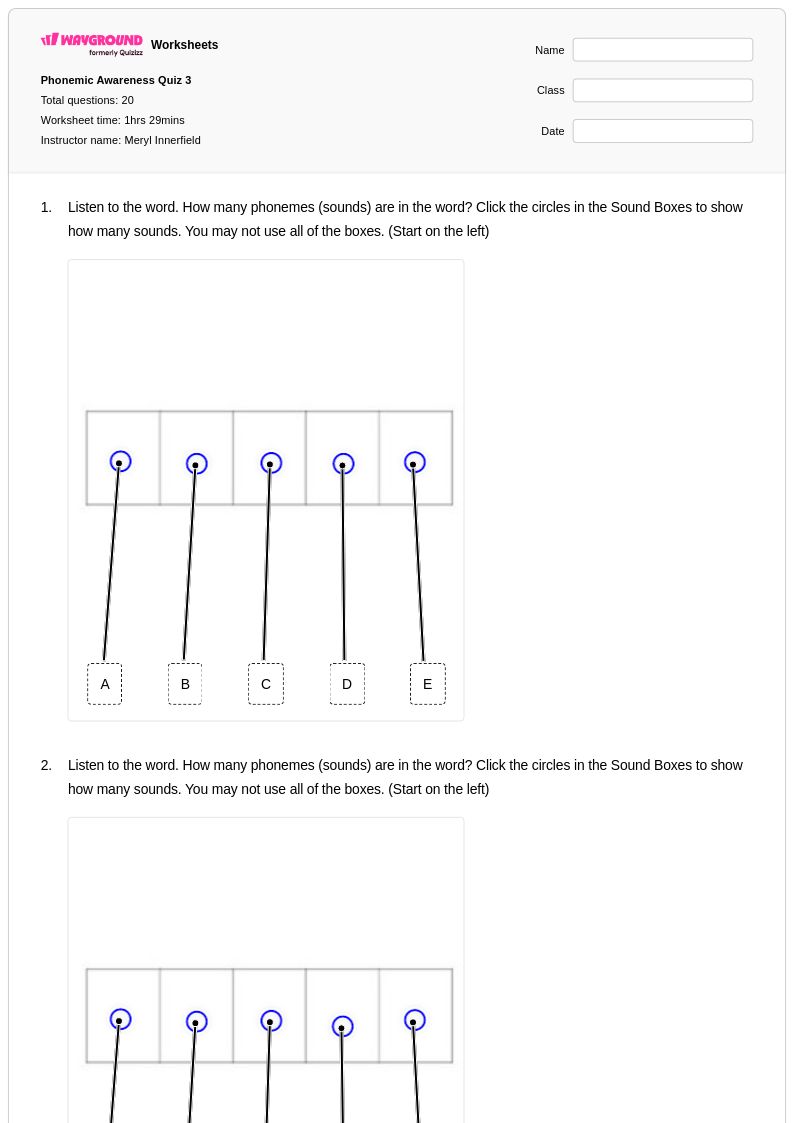
Explore Wayground's free middle sounds worksheets and printables that help students identify and practice phonetic sounds within words through engaging exercises, practice problems, and comprehensive answer keys.
Middle sounds worksheets available through Wayground (formerly Quizizz) provide essential phonemic awareness practice that strengthens students' ability to identify and manipulate vowel and consonant sounds within words. These comprehensive printables target the critical skill of recognizing medial phonemes, which serves as a foundational building block for reading fluency and spelling accuracy. Each worksheet collection includes systematic practice problems that progress from simple CVC patterns to more complex phonetic structures, complete with answer keys that enable immediate feedback and self-correction. The free pdf resources incorporate engaging activities such as sound sorting, word completion exercises, and phoneme substitution tasks that reinforce auditory discrimination skills while building confidence in phonetic analysis.
Wayground (formerly Quizizz) empowers educators with an extensive library of millions of teacher-created middle sounds resources that streamline lesson planning and support differentiated instruction. The platform's robust search and filtering capabilities allow teachers to quickly locate materials aligned with specific phonics standards and customize worksheets to match individual student needs and learning objectives. These versatile collections are available in both printable and digital formats, including downloadable pdf versions that facilitate seamless integration into classroom rotations, homework assignments, and intervention programs. Teachers can efficiently address skill gaps through targeted remediation while providing enrichment opportunities for advanced learners, ensuring that every student receives appropriate phonemic awareness practice that accelerates reading development and phonetic understanding.
FAQs
How do I teach middle sounds to early readers?
Teaching middle sounds begins with helping students isolate the medial phoneme in simple CVC (consonant-vowel-consonant) words like 'cat', 'pin', or 'hop'. Use a stretching technique where students say the word slowly and identify the sound in the middle. Once students can isolate vowel sounds in CVC words, gradually introduce more complex patterns such as consonant blends and digraphs. Connecting middle sound work to spelling tasks reinforces both decoding and encoding simultaneously.
What exercises help students practice identifying middle sounds?
Effective middle sounds practice includes sound sorting activities where students categorize words by their medial vowel, word completion tasks where the middle phoneme is missing, and phoneme substitution exercises where students swap one middle sound for another to form a new word. Picture-based tasks are particularly useful for younger learners because they reduce decoding demands and keep the focus on phonemic awareness rather than print. Repeated exposure across varied formats builds automaticity with medial phoneme identification.
What mistakes do students commonly make when identifying middle sounds?
The most common error is confusing the middle sound with the beginning or ending sound, particularly in short words where phonemes blend together quickly. Students also frequently substitute visually similar vowels, such as mixing short /e/ and short /i/, because these sounds are acoustically close and easy to mishear. Another common misconception is treating vowel digraphs or blends as a single middle sound when they are not. Targeted practice with minimal pairs, such as 'pit' versus 'pet', helps students sharpen auditory discrimination for these tricky distinctions.
How can I use middle sounds worksheets in my classroom?
Middle sounds worksheets on Wayground are available as printable PDFs for traditional classroom use and in digital formats for technology-integrated environments, including the option to host them as a quiz directly on Wayground. Printable versions work well for small group instruction, literacy centers, and take-home practice, while digital formats are well suited for 1:1 device programs or remote learning. Both formats include answer keys so students can self-check or teachers can use them for quick formative assessment.
How do middle sounds fit into a broader phonics sequence?
Middle sounds, particularly short vowel sounds in CVC words, are typically introduced after students have mastered initial and final consonant sounds. Proficiency with medial phonemes is a critical prerequisite for blending full words and for accurate spelling, making it a central component of early phonics instruction. Once students reliably identify and manipulate middle sounds, they are better prepared to work with vowel teams, silent-e patterns, and multisyllabic words. Treating middle sounds as a distinct instructional focus, rather than bundling it with initial and final sounds, leads to stronger phonemic awareness outcomes.
How do I differentiate middle sounds practice for students at different skill levels?
For students who are still developing phonemic awareness, begin with oral-only tasks using pictures before introducing print, and limit practice to the five short vowels in simple CVC words. For students who are ready to extend their skills, introduce consonant clusters, vowel digraphs, or multisyllabic words with identifiable medial phonemes. On Wayground, teachers can apply individual accommodations such as read-aloud support, reduced answer choices, or extended time to specific students, ensuring that each learner engages with middle sounds practice at an appropriate level of challenge.