

Wayground
Parts of an Ecosystem Vocab - Printable Science Worksheets grade 5 - Wayground

Parts of an Ecosystem Vocab

20 questions

5th - 5th Grade

Science

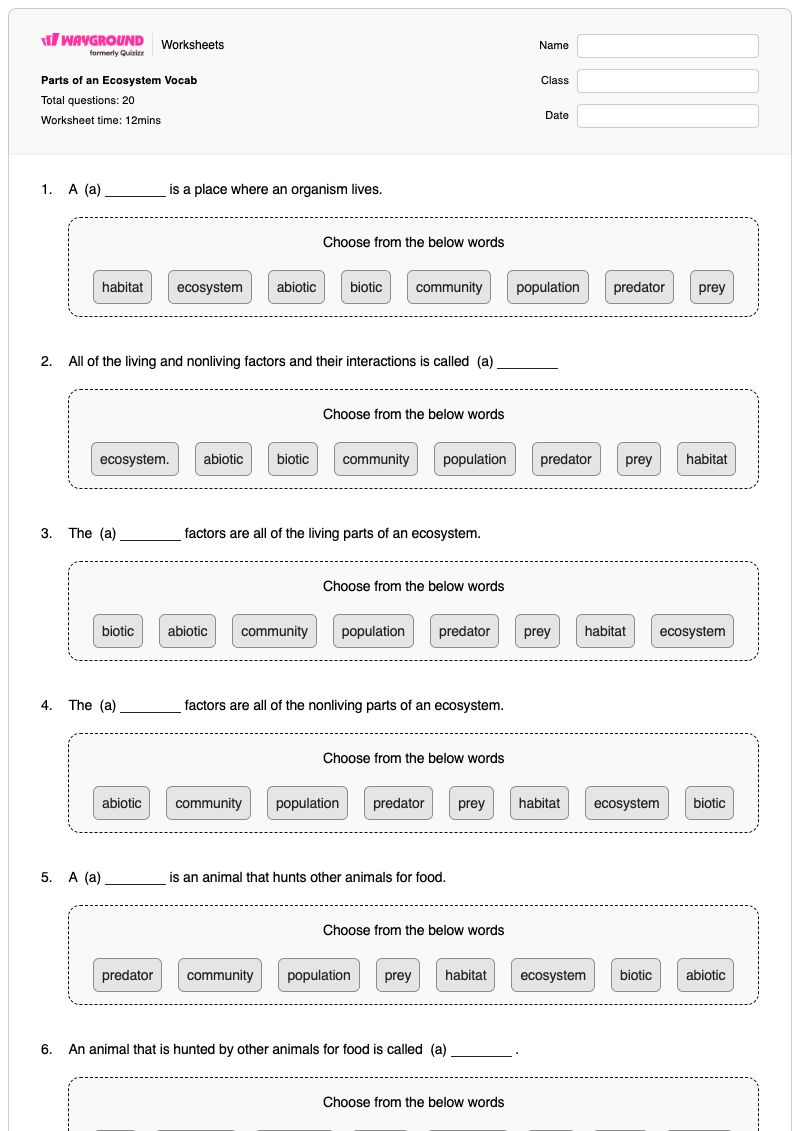
Parts of an Ecosystem Vocab is a free printable Grade 5 science worksheet with an answer key. It helps students define and distinguish habitat, ecosystem, biotic factors, abiotic factors, predator, prey, population, and community. Students complete 20 questions in three formats: eight drag-and-drop vocabulary items, two matching activities, and ten multiple-choice questions. The worksheet asks students to apply ecosystem vocabulary to examples, including identifying trees and squirrels as biotic and soil and water as abiotic. It also checks whether students can distinguish a population from a community and understand the relationship between a habitat and an ecosystem. Use it for vocabulary introduction, guided practice, independent review, or a quick check of Grade 5 science understanding.

Worksheet settings

Font size

S
M
L
XL
Worksheets

Parts of an Ecosystem Vocab

Total questions: 20

Name
Class
Date
1.

A ​ (a)   is a place where an organism lives.

Choose from the below words
habitat
ecosystem
abiotic
biotic
community
population
predator
prey
2.

All of the living and nonliving factors and their interactions is called ​ (a)  

Choose from the below words
ecosystem.
abiotic
biotic
community
population
predator
prey
habitat
3.

The ​ (a)   factors are all of the living parts of an ecosystem.

Choose from the below words
biotic
abiotic
community
population
predator
prey
habitat
ecosystem
4.

The ​ (a)   factors are all of the nonliving parts of an ecosystem.

Choose from the below words
abiotic
community
population
predator
prey
habitat
ecosystem
biotic
5.

A​ ​ (a)   is an animal that hunts other animals for food.

Choose from the below words
predator
community
population
prey
habitat
ecosystem
biotic
abiotic
6.

An animal that is hunted by other animals for food is called ​ (a)   .

Choose from the below words
prey
community
population
habitat
ecosystem
biotic
abiotic
predator
7.

A ​ (a)   refers to a group of organisms of one species that live in an area at the same time.

Choose from the below words
population
community
habitat
ecosystem
biotic
abiotic
predator
prey
8.

A ​ (a)   refers to different populations that live together in an area.

Choose from the below words
community
habitat
ecosystem
biotic
abiotic
predator
prey
population
9.

Match the following

habitat

place where an organism live

ecosystem

all the living and nonliving things that interact in an area

biotic

all of the living parts of an ecosystem

abiotic

the nonliving parts in an ecosystem

10.

Match the following

predator

an animal that hunts other animals for food

prey

an animal that is hunted and killed by another for food

population

a group of organisms of one species that live in an area at the same time

community

different populations that live together in an area

11.

TRUE OR FALSE: An ecosystem is bigger than a habitat.

a)

true

b)

false

12.

Biotic or Abiotic? A tree in the winter.

a)

biotic

b)

abiotic

13.

Biotic or Abiotic? The soil in a pot.

a)

biotic

b)

abiotic

14.

Biotic or Abiotic? The squirrels gathering acorns.

a)

biotic

b)

abiotic

15.

Biotic or Abiotic? The water in a fishtank.

a)

biotic

b)

abiotic

16.

Biotic or Abiotic? The clouds blocking the sunlight.

a)

biotic

b)

abiotic

17.

Biotic or Abiotic? The light from the sun.

a)

biotic

b)

abiotic

18.

Biotic or Abiotic? The people on a bus.

a)

biotic

b)

abiotic

19.

A scientist is comparing the number of zebra mussels in different lakes in Michigan. What is she studying?

a)

population

b)

community

20.

A scientist is identifying the different frogs in a pond. What is he trying to study?

a)

population

b)

community

Answer Key

Parts of an Ecosystem Vocab

Total questions: 20

1.
habitat
2.
ecosystem.
3.
biotic
4.
abiotic
5.
predator
6.
prey
7.
population
8.
community
9.

habitat

 - 

place where an organism live

, 

ecosystem

 - 

all the living and nonliving things that interact in an area

, 

biotic

 - 

all of the living parts of an ecosystem

, 

abiotic

 - 

the nonliving parts in an ecosystem

10.

predator

 - 

an animal that hunts other animals for food

, 

prey

 - 

an animal that is hunted and killed by another for food

, 

population

 - 

a group of organisms of one species that live in an area at the same time

, 

community

 - 

different populations that live together in an area

11.
a)

true

12.
a)

biotic

13.
b)

abiotic

14.
a)

biotic

15.
b)

abiotic

16.
b)

abiotic

17.
b)

abiotic

18.
a)

biotic

19.
a)

population

20.
b)

community

FAQs

What does the Parts of an Ecosystem Vocab worksheet cover?

This Grade 5 science worksheet covers eight ecosystem terms: habitat, ecosystem, biotic, abiotic, predator, prey, population, and community. Its eight drag-and-drop, two matching, and ten multiple-choice questions require students to match definitions, distinguish related terms, and classify examples such as trees, squirrels, soil, and water as biotic or abiotic.

How can I use this worksheet to teach parts of an ecosystem vocabulary?

Introduce the vocabulary by having students compare the definition pairs on the drag-and-drop items, such as predator and prey or population and community. Then use the matching questions to reinforce the groups of terms and discuss why a tree or squirrels are biotic while soil or water are abiotic before students complete the multiple-choice checks independently.

What mistakes should I watch for when students complete this ecosystem vocabulary worksheet?

Watch for students confusing a habitat with an ecosystem, or a population with a community. Students may also reverse predator and prey or treat nonliving examples such as soil and water as biotic; the classification questions provide a direct check for these errors.

How do I assign and grade this Parts of an Ecosystem Vocab worksheet?

The worksheet is available as a printable PDF and as a digital quiz on Wayground, and it includes a complete answer key. Printable submissions can be graded by scanning student work with the Wayground for Teachers app. The printable format can also support schools that are reducing screen time.

How can I differentiate this ecosystem vocabulary worksheet for my students?

Use the worksheet’s Advanced Settings to adjust font spacing or font size so the drag-and-drop definitions, matching items, and multiple-choice choices are easier to read. You can also enable a dyslexia-friendly font or translate the ecosystem vocabulary worksheet into another language when appropriate.

Where can I find more worksheets like this on Wayground?

Wayground offers a broad collection of free printable worksheets and practice problems across subjects, with downloadable PDFs and answer keys to help students master essential skills and concepts. Browse more resources at https://wayground.com/en-us/worksheets.