

Wayground
Causes of the Civil War - Printable Social studies Worksheets grade 5 - Wayground

Causes of the Civil War

Kristen Mann

By Kristen Mann

20 questions

5th - 5th Grade

Social studies

151 plays

Updated Aug 2026

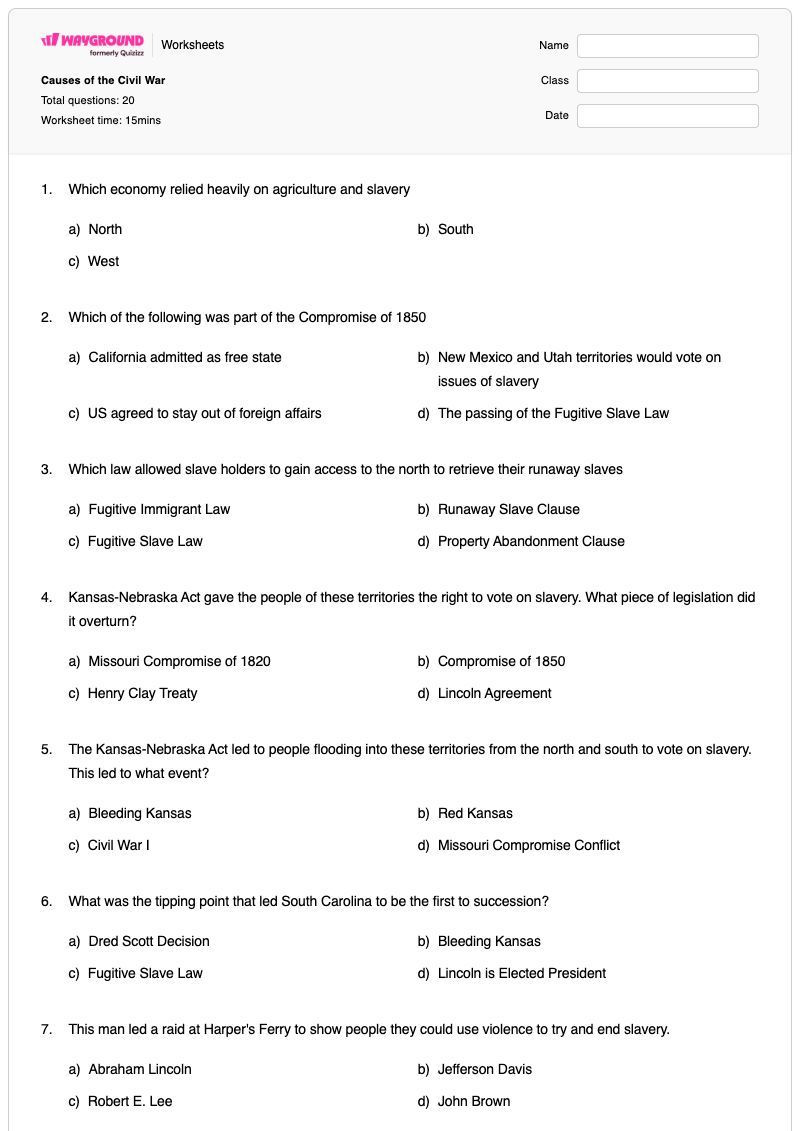
Causes of the Civil War is a Grade 5 social studies worksheet that helps students connect economic differences, slavery-related legislation, key events, and political decisions leading to the Civil War. Students identify the South’s agricultural and slavery-based economy, the North’s factory-based economy, and the effects of the Compromise of 1850, the Kansas-Nebraska Act, Bleeding Kansas, John Brown’s raid, and Lincoln’s election. They also review state’s rights, secession, abolition, abolitionists, and the meaning of civil war. The worksheet includes 20 questions: 19 multiple-choice items and 1 multiple-select item. Students use recall, vocabulary understanding, and cause-and-effect reasoning to distinguish major people, laws, events, and ideas connected to the conflict. This free printable worksheet includes a complete answer key for checking understanding, independent practice, review, or a social studies assessment.

Worksheet settings

Font size

S
M
L
XL
WaygroundWorksheets

Causes of the Civil War

Total questions: 20

Name
Class
Date
1.

Which economy relied heavily on agriculture and slavery

a)

North

b)

South

c)

West

2.

Which of the following was part of the Compromise of 1850

a)

California admitted as free state

b)

New Mexico and Utah territories would vote on issues of slavery

c)

US agreed to stay out of foreign affairs

d)

The passing of the Fugitive Slave Law

3.

Which law allowed slave holders to gain access to the north to retrieve their runaway slaves

a)

Fugitive Immigrant Law

b)

Runaway Slave Clause

c)

Fugitive Slave Law

d)

Property Abandonment Clause

4.

Kansas-Nebraska Act gave the people of these territories the right to vote on slavery. What piece of legislation did it overturn?

a)

Missouri Compromise of 1820

b)

Compromise of 1850

c)

Henry Clay Treaty

d)

Lincoln Agreement

5.

The Kansas-Nebraska Act led to people flooding into these territories from the north and south to vote on slavery. This led to what event?

a)

Bleeding Kansas

b)

Red Kansas

c)

Civil War I

d)

Missouri Compromise Conflict

6.

What was the tipping point that led South Carolina to be the first to succession?

a)

Dred Scott Decision

b)

Bleeding Kansas

c)

Fugitive Slave Law

d)

Lincoln is Elected President

7.
This man led a raid at Harper's Ferry to show people they could use violence to try and end slavery. 
a)
Abraham Lincoln
b)
Jefferson Davis
c)
Robert E. Lee 
d)
John Brown
8.
This was the main cause that caused the South to secede because they said they did not have to follow the Federal laws 
a)
Harriet Beecher Stowe's Uncle Tom's Cabin
b)
John Brown's Raid
c)
State's Rights
d)
Fort Sumter
9.
The North used what for their economy?
a)
Plantations 
b)
Factories 
c)
Slaves 
d)
Farming
10.
Secede means to.....
a)
join
b)
get rid of
c)
come together
d)
seperate
11.
Abolish means to....
a)
separate
b)
get rid of
c)
make more of
d)
bring together
12.
This person was the president of the United States during the Civil War?
a)
Jefferson Davis
b)
Ulysses S. Grant
c)
Abraham Lincoln
d)
Robert E. Lee
13.

True or False: The North's economy was agriculture like cotton.

a)

True

b)

False

14.
A Civil War is...
a)
a battle between people from the same country
b)
a domestic dispute
c)
a war between people from the same country
d)
a war between civilians
15.
What is an abolitionist?
a)
A person against slavery
b)
A person who is a slave
c)
A person for slavery
d)
A person who owns slaves
16.

To withdraw from a larger unit one belongs to.

a)

Secede

b)

Blockade

c)

Sovereign

d)

Freedmen

17.
What was the Underground Railroad?
a)
Railroad tracks that ran East and West
b)
Secret routes that runaway slaves used to reach freedom
c)
An underground tunnel that ran to Canada
d)
A rode that returned escaped slaves to the south
18.
Which region was considered "free states?"
a)
North 
b)
South
c)
East 
d)
West
19.

Which of the following describes "Bleeding Kansas"?

a)

A violent slave uprising led by Joseph Cinque

b)

Violence in Kansas between proslavery and antislavery settlers prior to the Civil War

c)

The turning point of the Civil War, in which Robert E. Lee's army was routed from Kansas

d)

The devastation caused by a tornado in Kansas in 1854, which killed 55 people

20.
The Missouri Compromise allowed what state to be a slave state and what state to be a free state?
a)
Missouri/ Maine
b)
Maine/Missouri
c)
Texas/California
d)
California/ D.C
WaygroundAnswer Key

Causes of the Civil War

Total questions: 20

1.
b)

South

2.
a)

California admitted as free state

, b)

New Mexico and Utah territories would vote on issues of slavery

, d)

The passing of the Fugitive Slave Law

3.
c)

Fugitive Slave Law

4.
a)

Missouri Compromise of 1820

5.
a)

Bleeding Kansas

6.
d)

Lincoln is Elected President

7.
d) John Brown
8.
c) State's Rights
9.
b) Factories 
10.
d) seperate
11.
b) get rid of
12.
c) Abraham Lincoln
13.
b)

False

14.
c) a war between people from the same country
15.
a) A person against slavery
16.
a)

Secede

17.
b) Secret routes that runaway slaves used to reach freedom
18.
a) North 
19.
b)

Violence in Kansas between proslavery and antislavery settlers prior to the Civil War

20.
a) Missouri/ Maine

FAQs

What does the Causes of the Civil War worksheet cover?

This Grade 5 worksheet uses 19 multiple-choice questions and 1 multiple-select question to examine the economic differences between the North and South and the laws, events, and decisions that increased sectional conflict. Students connect the Compromise of 1850, the Kansas-Nebraska Act, Bleeding Kansas, John Brown’s raid, Lincoln’s election, state’s rights, and secession while reviewing related vocabulary such as abolish and abolitionist.

How can I use this worksheet to teach the causes of the Civil War?

Introduce the worksheet by organizing its content into three categories: economic differences, slavery-related laws and debates, and escalating events or political decisions. Have students complete the multiple-choice items after a lesson, then use the multiple-select Compromise of 1850 question to discuss why more than one provision can belong to a single agreement and ask students to explain how the listed events contributed to rising sectional tension.

What mistakes should I watch for when students complete this Civil War causes worksheet?

Watch for students reversing the economic roles of the regions, such as choosing agriculture or cotton for the North instead of factories for the South-focused comparison. Students may also confuse the Fugitive Slave Law with the Kansas-Nebraska Act, mistake Bleeding Kansas for a law, select only one correct provision in the Compromise of 1850 multiple-select item, or mix up the meanings of secede, abolish, and abolitionist.

How do I assign and grade this Causes of the Civil War worksheet?

Wayground provides this worksheet as a printable PDF and as a digital quiz, and it includes a complete answer key for all 20 items. You can grade printable submissions by scanning student work with the Wayground for Teachers app, or review responses from the digital quiz.

How can I differentiate this Civil War causes worksheet for my students?

In the worksheet’s Advanced Settings, adjust font spacing or font size to make the multiple-choice options and the longer law-and-event questions easier to read. You can also enable a dyslexia-friendly font or translate the worksheet into another language while keeping its Civil War causes question format.

Where can I find more worksheets like this on Wayground?

Wayground offers a comprehensive collection of free printable worksheets and practice problems across all subjects, with downloadable PDFs and answer keys to support essential skills and concepts. Browse more resources at https://wayground.com/en-us/worksheets.