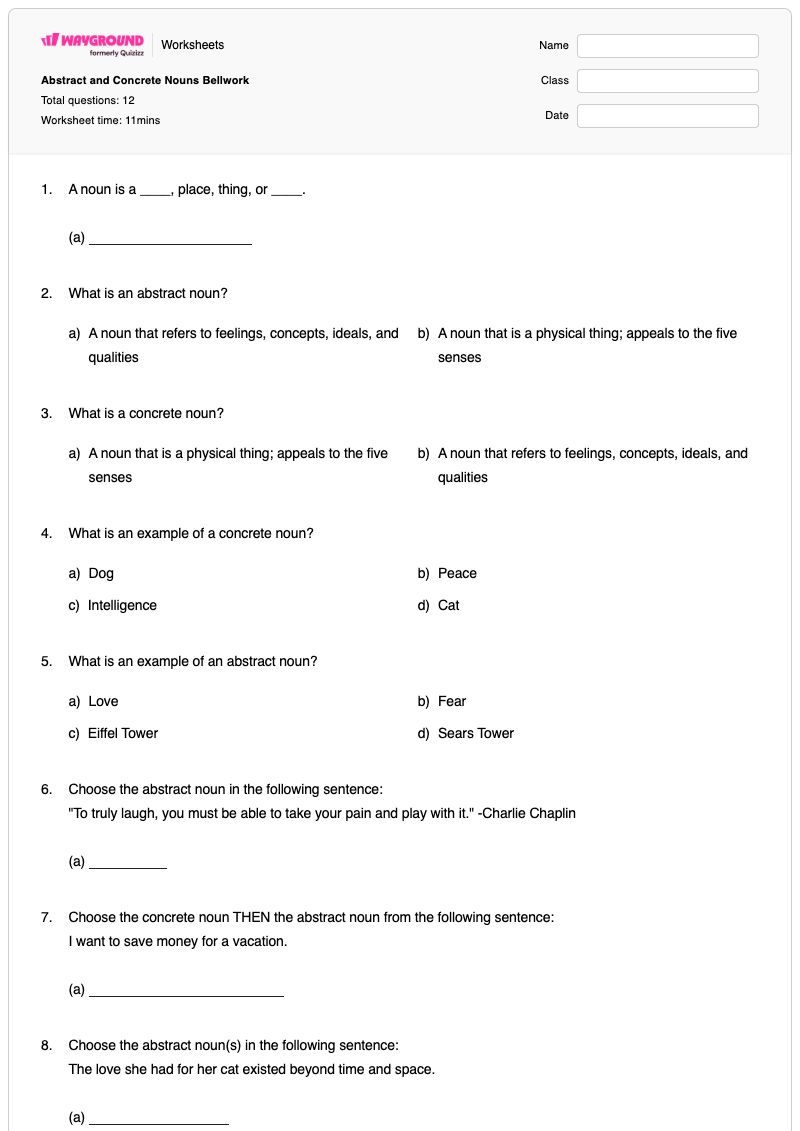
This Grade 6 English worksheet builds students’ ability to distinguish abstract nouns from concrete nouns. It introduces nouns as people, places, things, or ideas, then uses multiple-choice and multiple-select questions to check whether students can identify abstract nouns connected to feelings, concepts, ideals, and qualities and concrete nouns that appeal to the five senses. Students also complete fill-in-the-blank items by locating noun types in sentences.
The worksheet’s sentence-based practice includes identifying one or more abstract or concrete nouns and selecting a concrete noun before an abstract noun when prompted. Examples such as pain, money, vacation, love, books, lotion, and hate require students to apply the definitions in context rather than rely only on memorized examples. Designed for Grade 6 English bellwork, review, or a quick formative check, this free printable worksheet includes an answer key for efficient feedback and grading.
Worksheet settings
Font size
S
M
L
XL
Worksheets
Abstract and Concrete Nouns Bellwork
Total questions: 12
Name
Class
Date
1.
A noun is a ____, place, thing, or ____.
(a)
2.
What is an abstract noun?
a)
A noun that refers to feelings, concepts, ideals, and qualities
b)
A noun that is a physical thing; appeals to the five senses
3.
What is a concrete noun?
a)
A noun that is a physical thing; appeals to the five senses
b)
A noun that refers to feelings, concepts, ideals, and qualities
4.
What is an example of a concrete noun?
a)
Dog
b)
Peace
c)
Intelligence
d)
Cat
5.
What is an example of an abstract noun?
a)
Love
b)
Fear
c)
Eiffel Tower
d)
Sears Tower
6.
Choose the abstract noun in the following sentence:
"To truly laugh, you must be able to take your pain and play with it." -Charlie Chaplin
(a)
7.
Choose the concrete noun THEN the abstract noun from the following sentence:
I want to save money for a vacation.
(a)
8.
Choose the abstract noun(s) in the following sentence:
The love she had for her cat existed beyond time and space.
(a)
9.
Choose the concrete noun(s) in the following sentence:
"Oh my gosh! I just love to read books and watch movies."
(a)
10.
Choose the abstract noun(s) in the following sentence:
"I hope for world peace!"
(a)
11.
Choose the concrete noun(s) in the following sentence:
My lotion was too oily so I had to wash my hands.
(a)
12.
Choose the concrete THEN the abstract noun in the following sentence:
I just hate when people mark on other peoples' papers.
(a)
Answer Key
Abstract and Concrete Nouns Bellwork
Total questions: 12
1.
person, idea
2.
a)
A noun that refers to feelings, concepts, ideals, and qualities
3.
a)
A noun that is a physical thing; appeals to the five senses
4.
a)
Dog
, d)
Cat
5.
a)
Love
, b)
Fear
6.
pain
7.
money, vacation
8.
love, time
9.
books, movies
10.
hope, peace
11.
lotion, hands
12.
papers, hate
140 %
Browse by subjects
Browse by grades
Browse by format
FAQs
What does the Abstract and Concrete Nouns Bellwork worksheet cover?
This Grade 6 English worksheet asks students to distinguish abstract nouns—feelings, concepts, ideals, and qualities—from concrete nouns, which are physical and appeal to the five senses. Across 8 fill-in-the-blank, 2 multiple-choice, and 2 multiple-select questions, students classify examples and identify noun types in sentences, including cases where they must choose a concrete noun before an abstract noun.
How can I use this worksheet to teach abstract and concrete nouns?
Begin by reviewing the worksheet’s two definitions: concrete nouns can be experienced through the five senses, while abstract nouns name ideas, feelings, or qualities. Model the classification of an example such as dog or peace, then have students explain why nouns in sentences such as “I hope for world peace!” fit one category. Use the final sentence items to move from guided identification to independent practice.
What mistakes should I watch for when students complete this worksheet?
Students may confuse a noun that feels important or familiar with a concrete noun, selecting examples such as peace or intelligence even though they cannot be experienced through the five senses. In the multiple-select items, they may choose only one correct example instead of selecting both dog and cat or both love and fear. Also watch for students who identify the right nouns but reverse the required concrete-then-abstract order, or overlook more than one target noun in a sentence.
How do I assign and grade this abstract and concrete nouns worksheet?
The worksheet is available as a printable PDF and as a digital quiz on Wayground, with a complete answer key for all 12 items. You can grade printable submissions by scanning student work with the Wayground for Teachers app, or use the digital quiz for online response collection and grading. The printable format can also support schools that are reducing screen time.
How can I differentiate this worksheet for my students?
Use the worksheet’s Advanced Settings to adjust font spacing or increase the font size so the noun definitions, answer choices, and sentence prompts are easier to read. You can also enable a dyslexia-friendly font for students who benefit from that presentation, or translate the abstract and concrete noun directions and examples into another language.
Where can I find more free worksheets like this on Wayground?
Wayground offers a comprehensive collection of free printable worksheets and practice problems across subjects, with downloadable PDFs and answer keys to help students master essential skills and concepts. Browse more resources at https://wayground.com/en-us/worksheets.

 Worksheets