

Wayground
The New Deal | Alphabet Soup of Agencies - Printable Social Studies Worksheets grade 11 - Wayground

The New Deal | Alphabet Soup of Agencies

21 questions

5th - 11th Grade

Social Studies

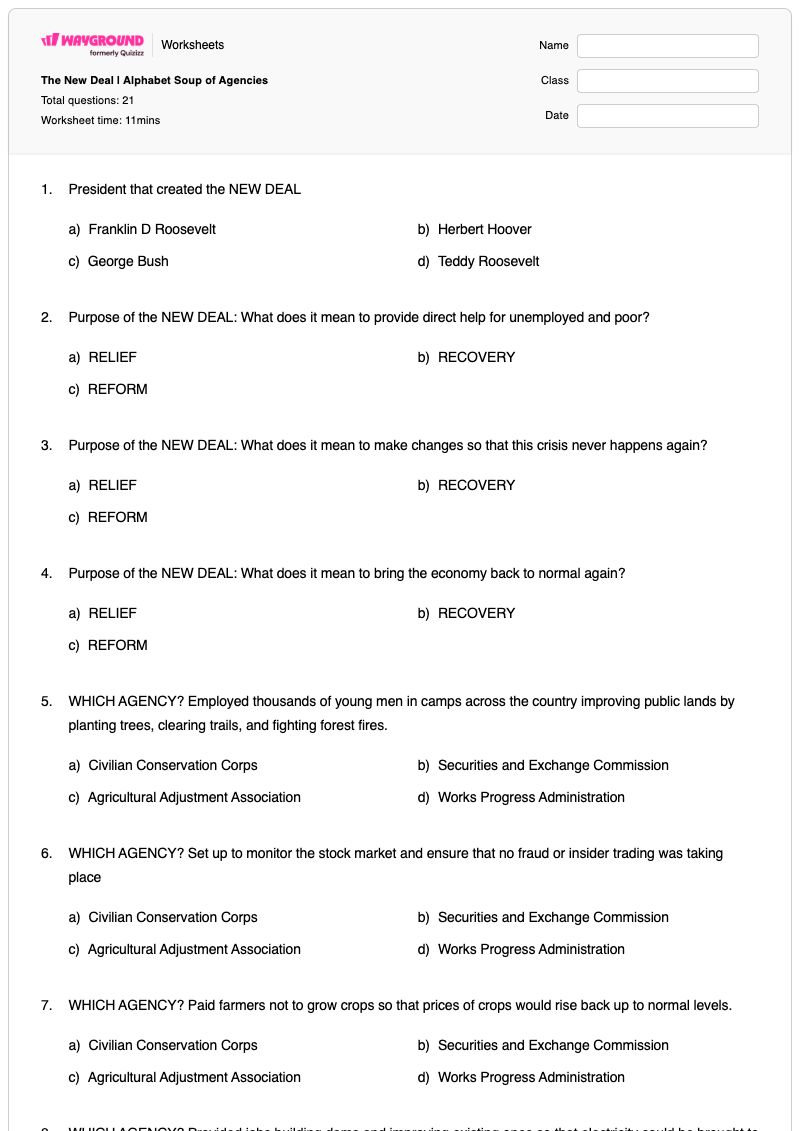
The New Deal | Alphabet Soup of Agencies is a free printable Social Studies worksheet for students in Grades 5–11. Through 21 multiple-choice questions, students identify President Franklin D. Roosevelt as the creator of the New Deal, distinguish its three purposes—Relief, Recovery, and Reform—and connect New Deal agencies with their functions. Students use descriptions to identify agencies such as the Civilian Conservation Corps, Securities and Exchange Commission, Agricultural Adjustment Association, Tennessee Valley Authority, Social Security Administration, Federal Deposit Insurance Corporation, National Youth Administration, and Works Progress Administration. Additional questions ask students to classify an agency’s work as Relief, Recovery, or Reform, building recognition of how New Deal programs addressed unemployment, economic recovery, public works, financial regulation, and long-term protections. The worksheet includes a complete answer key for efficient review and assessment.

Worksheet settings

Font size

S
M
L
XL
Worksheets

The New Deal | Alphabet Soup of Agencies

Total questions: 21

Name
Class
Date
1.

President that created the NEW DEAL

a)

Franklin D Roosevelt

b)

Herbert Hoover

c)

George Bush

d)

Teddy Roosevelt

2.

Purpose of the NEW DEAL: What does it mean to provide direct help for unemployed and poor?

a)

RELIEF

b)

RECOVERY

c)

REFORM

3.

Purpose of the NEW DEAL: What does it mean to make changes so that this crisis never happens again?

a)

RELIEF

b)

RECOVERY

c)

REFORM

4.

Purpose of the NEW DEAL: What does it mean to bring the economy back to normal again?

a)

RELIEF

b)

RECOVERY

c)

REFORM

5.

WHICH AGENCY? Employed thousands of young men in camps across the country improving public lands by planting trees, clearing trails, and fighting forest fires.

a)

Civilian Conservation Corps

b)

Securities and Exchange Commission

c)

Agricultural Adjustment Association

d)

Works Progress Administration

6.

WHICH AGENCY? Set up to monitor the stock market and ensure that no fraud or insider trading was taking place

a)

Civilian Conservation Corps

b)

Securities and Exchange Commission

c)

Agricultural Adjustment Association

d)

Works Progress Administration

7.

WHICH AGENCY? Paid farmers not to grow crops so that prices of crops would rise back up to normal levels.

a)

Civilian Conservation Corps

b)

Securities and Exchange Commission

c)

Agricultural Adjustment Association

d)

Works Progress Administration

8.

WHICH AGENCY? Provided jobs building dams and improving existing ones so that electricity could be brought to the Deep South.

a)

Tennessee Valley Authority

b)

Social Security Administration

c)

Federal Deposit Insurance Corporation

d)

Home Owners Loan Corporation

9.

WHICH AGENCY? Form of insurance for old age and people with disabilities.

a)

Tennessee Valley Authority

b)

Social Security Administration

c)

Federal Deposit Insurance Corporation

d)

Home Owners Loan Corporation

10.

WHICH AGENCY? Inspected banks and provided deposit insurance up to $5,000 on checking and savings accounts in the event of a bank failure.

a)

Tennessee Valley Authority

b)

Social Security Administration

c)

Federal Deposit Insurance Corporation

d)

Home Owners Loan Corporation

11.

WHICH AGENCY? Provided job training for unemployed young people and part-time jobs for needy students. Grants were given to high school and college students in exchange for work.

a)

National Youth Administration

b)

Civilian Conservation Corporation

c)

Federal Deposit Insurance Corporation

d)

Home Owners Loan Corporation

12.

WHAT'S THE PURPOSE? Securities and Exchange Commission Set up to monitor the stock market and ensure that no fraud or insider trading was taking place

a)

RELIEF: direct help for poor and unemployed

b)

RECOVERY: Get economy going again

c)

REFORM: make changes to never happen again

13.

WHAT'S THE PURPOSE? Works Progress Administration Provided jobs to young men to build schools, hospitals, and other public works

a)

RELIEF: direct help for poor and unemployed

b)

RECOVERY: Get economy going again

c)

REFORM: make changes to never happen again

14.

WHAT'S THE PURPOSE? Social Security Administration Form of insurance for old age and people with disabilities.

a)

RELIEF: direct help for poor and unemployed

b)

RECOVERY: Get economy going again

c)

REFORM: make changes to never happen again

15.

WHAT'S THE PURPOSE? Federal Deposit Insurance Corporation Inspected banks and provided deposit insurance up to $5,000 on checking and savings accounts in the event of a bank failure.

a)

RELIEF: direct help for poor and unemployed

b)

RECOVERY: Get economy going again

c)

REFORM: make changes to never happen again

16.

WHAT'S THE PURPOSE? Agricultural Adjustment Association Paid farmers not to grow crops so that prices of crops would rise back up to normal levels.

a)

RELIEF: direct help for poor and unemployed

b)

RECOVERY: Get economy going again

c)

REFORM: make changes to never happen again

17.

WHAT did the CIVILIAN CONSERVATION CORPS do?

a)

Employed thousands of young men in camps across the country improving public lands by planting trees, clearing trails, and fighting forest fires.

b)

Paid farmers not to grow crops so that prices of crops would rise back up to normal levels.

c)

Form of insurance for old age and people with disabilities.

d)

Inspected banks and provided deposit insurance up to $5,000 on checking and savings accounts in the event of a bank failure.

18.

WHAT does the Federal Deposit Insurance Corporation do?

a)

Provided jobs building dams and improving existing ones so that electricity could be brought to the Deep South.

b)

Provided job training for unemployed young people and part-time jobs for needy students. Grants were given to high school and college students in exchange for work.

c)

Form of insurance for old age and people with disabilities.

d)

Inspected banks and provided deposit insurance up to $5,000 on checking and savings accounts in the event of a bank failure.

19.

WHAT does the Social Security Administration do?

a)

Provided jobs building dams and improving existing ones so that electricity could be brought to the Deep South.

b)

Provided job training for unemployed young people and part-time jobs for needy students. Grants were given to high school and college students in exchange for work.

c)

Form of insurance for old age and people with disabilities.

d)

Inspected banks and provided deposit insurance up to $5,000 on checking and savings accounts in the event of a bank failure.

20.
In 1929 the Great Depression started in the United States. In 1932 Franklin D. Roosevelt was elected president and he promised a "New Deal" to the American people. Which of the following BEST describes the role of the government during the New Deal?
a)
The government wanted people to take care of themselves and not use the government.
b)
The New Deal led to the government being more involved in the economy of the country.
c)
The government wanted people to let the government provide everything they needed.
d)
The New Deal led to the government being less involved in the economy of the country.
21.

The New Deal is a collection of government programs that were started by Franklin D. Roosevelt to solve the problems of the Great Depression between the years of

a)

1932-1939

b)

1919-1929

c)

1932

d)

1941-1945

Answer Key

The New Deal | Alphabet Soup of Agencies

Total questions: 21

1.
a)

Franklin D Roosevelt

2.
a)

RELIEF

3.
c)

REFORM

4.
b)

RECOVERY

5.
a)

Civilian Conservation Corps

6.
b)

Securities and Exchange Commission

7.
c)

Agricultural Adjustment Association

8.
a)

Tennessee Valley Authority

9.
b)

Social Security Administration

10.
c)

Federal Deposit Insurance Corporation

11.
a)

National Youth Administration

12.
c)

REFORM: make changes to never happen again

13.
a)

RELIEF: direct help for poor and unemployed

14.
c)

REFORM: make changes to never happen again

15.
c)

REFORM: make changes to never happen again

16.
b)

RECOVERY: Get economy going again

17.
a)

Employed thousands of young men in camps across the country improving public lands by planting trees, clearing trails, and fighting forest fires.

18.
d)

Inspected banks and provided deposit insurance up to $5,000 on checking and savings accounts in the event of a bank failure.

19.
c)

Form of insurance for old age and people with disabilities.

20.
b) The New Deal led to the government being more involved in the economy of the country.
21.
a)

1932-1939

FAQs

What does The New Deal | Alphabet Soup of Agencies worksheet cover?

This 21-question multiple-choice worksheet builds students’ ability to identify New Deal agencies from descriptions of their work and classify those agencies as providing Relief, promoting Recovery, or creating Reform. Students connect programs such as the Civilian Conservation Corps, Securities and Exchange Commission, Tennessee Valley Authority, and Federal Deposit Insurance Corporation to specific actions and historical purposes.

How can I use this worksheet to teach New Deal agencies and their purposes?

Introduce the three categories—Relief, Recovery, and Reform—before students complete the agency-identification questions. Have students underline the key action in each description, such as planting trees, regulating the stock market, building dams, or insuring bank deposits, then explain why that action fits its selected New Deal purpose.

What mistakes should I watch for when students complete this New Deal worksheet?

Students may confuse an agency’s name with another agency that addressed a related problem, such as selecting the Securities and Exchange Commission for a banking-insurance description instead of the Federal Deposit Insurance Corporation. They may also treat any job-creation program as Recovery without considering whether the question emphasizes direct help for unemployed people, as in the Relief classification, or a lasting system change, as in Reform.

How do I assign and grade The New Deal | Alphabet Soup of Agencies worksheet?

Wayground provides this worksheet as a printable PDF and as a digital quiz, and it includes a complete answer key for checking the 21 multiple-choice responses. Printable submissions can also be graded by scanning student work with the Wayground for Teachers app.

Which New Deal agencies do students identify in this worksheet?

The questions use agency descriptions to assess recognition of the Civilian Conservation Corps, Securities and Exchange Commission, Agricultural Adjustment Association, Tennessee Valley Authority, Social Security Administration, Federal Deposit Insurance Corporation, National Youth Administration, and Works Progress Administration. Students identify agencies from functions including conservation work, stock-market oversight, farm production controls, dam construction, social insurance, bank-deposit protection, student employment, and public works.

Where can I find more worksheets like this on Wayground?

Wayground offers a broad collection of free printable worksheets and practice problems across subjects, with downloadable PDFs and answer keys to support essential skills and concepts. Browse more resources at https://wayground.com/en-us/worksheets.