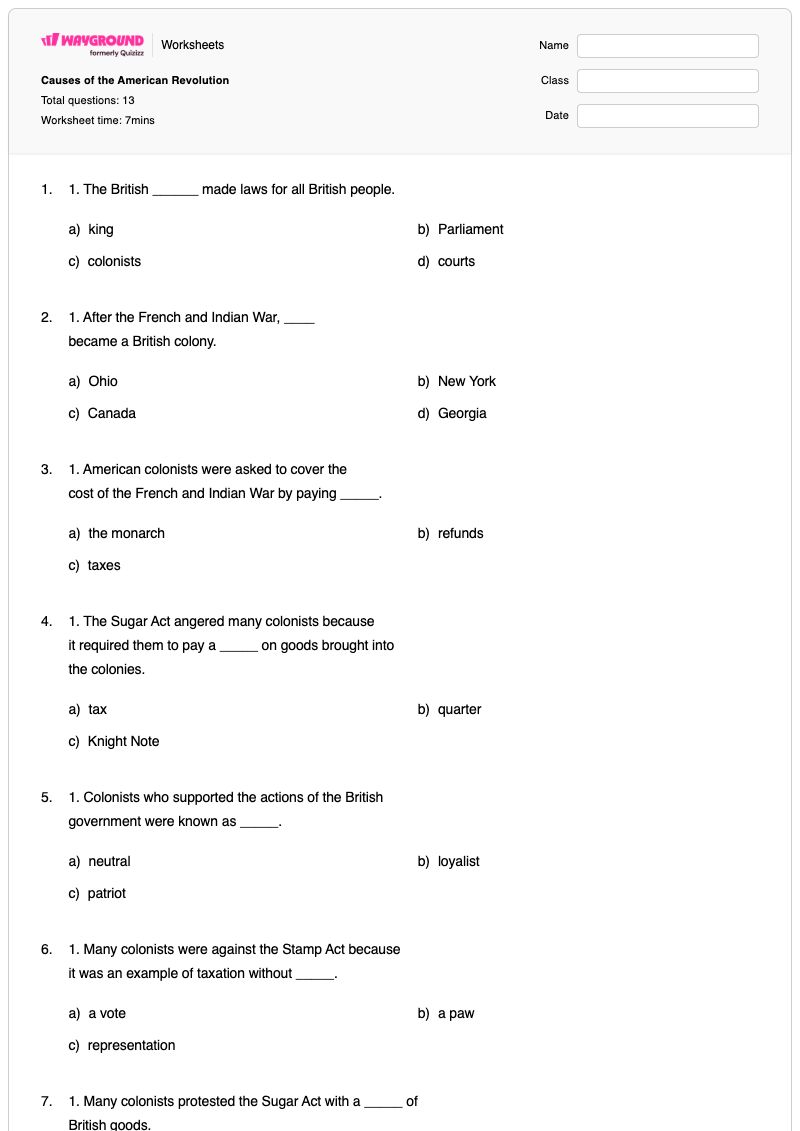
Causes of the American Revolution is a Grade 4 social studies worksheet that uses 13 multiple-choice questions to build students’ understanding of the events, laws, protests, and groups that contributed to the American Revolution. Students identify Parliament’s role, postwar taxation, the Sugar Act and Stamp Act, taxation without representation, colonial boycotts, and the repeal of the Stamp Act. They also recognize the Committee of Correspondence, Sons of Liberty, Loyalists, Minutemen, and key events such as the Boston Tea Party and the fighting at Lexington and Concord.
This free printable worksheet helps students connect important vocabulary with the actions and tensions that shaped the colonies’ conflict with Britain. The selected-response format provides focused practice in recalling historical terms and matching each law, protest, organization, or event with its significance. It is suitable for Grade 4 social studies instruction, review, or a formative check of understanding, and it includes a complete answer key for efficient checking.
Worksheet settings
Font size
S
M
L
XL
Worksheets
Causes of the American Revolution
Total questions: 13
Name
Class
Date
1.
1. The British ______ made laws for all British people.
a)
king
b)
Parliament
c)
colonists
d)
courts
2.
1. After the French and Indian War, ____
became a British colony.
a)
Ohio
b)
New York
c)
Canada
d)
Georgia
3.
1. American colonists were asked to cover the
cost of the French and Indian War by paying _____.
a)
the monarch
b)
refunds
c)
taxes
4.
1. The Sugar Act angered many colonists because
it required them to pay a _____ on goods brought into
the colonies.
a)
tax
b)
quarter
c)
Knight Note
5.
1. Colonists who supported the actions of the British
government were known as _____.
a)
neutral
b)
loyalist
c)
patriot
6.
1. Many colonists were against the Stamp Act because
it was an example of taxation without _____.
a)
a vote
b)
a paw
c)
representation
7.
1. Many colonists protested the Sugar Act with a _____ of
British goods.
a)
buyout
b)
boycott
c)
bungalo
d)
band
8.
1. Parliament ____ the Stamp Act when it heard that nine
of the colonies sent representatives to the
Stamp Act Congress
a)
doubled
b)
tripled
c)
quadrupled
d)
repealed
9.
1. The colonists formed the ______ to keep colonists informed about protests against British laws.
a)
newspaper
b)
Kids of Liberty
c)
Committee of Correspondence
d)
Minutemen
10.
1. The Sons of Liberty protested the tax on tea with an
action that later became known as the ______.
a)
Boston Massacre
b)
Committee of Correspondence
c)
Liberty Bell
d)
Boston Tea Party
11.
1. Colonists in Massachusetts felt that to ______, or provide housing for, British soldiers was intolerable.
a)
hotel
b)
host
c)
quarter
d)
boycott
12.
1. _______ were members of the Massachusetts militia who
were always ready to defend the colony.
a)
Minutemen
b)
Sons of Liberty
c)
Daughters of Liberty
d)
Regulars
13.
1. The fighting between the colonists and the British
army that took place in the towns of Lexington
and ______ marked the beginning of the Revolutionary War.
a)
Boston
b)
Concord
c)
Philadelphia
d)
New York
Answer Key
Causes of the American Revolution
Total questions: 13
1.
b)
Parliament
2.
c)
Canada
3.
c)
taxes
4.
a)
tax
5.
b)
loyalist
6.
c)
representation
7.
b)
boycott
8.
d)
repealed
9.
c)
Committee of Correspondence
10.
d)
Boston Tea Party
11.
c)
quarter
12.
a)
Minutemen
13.
b)
Concord
140 %
Browse by subjects
Browse by grades
Browse by format
FAQs
What does the Causes of the American Revolution worksheet cover?
This Grade 4 social studies worksheet covers 13 multiple-choice questions about the laws, protests, groups, and events that contributed to the American Revolution. Students identify concepts such as taxation without representation, the Sugar Act, the Stamp Act, boycotts, the Committee of Correspondence, the Boston Tea Party, the Minutemen, and Lexington and Concord.
How can I use this worksheet to teach the causes of the American Revolution?
Use the 13 multiple-choice items after introducing the relationship between Parliament, colonial taxes, and colonial protests. Have students explain why “taxation without representation” angered colonists, then discuss how actions such as the boycott, the Boston Tea Party, and the formation of the Committee of Correspondence increased resistance to British laws.
What mistakes should I watch for when students complete this worksheet?
Watch for students confusing Parliament with the king as the lawmaking body, or choosing “a vote” instead of “representation” in the phrase “taxation without representation.” Students may also mix up Loyalists and Patriots, confuse the Committee of Correspondence with the Sons of Liberty, or select Boston instead of Concord in the Lexington and Concord item.
How do I assign and grade this Causes of the American Revolution worksheet?
Wayground provides this worksheet as a printable PDF and as a digital quiz, with a complete answer key for all 13 multiple-choice questions. Printable submissions can be graded by scanning student work with the Wayground for Teachers app, while the digital quiz supports online completion and grading.
How can I differentiate this worksheet for my students?
In the worksheet’s Advanced Settings, adjust font spacing or choose a larger font size to make the 13 multiple-choice questions easier to read. You can also apply a dyslexia-friendly font or translate the worksheet into another language while students review the historical terms and events.
Where can I find more worksheets like this on Wayground?
Wayground offers a broad collection of free printable worksheets and practice problems across subjects, with downloadable PDFs and answer keys to support essential skills and concepts. Browse more resources at https://wayground.com/en-us/worksheets.

 Worksheets