

Wayground
telling time - Printable Mathematics Worksheets kindergarten - Wayground

telling time

27 questions

2nd - 2nd Grade

Mathematics

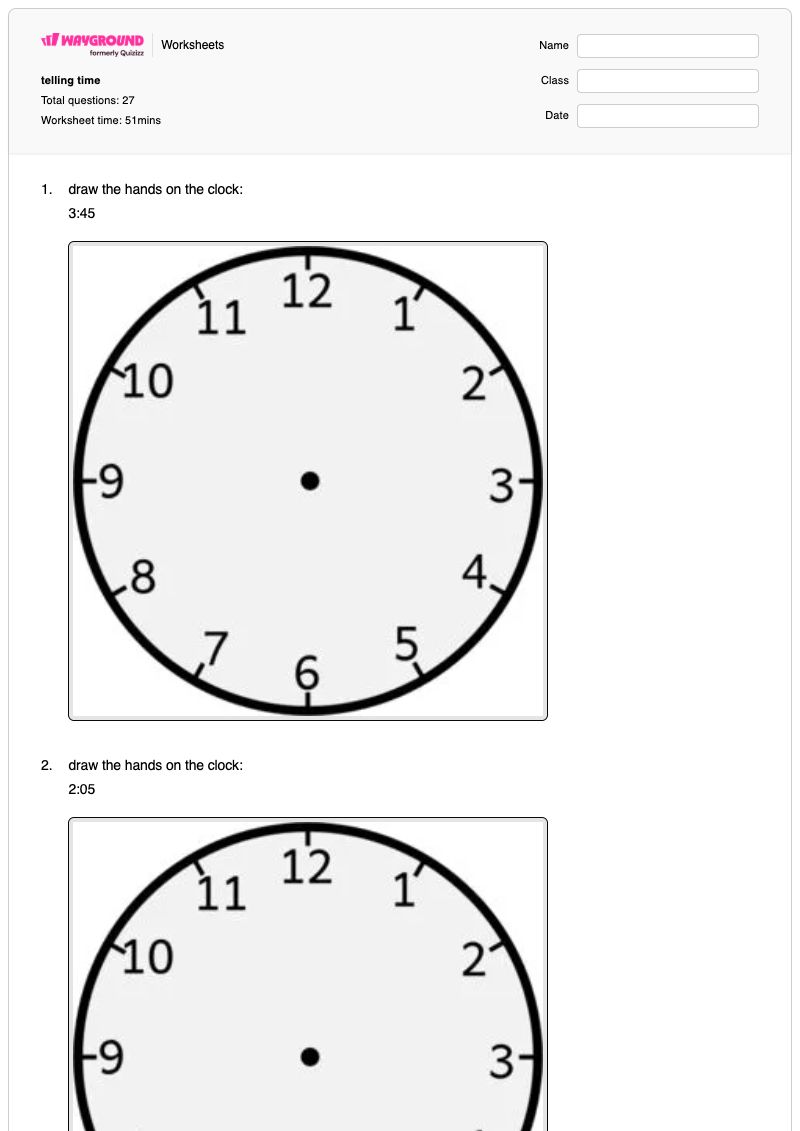
This Grade 2 mathematics worksheet builds foundational time-telling skills through 27 varied questions. Students draw clock hands to show times such as 3:45, 2:05, half past 6, quarter past 1, and quarter till 10; identify times shown on analog clocks; and connect times such as 3:45 a.m. and 3:00 p.m. with daily activities. Multiple-choice questions also check understanding that clock numbers represent five-minute intervals and that an hour contains 60 minutes. The worksheet includes three open-ended prompts that ask students to distinguish the minute and hour hands, explain why the hour hand moves between numbers at 7:30, and clarify why a quarter past 5 means 5:15 rather than 5:25. Six fill-in-the-blank items extend the practice to time patterns, including a schedule that advances by 30 minutes. Designed for Grade 2 learners, this free printable worksheet includes a complete answer key for independent practice, classroom instruction, or review.

Worksheet settings

Font size

S
M
L
XL
Worksheets

telling time

Total questions: 27

Name
Class
Date
1.

draw the hands on the clock:

3:45

2.

draw the hands on the clock:

2:05

3.

draw the hands on the clock:

half past 6

4.

draw the hands on the clock:

quarter past 1

5.

draw the hands on the clock:

quarter till 10

6.

what time is shown on the clock?

a)

12:00

b)

6:00

c)

7:00

d)

12:35

7.

what time is shown on the clock?

a)

6:27

b)

5:00

c)

5:30

d)

6:00

8.
a)

9:35

b)

10:45

c)

10:35

d)

7:45

9.

what is something you would be doing at 3:45am?

a)

playing in a soccer game

b)

eating dinner

c)

sleeping

d)

leaving school

10.

what is something you would be doing at 3:00pm?

a)

sleeping

b)

eating breakfast

c)

taking a bath

d)

at school

11.

what is one way you can tell the difference between the minute hand and the hour hand?

4 lines
12.

we know that if the time is 7:30, the hour hand is between the 7 and the 8, why does this happen?

4 lines
13.

Miss Chadwick thinks that a quarter past 5 is 5:25 because she remembers a quarter is 25 cents. Explain to Miss Chadwick why it is actually 5:15.

4 lines
14.

the numbers on the clock represent ___ minutes

a)

1 minute

b)

5 minutes

c)

15 minutes

d)

60 minutes

15.

how many minutes are in an hour?

a)

15 minutes

b)

5 minutes

c)

60 minutes

d)

100 minutes

16.

The movie theater shows the movie at 12:30, 2:30 and 4:30. If the pattern continues when will the next movie show?

(a)  

17.

you are going for a walk in the park. it takes 20 minutes to walk around the park, you start your walk at 3:10, what time do you finish your walk?

(a)  

18.

the haunted house is offered at 4 times during the day. if each show is 2 hours long and the first one starts at 10, when will the last show start?

(a)  

19.

you spend 15 minutes reading on monday, 10 minutes reading tuesday and 5 minutes reading wednesday. How many minutes did you read so far this week?

a)

15 minutes

b)

10 minutes

c)

5 minutes

d)

20 minutes

20.

the parrots at the zoo are fed every 30 minutes. if they start feeding at 10:00am, what time will the 3rd feeding be?

a)

11:00

b)

11:30

c)

12:00

d)

12:30

21.

If the clock shows 8:00, what will be the time after 1 hour?

a)

7:00

b)

8:00

c)

9:00

d)

10:00

22.

What time is it?

(a)  

23.

What time is it?

(a)  

24.
a)

5:05

b)

5:01

c)

1:25

d)

1:26

25.

What time is it?

(a)  

26.

When the clock shows the short hand on the 12 and the long hand on the 6, what time is it?

a)

12:30

b)

6:00

c)

12:00

d)

6:30

27.

If the short hand is pointing directly at the 1 and the long hand is pointing at the 6, what time is it?

a)

1:30

b)

1:00

c)

6:05

d)

6:00

Answer Key

telling time

Total questions: 27

1.
n/a
2.
n/a
3.
n/a
4.
n/a
5.
n/a
6.
c)

7:00

7.
c)

5:30

8.
a)

9:35

9.
c)

sleeping

10.
d)

at school

11.
n/a
12.
n/a
13.
n/a
14.
b)

5 minutes

15.
c)

60 minutes

16.
6:30
17.
3:30
18.
6:00
19.
d)

20 minutes

20.
b)

11:30

21.
c)

9:00

22.
8:30
23.
3:55
24.
a)

5:05

25.
4:15
26.
a)

12:30

27.
a)

1:30

FAQs

What does this telling time worksheet help Grade 2 students learn?

This worksheet helps Grade 2 students read and represent analog time to five-minute intervals, including half past, quarter past, and quarter till. Its 27 items combine drawing clock hands, interpreting clocks in multiple-choice questions, explaining hour- and minute-hand movement, identifying AM or PM activities, and completing a 30-minute time pattern.

How can I use this worksheet to teach students to tell time on an analog clock?

Begin by reviewing that each clock number represents five minutes and model how the hour and minute hands work together. Use the drawing items to think aloud through times such as 3:45 and quarter till 10, then discuss why the hour hand lies between numbers at 7:30. Finish with the open-ended explanations so students justify their reasoning rather than only select an answer.

What mistakes should I watch for when students complete this telling time worksheet?

Watch for students treating the clock numbers as one-minute intervals, confusing the hour hand with the minute hand, or placing the hour hand exactly on 7 at 7:30 instead of between 7 and 8. Students may also confuse quarter past with 25 minutes because of the word quarter, or overlook the difference between a.m. and p.m. when matching times with daily activities.

How do I assign and grade this telling time worksheet?

The worksheet is available as a printable PDF and as a digital quiz on Wayground, and it includes a complete answer key for the drawing, multiple-choice, open-ended, and fill-in-the-blank items. For printable submissions, scan student work with the Wayground for Teachers app to help grade responses efficiently. The PDF option also supports classrooms that want to reduce screen time.

How can I differentiate this analog time worksheet for my students?

Use the worksheet’s Advanced Settings to adjust font spacing or choose a larger font size so the clock-drawing prompts, answer choices, and written explanations are easier to read. You can also enable a dyslexia-friendly font or translate the worksheet into another language when that better supports students working with the time vocabulary.

Where can I find more free worksheets like this on Wayground?

Wayground offers a broad collection of free printable worksheets and practice problems across subjects, with downloadable PDFs and answer keys to support essential skills and concepts. Browse more resources at https://wayground.com/en-us/worksheets.