

Wayground
Plants and Animal Cells - Printable Science Worksheets grade 7 - Wayground

Plants and Animal Cells

20 questions

7th - 7th Grade

Science

Plants and Animal Cells is a Grade 7 science worksheet that builds students’ understanding of cells as the smallest units of life. Across 20 questions—19 multiple choice and 1 multiple-select—students identify the microscope used to view cells, recognize organelles, and connect structures such as the nucleus, cell membrane, cytoplasm, chloroplast, and cell wall with their functions. Several items require students to identify organelles labeled in cell diagrams, while the multiple-select question asks them to distinguish structures not found in animal cells. This free printable worksheet helps students apply cell vocabulary rather than simply recall isolated definitions. It is useful for introducing or reviewing plant and animal cell structures, checking whether students can interpret labeled diagrams, and reinforcing differences between organelles and their roles. The worksheet includes a complete answer key, making it practical for independent practice, homework, science centers, or a quick formative assessment.

Worksheet settings

Font size

S
M
L
XL
Worksheets

Plants and Animal Cells

Total questions: 20

Name
Class
Date
1.

What type of instrument is used to look at cells?

a)

Binoculars

b)

Magnifying glass

c)

Telescope

d)

Microscope

2.

What part of the cell helps control what enters and leaves the cell?

a)

Chloroplast

b)

Nucleus

c)

Cell membrane

d)

Cell wall

e)

Cytoplasm

3.

Which of the following is NOT found in an animal cell?

a)

Cytoplasm

b)

Nucleus

c)

Chloroplast

d)

Cell wall

e)

Cell membrane

4.

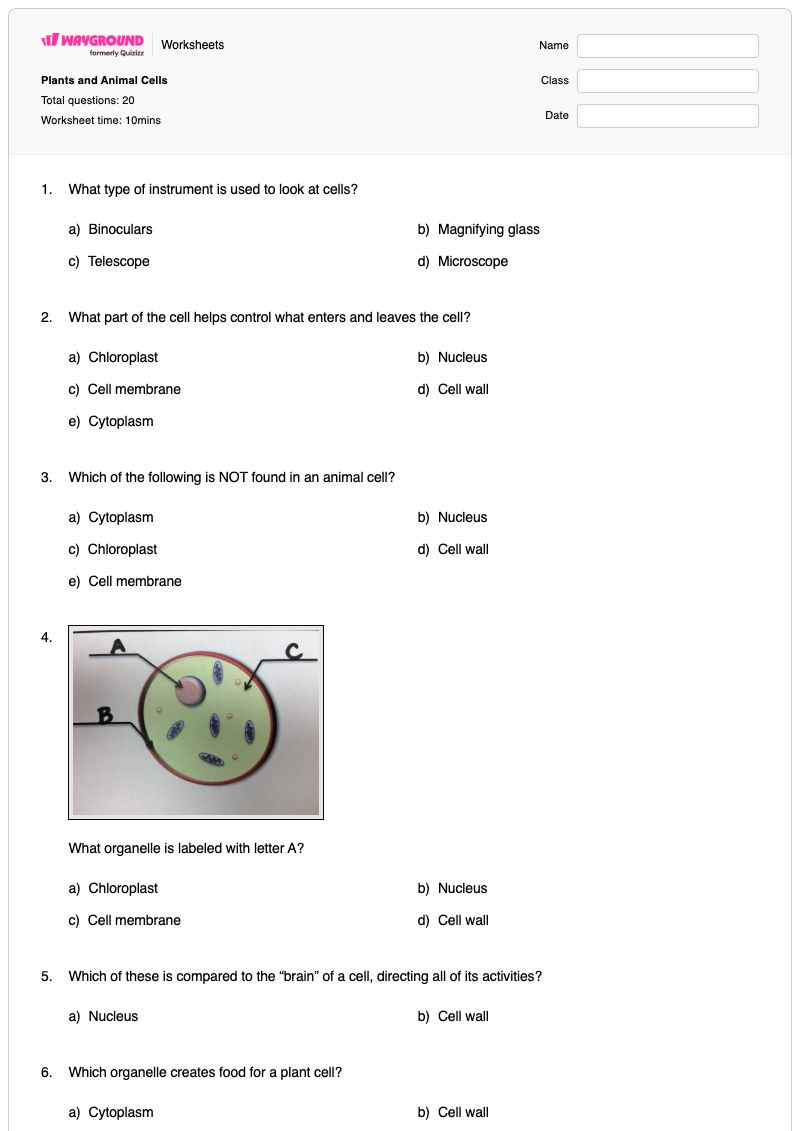
What organelle is labeled with letter A?

a)

Chloroplast

b)

Nucleus

c)

Cell membrane

d)

Cell wall

5.

Which of these is compared to the “brain” of a cell, directing all of its activities?

a)

Nucleus

b)

Cell wall

6.

Which organelle creates food for a plant cell?

a)

Cytoplasm

b)

Cell wall

c)

Chloroplast

7.

Which organelle creates food for a plant cell?

a)

Cytoplasm

b)

Chloroplast

c)

Cell wall

d)

Cell membrane

e)

Nucleus

8.

What is a jelly-like substance that contains chemicals that help the cell stay healthy?

a)

Chloroplast

b)

Nucleus

c)

Cell membrane

d)

Cytoplasm

e)

Cell wall

9.

What helps shape and support a plant cell?

a)

Cell wall

b)

Cytoplasm

c)

Cell membrane

d)

Cell

e)

Chloroplast

10.

What organelle is labeled with letter A?

a)

Nucleus

b)

Cell membrane

c)

Cell wall

11.

What are the structures within a cell that have specialized jobs that keep the cells alive?

a)

Cells

b)

Organelles

c)

Cell wall

d)

Cell membrane

12.

What organelle is labeled with letter B?

a)

Cell membrane

b)

Cytoplasm

13.

What organelle is labeled with letter C?

a)

Nucleus

b)

Cytoplasm

14.

What organelle is labeled with letter B?

a)

Chloroplast

b)

Cytoplasm

c)

Cell wall

15.

What are the building blocks or smallest units of life?

a)

Mitochondria

b)

Cells

c)

Cytoplasm

d)

Cell wall

16.

Both plants and animals have a cell wall.

a)

True

b)

False

17.

Name two parts that are in the plant cell but that are NOT in an animal cell.

a)

Cytoplasm and Mitochondria

b)

Mitochondria and cell wall

c)

Cell wall and chloroplast

d)

Chloroplast and mitochondria

18.

The cell wall provides this for the plant.

a)

Protection and support

b)

Stores food and water

19.

Chloroplast in cells do this.

a)

Stores food for the cells

b)

Protect the cell and gives it support.

20.

What does the cell membrane do?

a)

Kills bacteria

b)

Give support

c)

None of the above

Answer Key

Plants and Animal Cells

Total questions: 20

1.
d)

Microscope

2.
c)

Cell membrane

3.
c)

Chloroplast

, d)

Cell wall

4.
b)

Nucleus

5.
a)

Nucleus

6.
c)

Chloroplast

7.
b)

Chloroplast

8.
d)

Cytoplasm

9.
a)

Cell wall

10.
a)

Nucleus

11.
b)

Organelles

12.
a)

Cell membrane

13.
b)

Cytoplasm

14.
a)

Chloroplast

15.
b)

Cells

16.
b)

False

17.
c)

Cell wall and chloroplast

18.
a)

Protection and support

19.
a)

Stores food for the cells

20.
c)

None of the above

FAQs

What does the Plants and Animal Cells worksheet cover?

This Grade 7 science worksheet uses 19 multiple-choice questions and 1 multiple-select question to assess cell structures, organelle functions, and plant-versus-animal cell differences. Students also identify labeled organelles in cell diagrams, including the nucleus, cell membrane, cytoplasm, chloroplast, and cell wall, which builds both vocabulary knowledge and diagram-reading skills.

How can I use this worksheet to teach plant and animal cell structures?

Introduce the cell structures and their jobs before students complete the questions, then model how to use labels and answer choices as evidence when identifying an organelle in a diagram. Afterward, have students explain why a chloroplast or cell wall belongs in a plant-cell discussion and why the multiple-select item requires choosing more than one structure not found in an animal cell.

What mistakes should I watch for when students complete this cell worksheet?

Students may confuse the cell membrane, which controls what enters and leaves, with the cell wall, which helps shape and support a plant cell. Watch for students selecting only one answer in the multiple-select item, mixing up the nucleus, cytoplasm, and chloroplast, or relying on a diagram label without checking the organelle’s function.

How do I assign and grade the Plants and Animal Cells worksheet?

You can assign this worksheet as a printable PDF or use it as a digital quiz on Wayground, and it includes a complete answer key for checking the 20 responses. For printable submissions, scan student work with the Wayground for Teachers app to help grade responses efficiently.

How can I differentiate this plant and animal cell worksheet for my students?

In the worksheet’s Advanced Settings, adjust font spacing and font size to make the organelle descriptions, answer choices, and labeled cell diagrams easier to read. You can also enable a dyslexia-friendly font or translate the worksheet into another language to support access to its cell-structure vocabulary.

Where can I find more worksheets like this on Wayground?

Wayground offers a comprehensive collection of free printable worksheets and practice problems across all subjects, with downloadable PDFs and answer keys to help students master essential skills and concepts. Browse more resources at https://wayground.com/en-us/worksheets.