
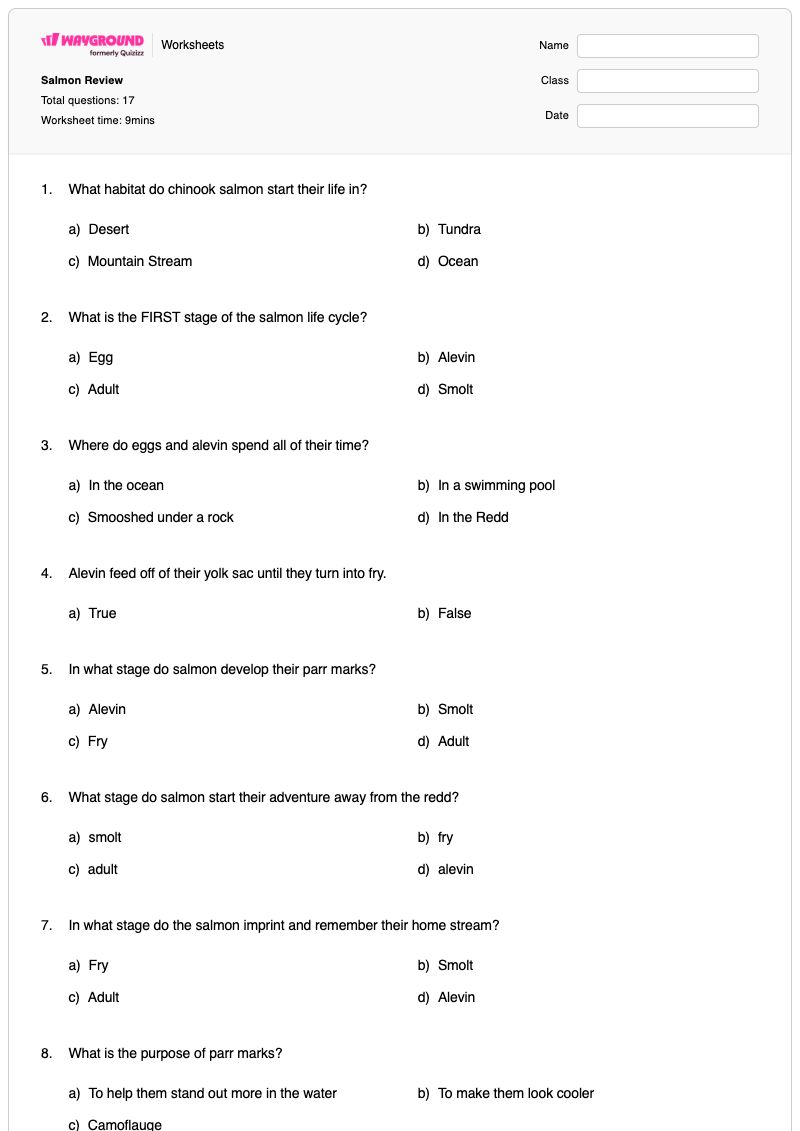

Salmon Review is a free printable Grade 3 science worksheet that checks students’ understanding of the chinook salmon life cycle and the environments salmon use. Across 17 questions—15 multiple-choice and 2 multiple-select—students identify the sequence from egg to alevin, fry, and smolt; connect stages to features such as the yolk sac and parr marks; and identify the redd, estuary, and home stream as important locations.
The worksheet also asks students to distinguish human-made problems, including overfishing, dams, and pollution, from natural predators such as birds, bears, and people. It is useful for reviewing salmon development, migration-related habitats, and survival challenges after instruction or as a formative science assessment. The free printable worksheet includes a complete answer key for efficient checking and feedback.
Worksheet settings
Font size
S
M
L
XL
Worksheets
Salmon Review
Total questions: 17
Name
Class
Date
1.
What habitat do chinook salmon start their life in?
a)
Desert
b)
Tundra
c)
Mountain Stream
d)
Ocean
2.
What is the FIRST stage of the salmon life cycle?
a)
Egg
b)
Alevin
c)
Adult
d)
Smolt
3.
Where do eggs and alevin spend all of their time?
a)
In the ocean
b)
In a swimming pool
c)
Smooshed under a rock
d)
In the Redd
4.
Alevin feed off of their yolk sac until they turn into fry.
a)
True
b)
False
5.
In what stage do salmon develop their parr marks?
a)
Alevin
b)
Smolt
c)
Fry
d)
Adult
6.
What stage do salmon start their adventure away from the redd?
a)
smolt
b)
fry
c)
adult
d)
alevin
7.
In what stage do the salmon imprint and remember their home stream?
a)
Fry
b)
Smolt
c)
Adult
d)
Alevin
8.
What is the purpose of parr marks?
a)
To help them stand out more in the water
b)
To make them look cooler
c)
Camoflauge
9.
What is the SECOND stage of the salmon life cycle?
a)
Eggs
b)
Alevin
c)
Smolt
d)
Fry
10.
An estuary is...
a)
where the river meets the sea
b)
at the bottom of a waterfall
11.
What are some human made problems salmon might have? (Select all that apply)
a)
Over Fishing
b)
Human Made Dams
c)
Pollution
d)
Bears
12.
What is the THIRD stage of the salmon life cycle?
a)
Fry
b)
Smolt
c)
Adult
d)
Alevin
13.
What are some predators salmon face?
a)
Predatory Birds
b)
Bears
c)
People
d)
Logs
14.
What is the FOURTH stage of the salmon life cycle?
a)
fry
b)
adult
c)
smolt
d)
egg
15.
Where do adult salmon go to spawn?
a)
a swimming pool
b)
fish tank
c)
estuary
d)
home stream
16.
What is the FIFTH stage of the salmon life cycle?
a)
Adult/Spawning Adult
b)
Egg
c)
Smolt
d)
Alevin
17.
Salmon change color on their journey to spawn.
a)
True
b)
False
Answer Key
Salmon Review
Total questions: 17
1.
c)
Mountain Stream
2.
a)
Egg
3.
d)
In the Redd
4.
a)
True
5.
c)
Fry
6.
b)
fry
7.
a)
Fry
8.
c)
Camoflauge
9.
b)
Alevin
10.
a)
where the river meets the sea
11.
a)
Over Fishing
, b)
Human Made Dams
, c)
Pollution
12.
a)
Fry
13.
a)
Predatory Birds
, b)
Bears
, c)
People
14.
c)
smolt
15.
d)
home stream
16.
a)
Adult/Spawning Adult
17.
a)
True
140 %
Browse by subjects
Browse by grades
Browse by format
FAQs
What does the Salmon Review worksheet cover?
This Grade 3 science worksheet uses 15 multiple-choice and 2 multiple-select questions to assess salmon life-cycle stages, habitats, and survival challenges. Students identify the sequence from egg to alevin, fry, and smolt, connect fry with parr marks and imprinting, locate eggs and alevin in the redd, and distinguish human-made problems from salmon predators.
How can I use this worksheet to teach the salmon life cycle?
Introduce the salmon stages with a simple sequence: egg, alevin, fry, and smolt, then use the worksheet’s stage-order questions to have students explain what changes at each point. Pause on the items about the yolk sac, parr marks, imprinting, and the redd so students justify their choices rather than memorizing labels. Follow with the estuary, home-stream, predator, and human-impact questions to connect development with salmon habitats and survival.
What mistakes should I watch for when students complete this salmon worksheet?
Watch for students reversing alevin and fry, or selecting smolt as an earlier stage in the sequence. Students may also confuse the redd, where eggs and alevin remain, with the estuary, where the river meets the sea, or miss that the worksheet’s multiple-select items require every applicable answer. Check especially whether they distinguish human-made problems—overfishing, dams, and pollution—from predators such as birds, bears, and people.
How do I assign and grade the Salmon Review worksheet?
The Salmon Review worksheet is available as a printable PDF and as a digital quiz on Wayground, and it includes a complete answer key. You can grade printable submissions by scanning student work with the Wayground for Teachers app. The printable version also supports classrooms that are reducing screen time.
How can I differentiate this salmon life-cycle worksheet for my students?
Use the worksheet’s Advanced Settings to adjust font spacing and font size so the life-cycle sequence and answer choices are easier to scan. You can also enable a dyslexia-friendly font or translate the worksheet into another language. These options can make the stage-order, habitat, and multiple-select questions more accessible without changing what students are asked to identify.
Where can I find more worksheets like this on Wayground?
Wayground offers a broad collection of free printable worksheets and practice problems across subjects, with downloadable PDFs and answer keys to support essential skills and concepts. Browse more resources at https://wayground.com/en-us/worksheets.