
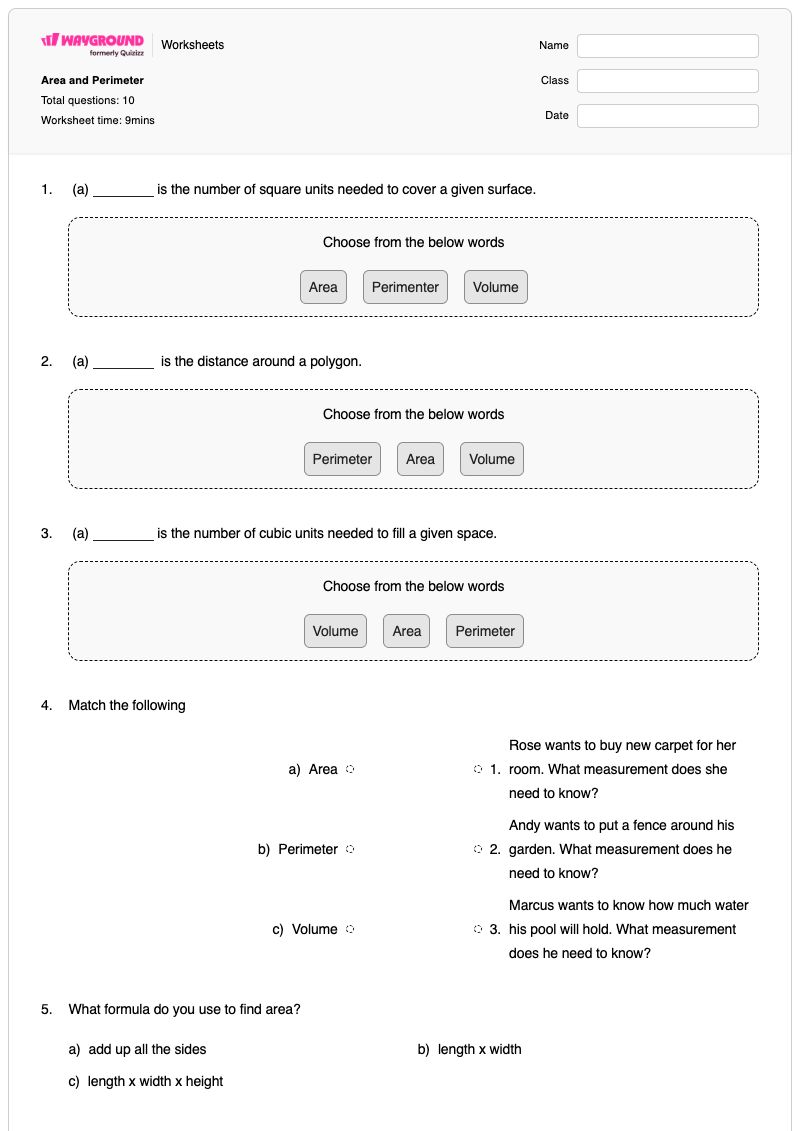

This free Grade 5 mathematics worksheet helps students distinguish among area, perimeter, and volume and select the correct formula for each measurement. It includes 10 items: three dropdown definitions, one matching activity, and six multiple-choice questions. Students identify area as the number of square units covering a surface, perimeter as the distance around a polygon, and volume as the number of cubic units filling a space. They also choose formulas for rectangles and rectangular prisms and apply them to find area, perimeter, and volume in diagram-based questions.
The worksheet is designed for classroom practice, independent work, review, or a quick check of students’ measurement vocabulary and formula knowledge. Its varied item types move from recognizing definitions to choosing and applying formulas, helping teachers see whether students can separate two-dimensional measures from three-dimensional volume. This free printable worksheet includes a complete answer key for efficient checking and feedback.
Worksheet settings
Font size
S
M
L
XL
Worksheets
Area and Perimeter
Total questions: 10
Name
Class
Date
1.
(a) is the number of square units needed to cover a given surface.
Choose from the below words
Area
Perimenter
Volume
2.
(a) is the distance around a polygon.
Choose from the below words
Perimeter
Area
Volume
3.
(a) is the number of cubic units needed to fill a given space.
Choose from the below words
Volume
Area
Perimeter
4.
Match the following
Area
Rose wants to buy new carpet for her room. What measurement does she need to know?
Perimeter
Andy wants to put a fence around his garden. What measurement does he need to know?
Volume
Marcus wants to know how much water his pool will hold. What measurement does he need to know?
5.
What formula do you use to find area?
a)
add up all the sides
b)
length x width
c)
length x width x height
6.
What formula do you use to find perimeter?
a)
add up all the sides
b)
length x width
c)
length x width x height
7.
What formula do you use to find volume?
a)
add up all the sides
b)
length x width
c)
length x width x height
8.
What is the area of the rectangle shown?
a)
84 square feet
b)
19 square feet
c)
5 square feet
9.
What is the volume of the rectangular prism shown?
a)
13 cubic inches
b)
27 cubic inches
c)
72 cubic inches
d)
94 cubic inches
10.
What is the perimeter of the rectangle shown?
a)
19 cm
b)
38 cm
c)
84 cm
Answer Key
Area and Perimeter
Total questions: 10
1.
Area
2.
Perimeter
3.
Volume
4.
Area
-
Rose wants to buy new carpet for her room. What measurement does she need to know?
,
Perimeter
-
Andy wants to put a fence around his garden. What measurement does he need to know?
,
Volume
-
Marcus wants to know how much water his pool will hold. What measurement does he need to know?
5.
b)
length x width
6.
a)
add up all the sides
7.
c)
length x width x height
8.
a)
84 square feet
9.
c)
72 cubic inches
10.
b)
38 cm
140 %
Browse by subjects
Browse by grades
Browse by format
FAQs
What does this area and perimeter worksheet cover?
This Grade 5 worksheet covers the definitions and formulas for area, perimeter, and volume. Its three dropdowns and matching item check vocabulary, while the multiple-choice questions ask students to select length × width, add all sides, or length × width × height and apply those formulas to rectangles and a rectangular prism.
How can I use this worksheet to teach area, perimeter, and volume?
Introduce the three measures by having students explain what is being measured: surface coverage, distance around a polygon, or space inside a solid. Then use the worksheet’s dropdown and matching items to sort the definitions before students justify the formula choices and solve the rectangle and rectangular-prism questions. Ask students to explain why area uses square units, perimeter uses linear units, and volume uses cubic units.
What mistakes should I watch for when students complete this worksheet?
Watch for students confusing area, perimeter, and volume definitions or choosing a formula based on a familiar-looking option rather than the quantity being measured. Common errors include using length × width for perimeter, adding sides for area, or selecting a two-dimensional formula for the rectangular prism. Students may also confuse square, cubic, and linear units or select a perimeter value when the question asks for area.
How do I assign and grade this area and perimeter worksheet?
The worksheet is available as a printable PDF and as a digital quiz on Wayground, so you can use the same area, perimeter, and volume practice in either format. It includes a complete answer key, and printable submissions can be graded by scanning student work with the Wayground for Teachers app. The printable version also supports classrooms that want to reduce screen time.
How can I differentiate this worksheet for my students?
Use the worksheet’s Advanced Settings to adjust font spacing or increase the font size, making the definitions, formula choices, and measurement questions easier to read. You can also apply a dyslexia-friendly font or translate the worksheet into another language. These options can support access to the dropdown, matching, and multiple-choice items without changing the area, perimeter, and volume content.
Where can I find more worksheets like this on Wayground?
Wayground offers a comprehensive collection of free printable worksheets and practice problems across subjects, with downloadable PDFs and answer keys to help students master essential skills and concepts. Browse more resources at https://wayground.com/en-us/worksheets.