Perimeter and Area of Rectangles is a Grade 3 mathematics worksheet that helps students calculate the perimeter and area of rectangles using given measurements. It includes 11 items: six multiple-choice questions, two open-ended responses, two fill-in-the-blank perimeter problems, and an applied pool-area task using length and width measurements. Students practise selecting the correct result, entering numerical answers, and solving a problem that requires finding the area of a 12-foot by 10-foot rectangle.
The worksheet gives students varied opportunities to distinguish perimeter from area and use the appropriate measurement units, including inches, centimeters, and feet. The combined perimeter-and-area question also asks students to identify both measurements for one rectangle, reinforcing careful reading and computation. This free printable worksheet includes a complete answer key, making it useful for independent practice, classwork, homework, or a quick Grade 3 skills check.
Worksheet settings
Font size
S
M
L
XL
Worksheets
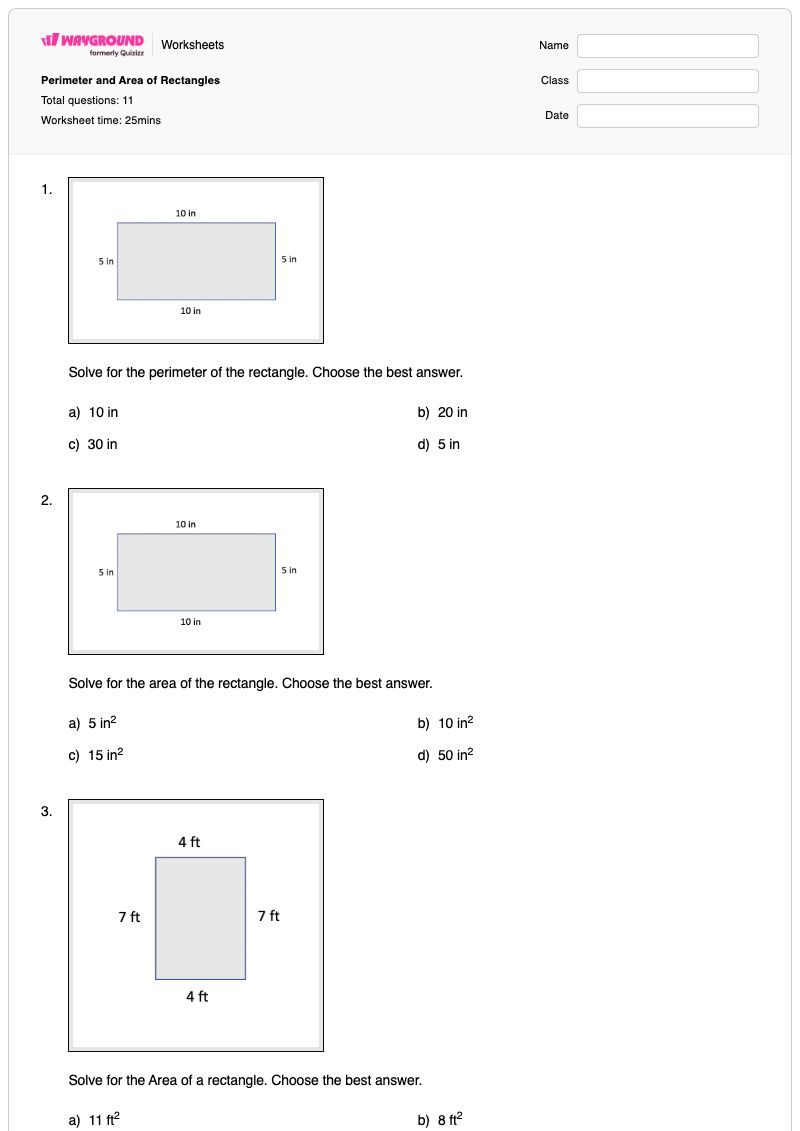
Perimeter and Area of Rectangles
Total questions: 11
Name
Class
Date
1.
Solve for the perimeter of the rectangle. Choose the best answer.
a)
10 in
b)
20 in
c)
30 in
d)
5 in
2.
Solve for the area of the rectangle. Choose the best answer.
a)
5 in2
b)
10 in2
c)
15 in2
d)
50 in2
3.
Solve for the Area of a rectangle. Choose the best answer.
a)
11 ft2
b)
8 ft2
c)
28 ft2
d)
18 ft2
4.
Solve for the perimeter of the rectangle. Choose the best answer.
a)
30 cm
b)
24 cm
c)
54 cm
d)
9 cm
5.
Solve for the perimeter of the rectangle. Choose the best answer.
a)
12 in
b)
8 in
c)
40 ft
d)
40 in
6.
Solve for the area of the rectangle. Type your answer below.
4 lines
7.
Solve for the perimeter of the rectangle. Type your answer below.
(a)
8.
Solve for the perimeter of the rectangle. Type your answer below.
(a)
9.
Solve for the area of the rectangle. Type your answer below.
4 lines
10.
Solve for the perimeter and area of the rectangle. Choose the best answer.
a)
Perimeter: 14ft ftArea: 49 ft2
b)
Perimeter: 24 ft Area: 25 ft2
c)
Perimeter: 24 ft Area: 35 ft2
d)
Perimeter: 17 ft Area: 35 ft2
11.
I just moved into a new house with a pool. The pool is in the shape of a rectangle. The pool is 12 feet long and 10 feet wide. What is the area of the pool?
Answer Key
Perimeter and Area of Rectangles
Total questions: 11
1.
c)
30 in
2.
d)
50 in2
3.
c)
28 ft2
4.
a)
30 cm
5.
d)
40 in
6.
n/a
7.
18 cm
8.
40 in
9.
n/a
10.
c)
Perimeter: 24 ft Area: 35 ft2
11.
n/a
140 %
Browse by subjects
Browse by grades
Browse by format
FAQs
What does the Perimeter and Area of Rectangles worksheet cover?
This Grade 3 worksheet focuses on calculating the perimeter and area of rectangles from given measurements. Its 11 items use multiple choice, open-ended responses, fill-in-the-blank answers, and an applied pool-area problem, helping students choose the correct operation, record answers with appropriate units, and distinguish perimeter from area.
How can I use this worksheet to teach rectangle perimeter and area?
Introduce perimeter as the distance around a rectangle and area as the space inside it, then model one example of each before students begin the worksheet. Have students explain why each item requires either adding side lengths or multiplying length by width, and use the final pool problem to connect area calculations to a real-world rectangular space. Review the combined perimeter-and-area item as a check that students can apply both methods to the same rectangle.
What mistakes should I watch for when students complete this rectangle worksheet?
Watch for students adding the length and width when an area question requires multiplication, or multiplying them when a perimeter question requires the total distance around the rectangle. Students may also confuse square units for area with linear units for perimeter, misread the units shown in inches, centimeters, or feet, or select a distractor after calculating only one of the two measurements in the combined perimeter-and-area question. The pool problem is a useful place to check whether students multiply 12 feet by 10 feet and report the result in square feet.
How do I assign and grade the Perimeter and Area of Rectangles worksheet?
This worksheet is available as a printable PDF and as a digital quiz on Wayground, with a complete answer key for all 11 items. Assign the digital quiz for online responses, or print the PDF for written work; printable submissions can be graded by scanning student work with the Wayground for Teachers app. The printable format can also support schools that are reducing screen time.
How can I differentiate this perimeter and area worksheet for my students?
Use the worksheet’s Advanced Settings to adjust font spacing or choose a larger font size so the perimeter and area diagrams, answer choices, and response spaces are easier to read. You can also enable a dyslexia-friendly font or translate the worksheet into another language, while keeping the rectangle calculations and pool-area problem intact.
Where can I find more free worksheets like this on Wayground?
Wayground offers a broad collection of free printable worksheets and practice problems across subjects, with downloadable PDFs and answer keys to help students build essential skills and concepts. Browse more resources at https://wayground.com/en-us/worksheets.

 Worksheets