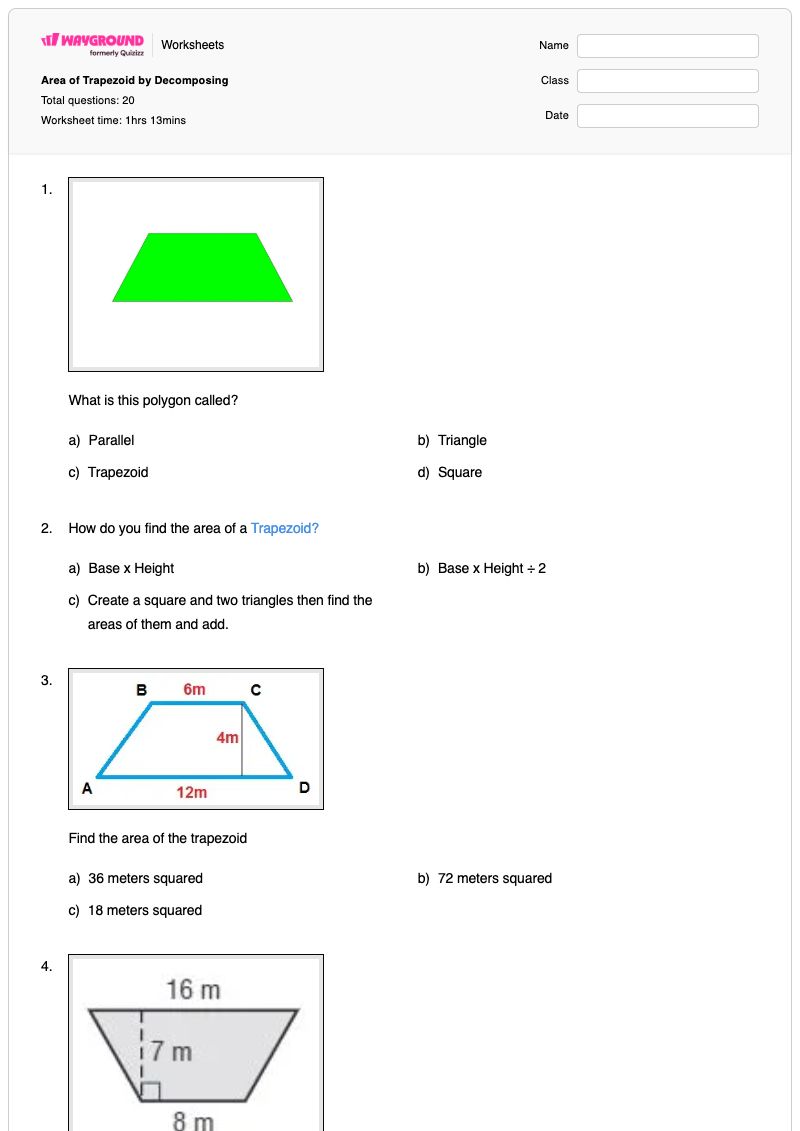

WorksheetsArea of Trapezoid by Decomposing
Total questions: 20
Answer KeyArea of Trapezoid by Decomposing
Total questions: 20
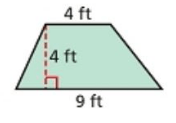
Create a square and two triangles then find the areas of them and add.
20.4in2
26 ft2
88 cm2
249.4 ft2
150 ft2

20 questions
6th - 7th Grade
Mathematics
Area of Trapezoid by Decomposing is a Grade 6–7 mathematics worksheet with 20 multiple-choice questions focused on finding the area of trapezoids by breaking each shape into a square and two triangles. Students first identify a trapezoid and recognize the decomposition strategy, then apply it to diagrams and problems with given bases and heights, including measurements in meters, feet, centimeters, and inches and values involving decimals. This free printable worksheet helps students connect a visual area model to accurate calculation and select the result that matches their work. It is useful for guided practice, independent review, or a quick check of whether students can use the decomposition method rather than rely on an inappropriate rectangle or triangle formula. A complete answer key is included for efficient checking and feedback.
Worksheet settings
Font size
Worksheets
Answer KeyCreate a square and two triangles then find the areas of them and add.
20.4in2
26 ft2
88 cm2
249.4 ft2
150 ft2
This worksheet uses 20 multiple-choice questions to help students find the area of trapezoids by decomposing each shape into a square and two triangles. It progresses from identifying a trapezoid and recognizing the decomposition method to calculating areas from diagrams and stated base-and-height measurements, including decimal values and square-unit answers.
Introduce the worksheet by modeling how a trapezoid can be partitioned into a square and two triangles, then calculate each part and add the areas. Work through one diagram-based item together before students complete the remaining multiple-choice problems, and ask them to explain why the decomposition is more appropriate than simply multiplying the two bases. Use the items with stated measurements, such as bases of 8 inches and 2.2 inches with a height of 4 inches, to connect the visual strategy to numerical calculation.
Watch for students choosing base × height, using only half of a product, or adding the base lengths without accounting for the height; these errors appear as plausible alternatives in the multiple-choice items. Students may also mishandle decimal measurements, select an answer with the wrong square-unit value, or confuse the two bases with a side that is not a base. Ask them to label both bases and the height, decompose the figure, and check that the final unit is squared.
You can assign this worksheet as a printable PDF or as a digital quiz on Wayground. It includes a complete answer key, and printable student work can be graded by scanning it with the Wayground for Teachers app. The printable format can also support classrooms that are reducing screen time while students practice the 20 area questions.
Use the worksheet’s Advanced Settings to adjust font spacing or choose a larger font size so the diagrams, measurements, and multiple-choice options are easier to read. You can also enable a dyslexia-friendly font or translate the worksheet into another language when appropriate for students working through the trapezoid decomposition steps.
Wayground offers a broad collection of free printable worksheets and practice problems across subjects, with downloadable PDFs and answer keys to help students build essential skills and concepts. Browse more resources at https://wayground.com/en-us/worksheets.