This Grade 6 mathematics worksheet helps students find the area of trapezoids using dimensions shown in diagrams and in a short numerical problem. Students identify the two bases, recognize that trapezoid bases are parallel, select and complete the area formula, follow the calculation steps, and report answers with correct square units. The 16-item set includes 15 multiple-choice questions and one multiple-select question, including practice with square feet, square inches, square meters, square centimeters, and square millimeters.
The sequence moves from identifying trapezoid features and substituting measurements into the formula to evaluating the expression and checking units. It is useful for guided practice, independent review, or a quick Grade 6 assessment of area-model and formula fluency. This free printable worksheet includes a complete answer key, making it practical for classroom instruction, homework, or intervention.
Worksheet settings
Font size
S
M
L
XL
Worksheets
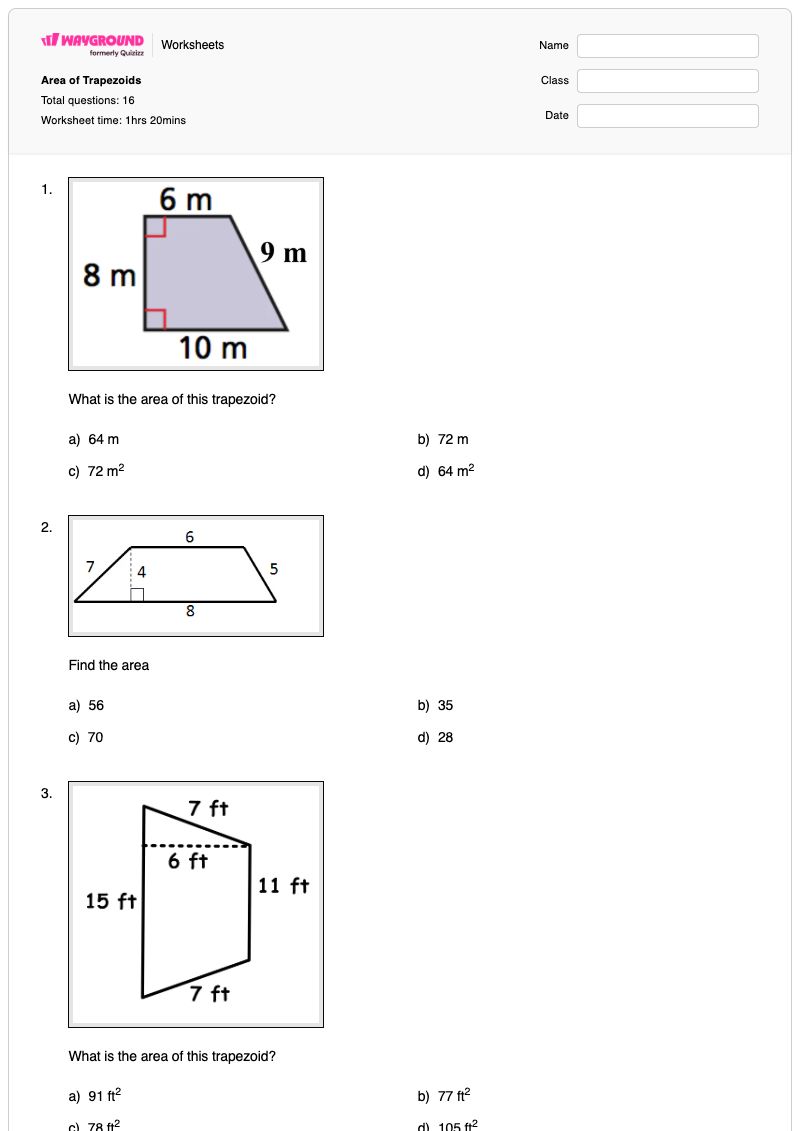
Area of Trapezoids
Total questions: 16
Name
Class
Date
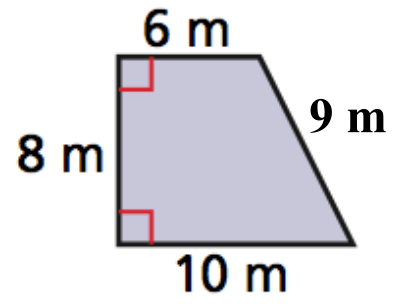
1.
What is the area of this trapezoid?
a)
64 m
b)
72 m
c)
72 m2
d)
64 m2
2.
Find the area
a)
56
b)
35
c)
70
d)
28
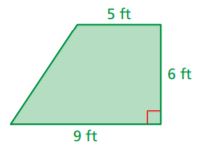
3.
What is the area of this trapezoid?
a)
91 ft2
b)
77 ft2
c)
78 ft2
d)
105 ft2
4.
Find the area of a trapezoid with bases of 5 feet and 7 feet, and a height of 3 feet.
a)
18
b)
36
c)
72
d)
40
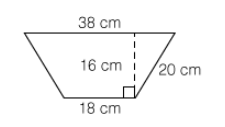
5.
Determine the area of the trapezoid.
a)
160 cm2
b)
304 cm2
c)
80 cm2
d)
152 cm2
6.
Find the area of the trapezoid.
a)
240 square inches
b)
159.5 square inches
c)
154 square inches
d)
66 square inches
7.
Fill in the area formula for the green trapezoid.
A=21⋅h⋅(b1+b2)
a)
A=21⋅6⋅(5+9)
b)
A=21⋅5⋅(6+9)
c)
A=21⋅9⋅(5+6)
8.
Shown is the correct formula for the green trapezoid. Which shows the next correct step? A=21⋅6⋅(5+9)
a)
A=21⋅6⋅14
b)
A=21⋅30+9
c)
A=21⋅6⋅45
9.
Shown is the correct next step in calculating the area. So what should the area be?
A=21⋅6⋅14
a)
42
b)
10
c)
84
d)
17
10.
Our answer was missing units! What should the area units be? (There are TWO correct answers!)
a)
ft
b)
ft2
c)
units
d)
sq ft
11.
What are the bases of the red trapezoid?
a)
8mm & 5mm
b)
5mm & 4mm
c)
8mm & 4mm
12.
In a trapezoid, the bases are always_________.
a)
congruent
b)
parallel
c)
perpendicular
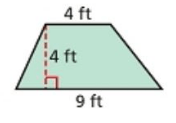
13.
Find the area of this trapezoid.
a)
26 ft2
b)
20 ft2
c)
52 ft2
d)
40 ft2
14.
Find the area.
a)
6 in
b)
9 in
c)
6 in2
d)
9 in2
15.
Find the area.
a)
180 in2
b)
165 in2
c)
105 in2
d)
157.5 in2
16.
What is the area of this trapezoid?
a)
320 square centimeters
b)
416 square centimeters
c)
448 square centimeters
d)
560 square centimeters
Answer Key
Area of Trapezoids
Total questions: 16
1.
d)
64 m2
2.
d)
28
3.
c)
78 ft2
4.
a) 18
5.
d) 152 cm2
6.
c)
154 square inches
7.
a)
A=21⋅6⋅(5+9)
8.
a)
A=21⋅6⋅14
9.
a)
42
10.
b)
ft2
, d)
sq ft
11.
c)
8mm & 4mm
12.
b)
parallel
13.
a)
26 ft2
14.
c) 6 in2
15.
c) 105 in2
16.
c)
448 square centimeters
140 %
Browse by subjects
Browse by grades
Browse by format
FAQs
What does the Area of Trapezoids worksheet cover?
This Grade 6 worksheet practises finding trapezoid area from diagrams and given measurements, identifying the parallel bases, completing the area formula, and carrying out the calculation. Its 16 questions use 15 multiple-choice items and one multiple-select item to check formula selection, calculation steps, and the use of square units such as ft² and sq ft.
How can I use this worksheet to teach students the area of trapezoids?
Begin by having students identify the two parallel bases and the height in the worksheet diagrams, then model how those measurements enter the trapezoid area formula. Use the formula-completion and next-step questions as guided practice before assigning the numerical area problems independently. Ask students to explain why the final unit must be squared and how they know which sides are the bases.
What mistakes should I watch for when students complete this trapezoid area worksheet?
Watch for students selecting a nonparallel side as a base, using only one base in the formula, or skipping the step of adding the two bases before multiplying by the height. Students may also choose a numerical answer without square units or confuse linear units such as ft with area units such as ft². The multiple-select units question is especially useful for checking whether they recognize both ft² and sq ft as valid area labels.
How do I assign and grade this Area of Trapezoids worksheet?
The worksheet is available as a printable PDF and as a digital quiz on Wayground, and it includes a complete answer key. Assign the digital version for online responses, or print it for students to show their formula and calculation steps. Printable submissions can be graded by scanning student work with the Wayground for Teachers app.
How can I differentiate this trapezoid area worksheet for my students?
Use the worksheet’s Advanced Settings to adjust font spacing or choose a larger font size so the diagrams, measurements, and formula steps are easier to read. You can also enable a dyslexia-friendly font or translate the worksheet into another language when helpful. These options apply to the trapezoid diagrams and area questions without changing the skill being practised.
Where can I find more worksheets like this on Wayground?
Wayground offers a comprehensive collection of free printable worksheets and practice problems across subjects, with downloadable PDFs and answer keys to support essential skills and concepts. Browse more resources at https://wayground.com/en-us/worksheets.

 Worksheets