
Wayground
Area of Composite Figures (Squares & Rectangles) - Printable Mathematics Worksheets grade 6 - Wayground

Area of Composite Figures (Squares & Rectangles)

20 questions

6th - 6th Grade

Mathematics

This Grade 6 mathematics worksheet helps students find the area of composite figures made from squares and rectangles. It begins with the meaning of area and the rectangle area formula, then asks students to identify missing side lengths from labeled diagrams and calculate the areas of component rectangles. Students use those measurements to determine total areas, shaded regions, and an unknown measure when the area is given. The worksheet includes 20 questions: 19 multiple-choice items and one fill-in-the-blank item. Its visual, step-by-step practice supports students as they partition compound shapes into simpler rectangles, apply length × width, combine partial areas, and interpret square-unit answers. Use it for Grade 6 math instruction, independent practice, review, or formative assessment. This is a free printable worksheet with a complete answer key for checking student work.

Worksheet settings

Font size

S
M
L
XL
Worksheets

Area of Composite Figures (Squares & Rectangles)

Total questions: 20

Name
Class
Date
1.
How do you find the area of a rectangle?
a)
Length + Length + Length + Length
b)
Length + Width
c)
Length x Width
d)
Width x Width
2.
What does area mean?
a)
the distance around a shape
b)
half the distance around a shape
c)
the amount of space outside a shape
d)
the amount of space inside a shape
3.

What is the length of the side labeled with the thick red line?

a)

5 cm

b)

4 cm

c)

3 cm

d)

9 cm

4.

What is the length of the side labeled with the thick purple line?

a)

4 cm

b)

5 cm

c)

6 cm

d)

7 cm

5.

For the purpose of this question, we are going to cut the shape as shown. What is the area of rectangle A?

a)

11 m²

b)

30 m²

c)

22 m²

d)

300 m²

6.

For the purpose of this question, we are going to cut the shape as shown. What is the area of rectangle B?

a)

144 m²

b)

17 m²

c)

36 m²

d)

16 m²

7.

What is the total area of this compound shape?

a)

200 m²

b)

50 m²

c)

66 m²

d)

90 m²

8.

What is the area of this shape?

a)

165 m²

b)

117 m²

c)

105 m²

d)

66 m²

9.

What is the area of rectangle A?

a)

20 m²

b)

50 m²

c)

28 m²

d)

18 m²

10.

What is the area of rectangle B?

a)

40 m²

b)

50 m²

c)

25 m²

d)

30 m²

11.

What is the total area of this shape?

a)

140 m²

b)

1,120 m²

c)

78 m²

d)

68 m²

12.

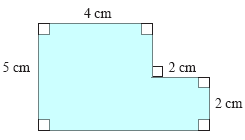
What is the area of the shaded region?

a)

20 sq cm

b)

4 sq cm

c)

30 sq cm

d)

24 sq cm

13.
What is the area of the shaded region?
a)
14 m2
b)
120 m2
c)
106 m2
d)
134 m2
14.
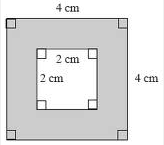
What is the area of the shaded region?
a)
4 cm2
b)
16 cm2
c)
8 cm2
d)
12 cm2
15.

 What is the missing measure if the Area is 50 m2 ?

a)

10 m

b)

45 m

c)

10 m2

d)

7 m

16.

A bulletin board is shaped like a parallelogram. The base is 57 inches and the area is 3,591 square inches. What is the height of the bulletin board?

a)

63 inches

b)

70 inches

c)

204,687 inches

d)

175,000 inches

17.

What is the area of this rectangle?

a)

5 units

b)

30 sq units

c)

15 sq units

d)

6 units

18.

Determine the area of the shaded region. Make sure you add sq.ft. to your answer.

(a)  

19.

What is the area of this rectangle? REDUCE

a)

520m2\frac{5}{20}m^2

b)

620m2\frac{6}{20}m^2

c)

310m2\frac{3}{10}m^2

d)

59m2\frac{5}{9}m^2

20.

Is a square has a width of 45 km\frac{4}{5}\ km , what is the area of the square?

a)

45km2\frac{4}{5}km^2  

b)

1625km2\frac{16}{25}km^2  

c)

1620km2\frac{16}{20}km^2  

d)

1225km2\frac{12}{25}km^2  

Answer Key

Area of Composite Figures (Squares & Rectangles)

Total questions: 20

1.
c) Length x Width
2.
d) the amount of space inside a shape
3.
b)

4 cm

4.
c)

6 cm

5.
b)

30 m²

6.
c)

36 m²

7.
c)

66 m²

8.
b)

117 m²

9.
c)

28 m²

10.
a)

40 m²

11.
d)

68 m²

12.
d)

24 sq cm

13.
c) 106 m2
14.
d) 12 cm2
15.
a)

10 m

16.
a)

63 inches

17.
c)

15 sq units

18.
20 sq. ft., 20
19.
c)

310m2\frac{3}{10}m^2

20.
b)

1625km2\frac{16}{25}km^2  

FAQs

What does this worksheet cover, and how does it help students find the area of composite figures?

This worksheet practices finding the area of composite figures by splitting them into labeled squares or rectangles, finding each component area, and combining the results. Its 19 multiple-choice questions and one fill-in-the-blank item also cover the meaning of area, the length × width formula, shaded regions, and finding a missing measure from a known area.

How can I use this worksheet to teach students to find the area of composite figures?

First review that area measures the space inside a shape and model length × width for a rectangle. Then work through a diagram by identifying missing side lengths, partitioning the composite figure into rectangles A and B, and adding their areas; use the shaded-region items to discuss which parts are included or excluded. Finish with the missing-measure problem to connect the area formula to reverse reasoning.

What mistakes should I watch for when students complete this composite-area worksheet?

Watch for students confusing area with the distance around a shape, adding lengths instead of multiplying length by width, or using a labeled side length for the wrong rectangle. Students may also calculate only rectangle A or B instead of the total, include an unshaded section, or report square units incorrectly. In the missing-measure item, check that they use the given area to determine a length rather than treating the answer as a square-unit measurement.

How do I assign and grade this worksheet?

You can assign this composite-figures worksheet as a printable PDF or as a digital quiz on Wayground. It includes a complete answer key, and printable submissions can be graded by scanning student work with the Wayground for Teachers app. The printable format can also support schools that are reducing screen time.

How can I differentiate this worksheet for my students?

Use the worksheet’s Advanced Settings to adjust font spacing or font size so the labeled diagrams, rectangle-area items, and shaded-region questions are easier to read. You can also apply a dyslexia-friendly font or translate the worksheet into another language when those options better support access to the composite-area practice.

Where can I find more worksheets like this on Wayground?

Wayground offers a broad collection of free printable worksheets and practice problems across subjects, with downloadable PDFs and answer keys to help students master essential skills and concepts. Browse more resources at https://wayground.com/en-us/worksheets.